Confession: myths, fantasy, fables, archetypes. If you were to ask me to make a list of things I like in books, those four words would top it. Ever since I was little, I've liked stories that are otherworldly. Children editions of Homer's Odyssey, Disney's fairy tales, epic poems of knights and heroes and dragons--these sorts and more lined my bookshelves and were the recipient of that most magical of gift, my public library card. From the Animorphs to Harry Potter to Kushiel's Legacy to A Song of Ice and Fire, I wraped myself in a mythic blanket, seeking shelter and warmth from the cold harsh and decidedly unmagical world. Among the greats of fantastical magical mythic storytelling, Neil Gaiman has always stood out as one of the quintessential--dare I say archetypal and elemental--best. The Ocean at the End of the Lane is the first Gaiman adult novel in almost a decade. Following in the wake of his landmark American Gods, I bought this book with a sort of desperate need, an unyielding desire to be transported out of the mundane and in to another world, one that only Gaiman can create. I have never felt so close to a protagonist than when our little seven year old narrator utters, "I liked myths. They weren't adult stories and they weren't children's stories. They were better than that. They just were."
Typically, before recommending Gaiman to anyone, I feel the need to point out a few things. First, magic exists. Don't argue with the author on this; it is a fruitless uphill battle and you will lose. Second, magic exists and neither you nor I have the mental ability to understand it. How does one sit down and try to apply any kind of law or logic to magic? It's nonsensical. The mere attempt of explaining magic--sussing out its "hows" and "why"--only renders the magic as nonmagic and in doing so you've ultimately lost the poetic beauty of the magical act. What this means in the course of reading a Gaiman book is that, by the end, you will probably walk away with very little in the way of answers. There is no grand exposition in which the central character is given a revelation of everything that has occurred in the book proper, boiled down into an easy-to-understand bullet point list. The magic will not explain itself to you; it doesn't have to. It's magic.
The "plot" (oh, such an ugly word that means almost nothing in good honest storytelling) is fairly straightforward once you release any reservations you have that by the end you will posses a clear line of progression of beginning, middle and end. Time doesn't work that way and neither does memory and thus why should storytelling. However, a bare bones sketch to at least entice you. A man in the middle of his life returns home for a funeral. Our unnamed narrator, wishing to delay the uncomfortable and awkward wake of the dead relative, drives around his former hometown, unknowingly searching for something to make him whole. His childhood house was demolished many years ago, modern uniform neatly trimmed houses replacing the romantic sprawl. He finds himself driving toward the end of the lane, where he remembers the Hempstock family lived--a triumvirate of females (grandmother, mother, and daughter). He recalls, vaguely, that he was friends with the little girl, Lettie, who insisted that the duck pond out back behind the farmhouse was really the ocean. Having gained permission to visit the non-ocean/duck pond from the still living grandmother, our narrator sits by the waters edge and, much like Narcicuss from the Greek myths he loved to read as a boy, examines his reflection and dips into the past, back to his childhood where magic and myth collided in his own backyard.
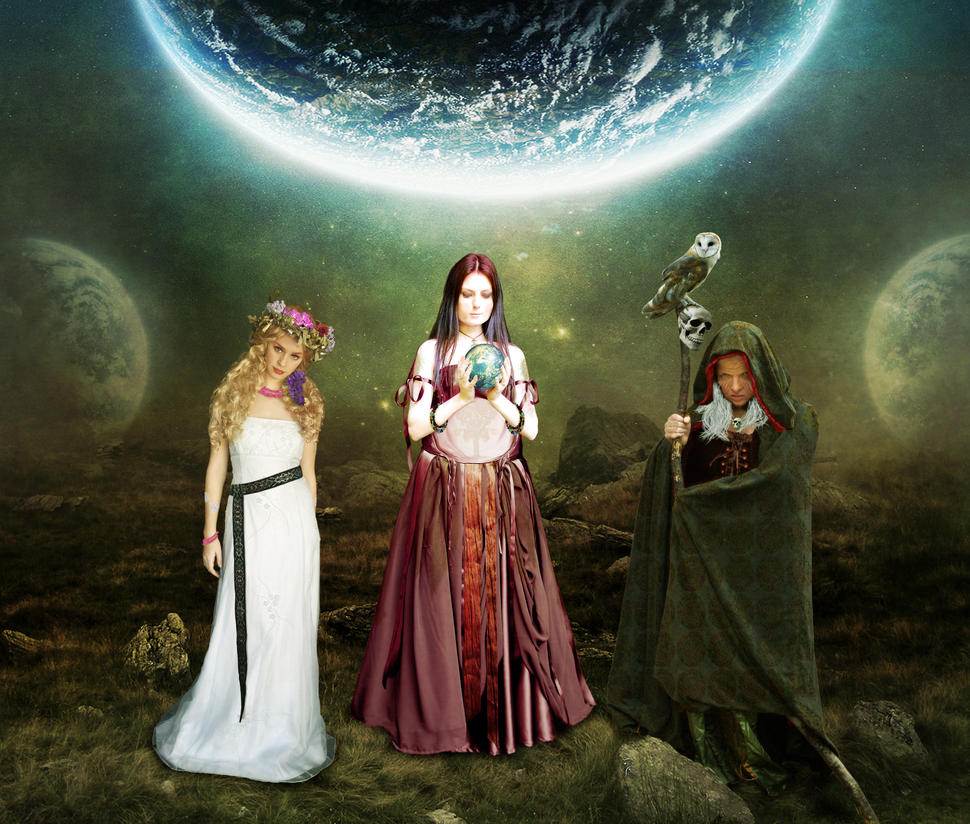
Our narrator is a very lonely seven year old boy, the kind that doesn't even realize the extent of his unhappiness. He rarely makes friends, no one comes to his birthday parties. Instead he has found solace in fantasy and myth; his prized possessions are his books. One fateful day he and his father discover a dead body and that one event sets off a chain reaction, magic having slid into our world where it proceeds to cause all sorts of havoc. At this time our little narrator meets the Hempstock family for the first time (all Maiden/Mother/Crone overtones are deliberate and intentional). Like Gaiman's other works wherein our main character finally meets the magical beings, the conversations are riddles that are hard to puzzle out--but again, don't try. Just let the magic flow. The narrator trusts them almost implicitly, but he's seven, he has no reason not to trust the very kind women. They seem to know more about what is happening than they care to explain, but they've also come up with a plan to send the magical spirit (referred to as a flea) back to its world. As one might expect, the plan goes wrong--due in large part to our narrator's inability to follow instructions--and the situation only gets worse. The magical being decides it wants to reshape our world to match its own, and uses our narrators family as a means to do so. The family is turned upside down and the horror of this is almost too real. While Gaiman uses magic and myth to examine what happens, somewhere in the back of my mind I wondered if these events were real to Gaiman--reinterpreted, like so many traumatic events are, in language that is more accessible and more easy with which to grapple. What follows is the meat of the story, so I won't spoil it, but it comes down to sacrifice and eventually memory and how clouded the latter can be, how no two stories are the same and that part of growing up is learning to tuck those memories away in the nooks of your mind, rationalizing them as the distant echos of a childhood long since past. Bu as Gaiman writes, "The truth is, there aren't any grown-ups. Not one, in the whole wide world." On the inside, we are all still children.
The non-ocean/duck pond is perhaps the biggest symbol of the book, bookending two of the more prominent moments in the story. The non-ocean/duck pond (that is really an ocean and barrier between our world and the universe that exists beyond this world that is populated by myth and monsters and magic) serves as anchor for our narrator, his inexplicable return to the shore never fully understood to him. It is a home where he can return but where he cannot stay. The ocean is bigger on the inside in more ways that one. It severs as a vessel for rebirth and as a link to answers we all seek: who am I? How did we lose that magic inside of ourselves? Where do I belong? Where is home? It is always just outside our grasp and just when we think we have latched onto it all, it slips--like so much water--between our fingers. This feeling of happiness beyond the pale is articulated best by this line:
“How can you be happy in this world? You have a hole in your heart. You
have a gateway to lands beyond the world you know. They will call you,
as you grow. There can never be a time when you forget them, when you
are not, in your heart, questing after something you cannot have,
something you cannot even properly imagine…” Something always calls him back, something always calls all of us back, that hole in our heart that yearns to be filled.
If this book does one thing specifically well--and it does a great many things well--it is in calling up some long forgotten distant pain of your past. Whether you had a happy childhood or not, this book will drudge up some memory that has alluded you in the years since, tugging at your minds eye, beckoning to be revisited. It could be a traumatic one--the fear of adults and adulthood, loneliness--or a good one--the joy of a new book, the act of playing with your first pet on a sunny afternoon. All memories are painful, because of the memory itself or because of the pain of loss, of knowing that you aren't that child anymore. At one point the older narrator waxes nostalgic about how he may not miss childhood, but he does miss how he never took anything for granted: the small wonders we experience as children that our jaded adult selves blindly toss aside as common and normative.
In the end this book flows wonderfully; I easily read it in four hours because the sheer act of putting it down meant I was no longer in that world where I so desperately belonged, that has called to me since I was a little girl. Gaiman's words are lush, you can taste the honeycomb and cream on the porridge. The villain of the story is cruel and petty for the sake of being evil, and I relished it. She was perfectly terrifying--the mythic monster that seeks to destroy a family by her mere presence.
I fully recognize that this is not a typical review. I will not analyze any elements that were "bad" because there were none. I'm sure others will find fault in the pacing or the narration or certain deus ex machina plot devices. Not so with me. This is a panegyric, a paean, a sacrifice lovingly offered up to Neil Gaiman as a token of appreciation for yet another hauntingly beautiful book that moves and tugs at the soul. This book is unquestionably Gaiman and I would not have it any other way.
Overall rating: A
Showing posts with label Neil Gaiman. Show all posts
Saturday, June 22, 2013
Saturday, May 25, 2013
In Which I Review Some Books
Confession: Back in December, before what was potentially my last Christmas break, I realized I missed reading. I was so caught up in academia and all the work that goes into being a full time Master's student, I had neglected fun reading, which was doubly sad as it has always been a hobby of mine. As an undergraduate, my friends and I used to drive to the local "dirt mall" (so named because of how tiny it was) and I would spend a good half hour in the bookstore, arms full of books I didn't have the money to buy but bought anyway. My friend Jenny used to think it was funny to add to my pile and then convince me that I should spend more money. Fantasy, sci-fi, historical fiction, fantastical historical fiction, romance, classic: you name it, I read it. So, upon realizing that my Christmas break was going to be full of still more research and thesis writing, I made a pact with myself that it would also include some novels. Five months later and I've read 30+ books.
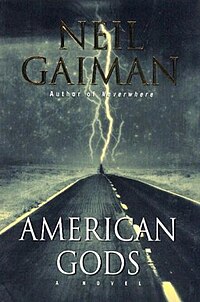
American Gods by Neil Gaiman.
Without a doubt, one of the best books I have ever read, there is a reason why Neil Gaiman is one of the heavyweights of fantasy. I was familiar with Gaiman in general, though sadly I had not read anything of his until this book; he is credited with writing what is probably the best episode of Doctor Who of all time (The Doctor's Wife). This book is complex and thoughtful with a large mythology but enough magic that suspends my need to have all my questions answered. Shadow, the main character, has just been released from prison after a few years and is trying to make his way in the world once more. Along the way he meets the mysterious Mr. Wednesday who wishes to hire Shadow as a bodyguard, more or less. Wednesday, a prolific con man, takes Shadow across country, introducing him to his incredibly colorful friends. Eventually the crux of the novel is revealed to Shadow, though the audience has already caught on. Mr. Wednesday and his friends are gods from the old world, transplanted to America by immigrants and travelers because--quite simply--they believed in them. People carry their gods wherever they go and thus gods from Viking mythology (Mr. Wednesday is a specific iteration of Odin), Egyptian myth (Mr. Ibis and Mr. Jaquel), Slavic myth (Czernobog), African folklore (Mr. Nancy), and even Native American traditions are scattered across the American landscape. But the old gods, as they call themselves, have a problem: they are dying in the face of the new gods of technology and media. America, we are told, is a bad place for gods. What ensues is a cosmic con and battle in which Shadow is part hero, part sacrifice. As a student of religion, the take on how the gods still survive in a land such as America was fascinating. How are mythologies and the figures of those myths transformed in new places? Can myths of the old world that so informed a people and a culture of long ago survive in land fueled by "new" and "innovative?"
Overall grade: A+ (Just read it!)
The Fault in Our Stars by John Green
If you look at any list of the top YA fiction for 2012, you'll find this book. Chances are if you look at several lists for the best books of 2012, this book is on there. For a time, you couldn't turn the corner in a bookstore without running into TFiOS. I have to admit, I was already predisposed to like anything John Green wrote, even though I was rather late in the game with reading this book. When he's not writing compelling young adult fiction, John Green is one half of the YouTube channel, the Vlogbrothers with his brother Hank, who have been trying to decrease world suck since 2007. I've been a member of their community (the Nerdfighters) for sometime. Communicating with mainly teenagers and young adults a few times a week, it's no surprise that Green knows how to write a book that is both funny and heartbreaking and altogether real. TFiOS tells the story of two cancer patients, Hazel and Gus, who meet in a support group. Sounds depressing, I know, but this not a cancer book. A cancer book would have our two young heroes struggle through their disease, coming to accept it and learn the value of living life to the fullest before quietly making peace with their inevitable death. No so with Hazel and Gus who are sarcastic and quick witted and who hate everything about their cancer. Life is not a platitude and knowing pain does not increase your feelings of joy. Hazel recognizes that someday, after she dies, she'll be forgotten, just as everyone else will. Oblivion is there, accept it. But along the way, these two souls find one other and even though they know that their deaths will affect the other in horrible ways, the choice to love one another was a simple one. You will laugh and you will cry and this book will stay with you.
Overall Grade: A
Divergent by Veronica Roth
In the wake of wildly successful and popular Hunger Games, it seems that post-apocalyptic dystopia novels are everywhere, and mostly found in the Young Adult section of the bookstore. The Divergent series follows in that wake. Dystopian literature is a personal favorite, Brave New World being one of the high school books that I actively remember and one that stayed with me. However, I remember hesitating before finally picking up this book: how could it be better than the Hunger Games (which is simply phenomenal, even though I don't agree with the ending)? However, Roth takes a different approach than Collins with her heroine; where Katniss knows that her society is tragically flawed and wrong, Beatrice Prior (Tris) spends the first half of the novel in passive acceptance of the society in which she lives. Somewhere in the not too distant future in Chicago, humanity has divided itself into factions based on virtues: candor, erudite, amity, dauntless, and abnegation. At the age of sixteen, a young adult chooses to either stay in the faction of their birth or leave for the one they feel fits them. Factions rarely interact with one another, so choosing to leave the faction of your birth possibly means never seeing your family again. Tris, born to Abnegation, is torn when the test taken at school reveals that she could potentially belong to several factions. This "affliction" is known as Divergence and is feared and prosecuted. Tris is told to keep it to herself for fear that she'll be harmed. What follows is a coming of age story as Tris struggles to accept her differences, her new faction, but also as she uncovers a plot that seeks to rip the society apart. Naturally there is a romance, though thankfully we are spared the typical love triangle that so often accompanies young adult literature these days. The concept itself is interesting though I found myself often wondering how someone could possibly be just ONE of those virtues and I have a sneaking suspicion that might be Roth's point, what drives her novel. Trying to separate out those virtues is next to impossible not only because of how hard they are to define but also because, for example, being brave can also mean being selfless or honest or smart. It's amazing more characters aren't Divergent. This is the first of three books, the third due out this year. The second book picks up where the first leaves off and then turns everything upside down so that the wait for the final book is close to excruciating. The middle section where Tris is learning how to be a member of her new faction drags on a bit and the secret plan she uncovers is a bit confusing, but it is well worth the read.
Overall Grade: B+
Miss Peregrine's Home for Peculiar Children by Ransom Riggs
An unbelievably strange book that combines myth, fantasy, time travel, pocket universes, and vernacular photography, this is a very interesting debut from Riggs. After the death of his grandfather, Jacob Portman is convinced that something terrible happened to the old man. His grandfather's stories of monsters and special children on a magical island seem the ravings of a senile mind until Jacob begins investigating. On a small isolated part of Wales, Jacob discovers a place pocketed away from time, where children who are "peculiar" live in a time bubble during World War Two. Some children can float, some can control fire, some have bees covering their face, and one child is even invisible. There are creepy monsters and an entertaining plot, but what really makes this book worth the read are the black and white photos sprinkled throughout. At first, I thought I would find them annoying but it's amazing how well they work with the narrative, fitting into the story at just the right moments. It was obvious that Riggs spent countless hours hunting down these photos to use, pouring through garage sales and personal collections. The photos are strange (like the cover photo of a girl floating) and are obviously "faked" but that is washed away in the explanation of who the children in the photos are. A very delightful read, I look forward to the sequel.
Overall Grade: B+
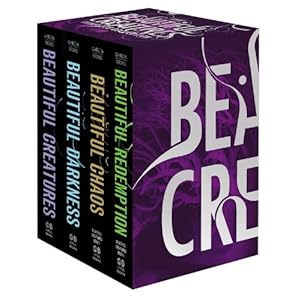
The Beautiful Creatures Collection by Kami Garcia and Margaret Stohl
Vampires, werewolves, succubi, inccubi, magic, witches, prophecy, and Southern manners surround this series of four supernatural novels. Typical gender roles are reversed in this series; instead of the guy being the supernatural creature with whom the young girl falls madly and inconsolably in love, Ethan Wate is a normal guy living in the deep south, in a tiny town where nothing exciting ever happens and all he can do is hope to escape. That is until Lena Duchannes comes to the town of Gatlin. Lena, it turns out, is a Caster (witch) and a super powerful one at that. On her 16th birthday she will be claimed (against her will) for either the Light or the Darkness. If she goes Dark, chances are she will not remember her love for Ethan. On top of the world's worst birthday present, Lena's mother is out to make sure her daughter goes Dark. The series is supernatural mythology run amok. Every conceivable supernatural trope you can think of is present and at times not well put together. It felt, occasionally, like the authors simply inserted crucial new information at just the right moment for our heroes, but information which had never been even so much as hinted at in earlier pages. The first book--Beautiful Creatures-- is interesting and gets the series off to a good start. However the middle two--Chaos and Darkness--suffer heavily from "middle book syndrome," especially the former which I had to force myself to "just get through." The final book brings back some of the things I liked about the first book. Supernatural books are in high demand right now and there are stronger series out there, but setting the series in the deep south and then making the ideals and customs of that local like another character in the book does make this series stand out. Lazy summer day or beach read at best.
Overall Grade (as a whole): C
This is just a small sampling of some of the books I've read. I think I'll try to review most of them sporadically as I continue blogging. In the meantime, just go out and buy American Gods already!
American Gods by Neil Gaiman.
Without a doubt, one of the best books I have ever read, there is a reason why Neil Gaiman is one of the heavyweights of fantasy. I was familiar with Gaiman in general, though sadly I had not read anything of his until this book; he is credited with writing what is probably the best episode of Doctor Who of all time (The Doctor's Wife). This book is complex and thoughtful with a large mythology but enough magic that suspends my need to have all my questions answered. Shadow, the main character, has just been released from prison after a few years and is trying to make his way in the world once more. Along the way he meets the mysterious Mr. Wednesday who wishes to hire Shadow as a bodyguard, more or less. Wednesday, a prolific con man, takes Shadow across country, introducing him to his incredibly colorful friends. Eventually the crux of the novel is revealed to Shadow, though the audience has already caught on. Mr. Wednesday and his friends are gods from the old world, transplanted to America by immigrants and travelers because--quite simply--they believed in them. People carry their gods wherever they go and thus gods from Viking mythology (Mr. Wednesday is a specific iteration of Odin), Egyptian myth (Mr. Ibis and Mr. Jaquel), Slavic myth (Czernobog), African folklore (Mr. Nancy), and even Native American traditions are scattered across the American landscape. But the old gods, as they call themselves, have a problem: they are dying in the face of the new gods of technology and media. America, we are told, is a bad place for gods. What ensues is a cosmic con and battle in which Shadow is part hero, part sacrifice. As a student of religion, the take on how the gods still survive in a land such as America was fascinating. How are mythologies and the figures of those myths transformed in new places? Can myths of the old world that so informed a people and a culture of long ago survive in land fueled by "new" and "innovative?"
Overall grade: A+ (Just read it!)
The Fault in Our Stars by John Green
If you look at any list of the top YA fiction for 2012, you'll find this book. Chances are if you look at several lists for the best books of 2012, this book is on there. For a time, you couldn't turn the corner in a bookstore without running into TFiOS. I have to admit, I was already predisposed to like anything John Green wrote, even though I was rather late in the game with reading this book. When he's not writing compelling young adult fiction, John Green is one half of the YouTube channel, the Vlogbrothers with his brother Hank, who have been trying to decrease world suck since 2007. I've been a member of their community (the Nerdfighters) for sometime. Communicating with mainly teenagers and young adults a few times a week, it's no surprise that Green knows how to write a book that is both funny and heartbreaking and altogether real. TFiOS tells the story of two cancer patients, Hazel and Gus, who meet in a support group. Sounds depressing, I know, but this not a cancer book. A cancer book would have our two young heroes struggle through their disease, coming to accept it and learn the value of living life to the fullest before quietly making peace with their inevitable death. No so with Hazel and Gus who are sarcastic and quick witted and who hate everything about their cancer. Life is not a platitude and knowing pain does not increase your feelings of joy. Hazel recognizes that someday, after she dies, she'll be forgotten, just as everyone else will. Oblivion is there, accept it. But along the way, these two souls find one other and even though they know that their deaths will affect the other in horrible ways, the choice to love one another was a simple one. You will laugh and you will cry and this book will stay with you.
Overall Grade: A
Divergent by Veronica Roth
In the wake of wildly successful and popular Hunger Games, it seems that post-apocalyptic dystopia novels are everywhere, and mostly found in the Young Adult section of the bookstore. The Divergent series follows in that wake. Dystopian literature is a personal favorite, Brave New World being one of the high school books that I actively remember and one that stayed with me. However, I remember hesitating before finally picking up this book: how could it be better than the Hunger Games (which is simply phenomenal, even though I don't agree with the ending)? However, Roth takes a different approach than Collins with her heroine; where Katniss knows that her society is tragically flawed and wrong, Beatrice Prior (Tris) spends the first half of the novel in passive acceptance of the society in which she lives. Somewhere in the not too distant future in Chicago, humanity has divided itself into factions based on virtues: candor, erudite, amity, dauntless, and abnegation. At the age of sixteen, a young adult chooses to either stay in the faction of their birth or leave for the one they feel fits them. Factions rarely interact with one another, so choosing to leave the faction of your birth possibly means never seeing your family again. Tris, born to Abnegation, is torn when the test taken at school reveals that she could potentially belong to several factions. This "affliction" is known as Divergence and is feared and prosecuted. Tris is told to keep it to herself for fear that she'll be harmed. What follows is a coming of age story as Tris struggles to accept her differences, her new faction, but also as she uncovers a plot that seeks to rip the society apart. Naturally there is a romance, though thankfully we are spared the typical love triangle that so often accompanies young adult literature these days. The concept itself is interesting though I found myself often wondering how someone could possibly be just ONE of those virtues and I have a sneaking suspicion that might be Roth's point, what drives her novel. Trying to separate out those virtues is next to impossible not only because of how hard they are to define but also because, for example, being brave can also mean being selfless or honest or smart. It's amazing more characters aren't Divergent. This is the first of three books, the third due out this year. The second book picks up where the first leaves off and then turns everything upside down so that the wait for the final book is close to excruciating. The middle section where Tris is learning how to be a member of her new faction drags on a bit and the secret plan she uncovers is a bit confusing, but it is well worth the read.
Overall Grade: B+
Miss Peregrine's Home for Peculiar Children by Ransom Riggs
An unbelievably strange book that combines myth, fantasy, time travel, pocket universes, and vernacular photography, this is a very interesting debut from Riggs. After the death of his grandfather, Jacob Portman is convinced that something terrible happened to the old man. His grandfather's stories of monsters and special children on a magical island seem the ravings of a senile mind until Jacob begins investigating. On a small isolated part of Wales, Jacob discovers a place pocketed away from time, where children who are "peculiar" live in a time bubble during World War Two. Some children can float, some can control fire, some have bees covering their face, and one child is even invisible. There are creepy monsters and an entertaining plot, but what really makes this book worth the read are the black and white photos sprinkled throughout. At first, I thought I would find them annoying but it's amazing how well they work with the narrative, fitting into the story at just the right moments. It was obvious that Riggs spent countless hours hunting down these photos to use, pouring through garage sales and personal collections. The photos are strange (like the cover photo of a girl floating) and are obviously "faked" but that is washed away in the explanation of who the children in the photos are. A very delightful read, I look forward to the sequel.
Overall Grade: B+
The Beautiful Creatures Collection by Kami Garcia and Margaret Stohl
Vampires, werewolves, succubi, inccubi, magic, witches, prophecy, and Southern manners surround this series of four supernatural novels. Typical gender roles are reversed in this series; instead of the guy being the supernatural creature with whom the young girl falls madly and inconsolably in love, Ethan Wate is a normal guy living in the deep south, in a tiny town where nothing exciting ever happens and all he can do is hope to escape. That is until Lena Duchannes comes to the town of Gatlin. Lena, it turns out, is a Caster (witch) and a super powerful one at that. On her 16th birthday she will be claimed (against her will) for either the Light or the Darkness. If she goes Dark, chances are she will not remember her love for Ethan. On top of the world's worst birthday present, Lena's mother is out to make sure her daughter goes Dark. The series is supernatural mythology run amok. Every conceivable supernatural trope you can think of is present and at times not well put together. It felt, occasionally, like the authors simply inserted crucial new information at just the right moment for our heroes, but information which had never been even so much as hinted at in earlier pages. The first book--Beautiful Creatures-- is interesting and gets the series off to a good start. However the middle two--Chaos and Darkness--suffer heavily from "middle book syndrome," especially the former which I had to force myself to "just get through." The final book brings back some of the things I liked about the first book. Supernatural books are in high demand right now and there are stronger series out there, but setting the series in the deep south and then making the ideals and customs of that local like another character in the book does make this series stand out. Lazy summer day or beach read at best.
Overall Grade (as a whole): C
This is just a small sampling of some of the books I've read. I think I'll try to review most of them sporadically as I continue blogging. In the meantime, just go out and buy American Gods already!
Subscribe to:
Posts (Atom)