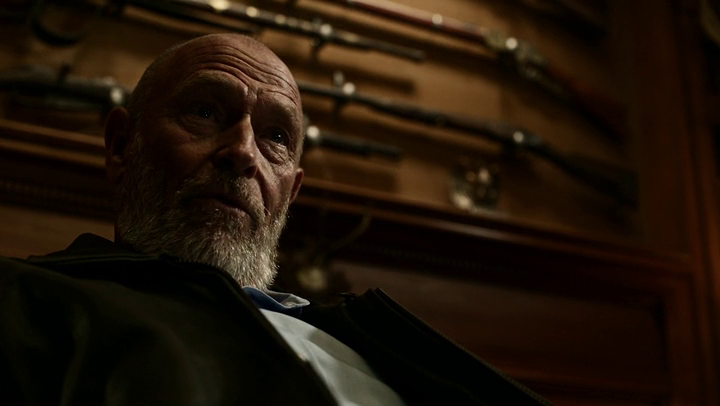
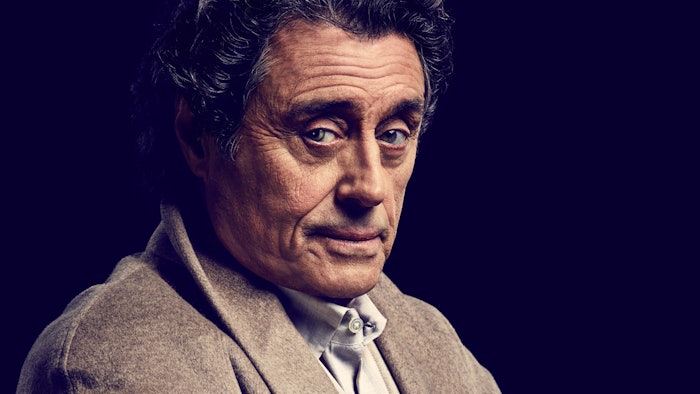
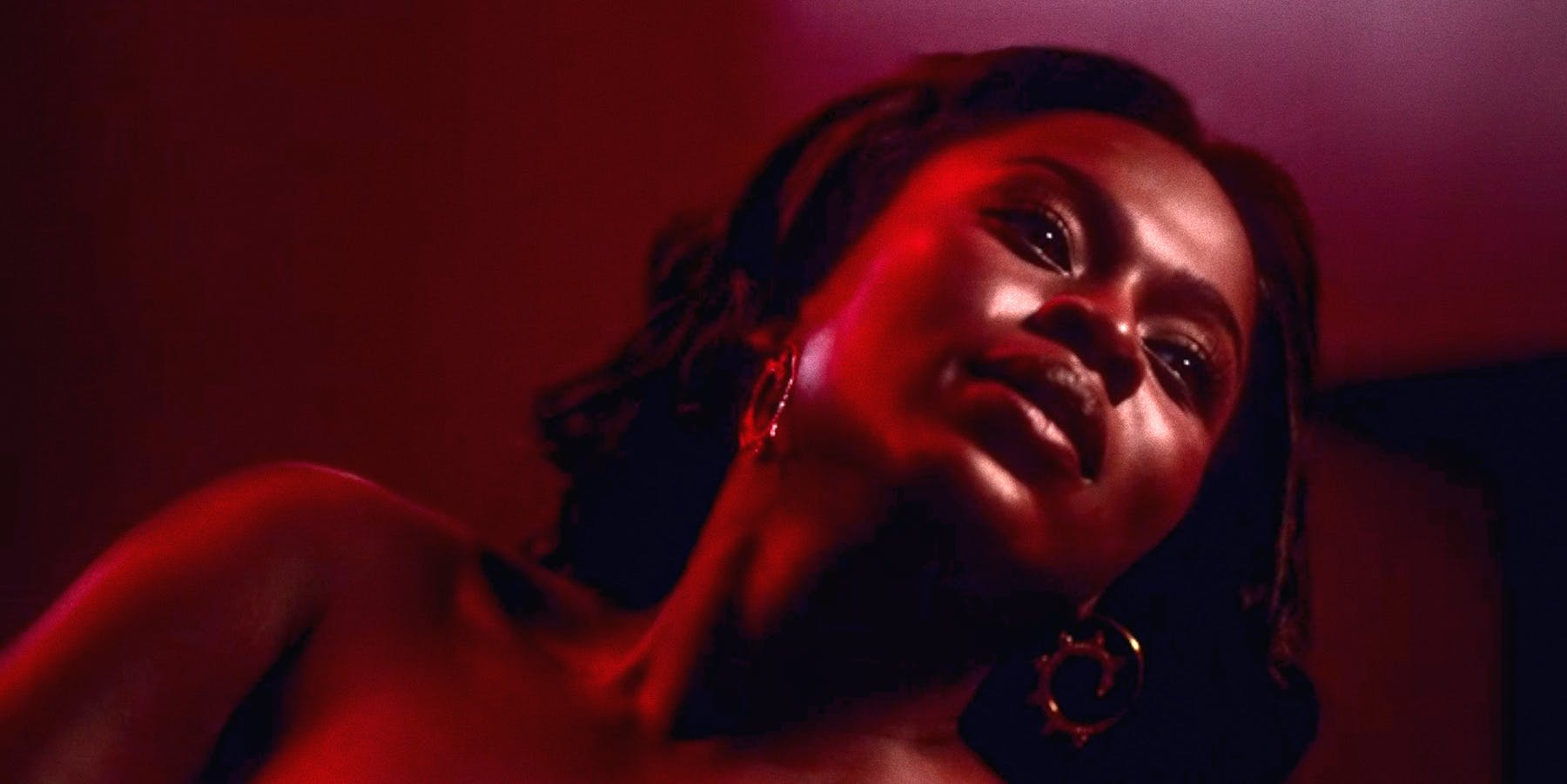
Showing posts with label American Gods. Show all posts

Monday, June 19, 2017

In Which I Review American Gods (1x8)

Every religion or code of faith is a story. It has all the hallmarks of a good narrative; there's a plot with a beginning, middle, and end; there are heroes and villains, quests for redemption and falls from grace. There are deeds of valor and actions of woe; magical creatures, far off places, larger than life characters who work their charms alongside any other talents or gifts the world has given to them. And like all good stories, faith is asking for only one thing: belief. Since the beginning of the series, I--and American Gods--have pounded home the idea that at its center, this show is about belief. Testing belief, finding belief, expanding your belief, losing belief, discovering all the unique ways that belief and faith manifest in our world--and in worlds unseen--are all at the heart of American Gods and perhaps no other episode quite captures that essence more than the season finale, "Come to Jesus," a fairly apropos title given that, on the one hand, there are several Jesuss' that are wandering around a villa in Kentucky on Easter and, on the other hand, the term means to have a conversation that leads to an epiphany, a reckoning, or an understanding. Shadow Moon, welcome to belief. It only gets weirder from here. Grab your bunny rabbit that poops jelly beans and let's go!


Every character in this episode has a story to sell and they are really hoping that you'll believe in it long enough to get whatever it is they want. Let's start with one of the more complicated stories to parse out: Shadow Moon and the problem of disbelief. Maybe the most frustrating--but necessary given the medium of TV where revelations are best served up in a climax--thing about Shadow is that after seven episodes of bat guano crazy twists and turns--from Laura coming back to life, to Not-Really-Lucy-Ricardo talking to him out of a TV, Marilyn Monroe floating and revealing herself to be in cahoots with the likes of Technology and Mr. World, to six foot plus leprechauns, to Slavic sisters and their cow killing family member--Shadow still doesn't know what to believe and worse still doesn't know if he believes in anything. It's a bit preposterous given that his confession of non-faith is given to a version of Jesus with a literal glowing halo who is literally floating on water. I'm not sure how Shadow, at this point, manages to avoid belief of any kind given all he's seen except to handwave it away as the magic of TV needing our hero and protagonist to come into belief by way of something explosive. However bizarre and frustrating, Shadow's disbelief serves a purpose in that it helps to illustrate how ordinary Americans manage to fall out of belief due to circumstance of life or the absence of gods that they can touch, feel, see, and interact with which in turn leads to the likes of Mr. Wednesday and his war. The ever present multiple Jesuss's (Jesi? Jesuses?) are a good example here. They are not the real McCoy; they're a specific image of an image, almost a magic trick meant to fool the observer. The reason why there are so many is because belief in Jesus takes many different forms from Catholic to Protestant to Greek Orthodox to Coptic and, I mean this quite seriously, the list could go on for quite awhile. Lists within lists. Jesus, a lot like Vulcan, can be adapted for whatever the believer needs: King of Kings, prophet, humble shepherd, fully human, fully divine, son of god, messiah, savior, or guy down on his luck. For Shadow and others it's hard to know which one to latch on to because while they all present a similar image, the up close version is distorted. Notice how the various types of Jesus have precious little to say that is meaningful; the one interaction we get between Shadow and the main Jesus is a platitude: "I am belief. I don't know how to be anything else." That's not super helpful and because it's so very opaque and Shadow is looking for something he can hold on to; it's no wonder that it takes Wednesday with a lightening storm, screaming his various names for Shadow's eyes to truly open and believe in something real. Wednesday feels real; he's tangible in a way that the other ephemeral Jesuss' aren't. The other part of Shadow's story that he's trying to sell (and failing at every turn, poor guy) is that he's so angry at Wednesday for how massively weird his life has gotten that he doesn't care about the truth, about what's really going on. The story Shadow himself wants to believe is that he can walk away from Wednesday at any time. But, of course, Shadow can't because a big part of Shadow wants to believe; he wants the surety of faith that everything that has happened has some sort of explanation. Shadow's story is one from disbelief and heavy skepticism to belief; because seeing is believing, he has finally witnessed that the gods are real and that there actually might be a reason behind all the crazy happenings around him.

At the center of Shadow's journey into belief is Mr. Wednesday who sells stories better than anyone we've met so far. The New Gods offer too much flash, too much pizzazz in their stories to make us receptive; they offer almost nothing concrete. Like Mr. Wednesday has told them twice now, they are mere distractions from any existential crisis of faith. What he offers, by contrast, is inspiration and, more importantly for the Old Gods he's trying to recruit: meaning. I should pause here to point out a few things; first it's worth noting that Wednesday lies a lot. He flat out lies to Easter (sorry, Ostara) about Vulcan's fate, claiming it was the New Gods who killed the lord of firepower. Second, the Old Gods understand that Wednesday is a tricky fellow. Several times gods have called him fraud, a deceiver, a liar, and outside of verbal cues we have many instances of Wednesday selling a story that simply isn't true from acting like a senile old man to get on to a plane, to pretending to be a bank guard taking people's deposits. The idea that Mr. Wednesday lies hovers around our story, even as it asks us to believe everything he is saying. It's a nice push/pull between wanting to believe and put faith in Odin despite what our eyes are telling us. The show has made clear several times that the motivation behind Mr. Wednesday's lies and trickery is desperation. He has been forgotten over time; his name (or names) no longer have any meaning in America except as a myth long since replaced by something newer, shiner, and prettier. If belief is the life blood of these Old Gods, prayers and sacrifices the appetizer and main course, then Odin is--essentially--starving. No one lifts up their voice in song to him anymore, no one beseeches him, no one offers up the fated calf, and so he'll spin his tale in whatever manner he can so that he can feast once more. His interactions with Easter demonstrate that he's not willing to go gently into that good night; he can't sell his soul--for want of a better term--and change his story to suit the new world; Easter can, though it's not the same. Easter's story offers up a chance to see how hollow Odin and the other Old Gods would be if they accepted the New Gods's way of life. Her high holiday has been overtaken by a different religion but also become a mass product that can be sold, not just to the religiously minded but to atheists as well. Peeps, Cadbury eggs, bunnies and chicks, it doesn't matter if you're of the faith or not, Easter has become a holiday that all participate in, though it's sugary sweet and doesn't fulfill anyone, Ostara least of all. The story Ostara is selling is one of peace through accommodation; hair pinned up, a beautiful picture but simply that: an image of an image. The real Ostara is spring itself; wild, beautiful, full of life and rebirth, and utterly powerful. What's interesting about Wednesday in all this is that it takes lying and manipulating Ostara to bring her back her muchness, to borrow a phrase. Does that make her return to self false? Or less powerful? Does it mean that, should Ostara find out what really happened to Vulcan, that she'll regress? Or does it not matter how one gets to belief and fullness just so long as they get there? Questions for season two, I suspect.

And finally, we have a few other stories being sold by various peoples and gods. The New Gods really like their narrative that you can't stop progress and that progress in and of itself is good. They are good because they are new, different, and longer lasting (or so they imagine). I don't know that progress itself is bad, but it is the way these New Gods want to go about doing it, which is to say destroying the old and offering something less substantial in their place. Wednesday is right; Media and Technology are distractions for the most part. We offer up our time, our energy, our attention, and sometimes each other for our computers, our phones, our TVs and I have to wonder if we really get anything in return (this is a deep piece of irony given that I spend several days a week writing a TV blog, parsing out one of the more prolific types of media for deeper meanings). Laura's story is that she has so much to live for, having finally realized that Shadow makes her happy to be alive and surely someone can help her; Mad Sweeney's story is that he can undo his past mistakes of killing Laura in the first place by resurrecting her with the help of Ostara. Meanwhile, out in the wilds of Hollywood, Bilquis tells herself the story that selling her soul to the New Gods is worth their price because she feels like a goddess again. All of these stories from Shadow to Wednesday to Easter to Laura to the New Gods to Mad Sweeney to Bilquis have belief at their center. The belief in love, in power, in sex, in progress, in life, in strength, in reverence, and in belief itself. We started off American Gods with a simple commandment: believe. Now as we move into the next phase of the story, a question arises: what do we do with all this belief?

Miscellaneous Notes on Come to Jesus 

--The art director for this show deserves all the awards not only for every single shot of Easter's house but also for the carefully constructed sewing room at Mr. Nancy's. Talk about gorgeous!

--"Once upon a time...see it sounds good already. You're hooked." Anansi doing what Anansi does best, telling a tall tale.

--Can we start a petition to have Ricky Whittle dress in grey and lavender all the time? Damn.

--"Worship is volume based; whoever has the most followers wins the game."

--I don't think I'd welcome Wednesday into my house either if he kept running over my bunny rabbits.

--"What are you pissed off about?" "You just cut off your friends head!"

--"People create gods when they wonder why things happen. Why do things happen? Because gods make things happen."

--There is a great power in sacrifice, most religious texts and traditions will tell you that. Notice that Laura was a sacrifice to get Shadow to where he is now, literally and mentally. Also, take note that Odin dedicates the deaths of the faceless men to Ostara which seems to give her some sort of power that she previously lacked.

--"Do you believe, Shadow?" "I believe." "What do you believe?" "Everything."

--I have enjoyed every single second of this show and reviewing it this season. The writers, actors, the producers, and everyone else have done Neil Gaiman and his magnificent work proud. Thanks to everyone who read! See you in season two.

Tuesday, June 13, 2017

In Which I Review American Gods (1x7)

When it comes to adaptations of novels, especially novels that I hold dear to my heart, I am a book purist. The book did it first, it did it the best, and the adaptation need not stray into uncharted waters because the perfect layout--with a clear beginning, middle, and an end--has already been written. The adaptation's job is to color the world with living, breathing actors who can capture the written word perfectly. In other words, an episode like this week's "A Prayer for Mad Sweeney" shouldn't have so captured my heart and been such a careful and considerate character study of two side character who, in the novel "American Gods," appear only a handful of times and mostly without adding anything character driven to the plot. Mad Sweeney and Laura show up to move the plot along--and one of them vanishes fairly quickly--or to hinder Shadow emotionally and literally but that's all. Fodder for the text, you might say. What this episode did was nothing short of remarkable, if only because I find that I honestly don't care that the vast majority of this episode took a brief "Coming to America" side story in Gaiman's novel meant to demonstrate how myths come to America from various places and made it feel like a piece of narrative as worthy to be told as Shadow's hero's journey and Mr. Wednesday's war. Put some bread and cream out for the fairy folk and let's go!


Nothing in this episode should have worked. Mad Sweeney has largely been played for laughs; he's been punched, kicked, robbed, and thrown from a moving vehicle at least once. His luck has run out and because we heavily and automatically associate leprechauns with luck, there's an inherent dramatic irony in watching a 6 foot plus Irish leprechaun stumble his way around modern America, getting his ass more or less handed to him at every turn. Mad Sweeney has been loud, rude, crude, and a danging thread in Mr. Wednesday's sprawling opus. Laura, on the other hand, got a whole episode to color her character but it did her few favors. Understand her we might, but sympathizing with her is much harder as we watched her attempts to find a reason to live before she actually died. This is why throwing in Salim, with his doe eyed belief and rigorous religious practice, was a delightful and smart move on the part of the writers. Two totally impious and unholy individuals strike up a deal with deeply pious and religious taxi driver who has literally been one with a mythical being. If there wasn't a coming war in America, it might be the start of sitcom. It's curious, then, that the writers dispense with Salim so quickly, sending him off in search for his djinn (stopping five times a day to pray to Allah along the way). That's why this episode shouldn't have worked; it does away with what was working to focus on two elements that, up until now, have been periphery to the main thrusts of the major plot of the show. To wit, Shadow and Mr. Wednesday do not appear at all and instead we get a multi-generational, mythical flashback about how Mad Sweeney came to American via a very stubborn, obstinate, and resilient Irish girl named Essie (cleverly played by the same actress portraying Laura Moon). What strikes me most about this episode is how singularly focused it is. Sure the themes of belief and prayer and remembrance are all there, tucked inside Essie's pocket like so much salt and bread. But what this episode is really about--almost in joyous celebration--is life. Just that. Good old fashioned life, with all the twists, turns, faults, and triumphs that come with it.

This story had love, hate, greed, choices, sex, grief, pain, heartache, and death all wrapped into one and in spite of taking place in 1721, Essie and Mad Sweeney's story felt universal. This is a life fully lived and while Laura and Essie aren't the same person, and Mad Sweeney isn't human at all, there's something transcendental about the way Essie's story was told. As if everyone is Essie because we've all been through the same hallmarks of life that she passed through. One of the things this adaptation of American Gods is trying to do, and I'd saying doing very well, is tell an immigrant story, of what it means to come to America. It doesn't matter if they are Vikings in the 9th century, an Egyptian woman, an Arabic man in New York, a group of Natives from long ago who crossed the Bering Straight, or a red haired Irish girl who lied and cunningly schemed her way to America, all the immigrant stories are the same at their core. They are painful and hopeful, sad and joyous. They are human stories, not to point to fine a point on it. The reason these Old Gods can come together and join up with Wednesday, in spite of coming from vastly different mythologies, from different time periods over different parts of the world, is because they understand what it means to be an immigrant. They are more alike than they are different and in the end, when Mad Sweeney gives up his lucky coin to save the already dead girl lying on the side of the road it's because he understands what it means to want something, to go after something and to feel alone--because after all, isn't Laura Moon just another kind of immigrant--and he's capturing the commonality of all the peoples and gods before him. His need for his lucky coin doesn't outweigh Laura's need for Shadow or forgiveness. If anything, his need for his lucky coin means he understands why Laura is holding on to Shadow and why Essie held on to her stories and beliefs. In America--a land where gods live and die as belief turns from the old to the new warp speed fast and without cycling back around--it's important to hold on to those things, those totems, those beliefs, that make us who we are. It's the same for all of us, be we human or god.

Miscellaneous Notes on A Prayer for Mad Sweeney 

--It sounds like all the gods are headed for the House on the Rock in Wisconsin. Hopefully, we aren't too far behind because--no exaggeration--it's my favorite part of the novel.

--"In truth, the American colonies were more of a dumping ground.

--"I will eat you!" Honestly surprised more people do not threaten Huginn and Muninn given how annoying they can be.

--Mad Sweeney himself becomes a much more sympathetic figure in this episode as we not only hear about how he fled from a war, but also hear just how far his kind have fallen over time. From kings to fairies to being a joke and mascot for a breakfast cereal. Is it any wonder he'd join up with Wednesday?

--Another thing that shouldn't have worked but did: the 1950 doo-whop soundtrack that played throughout most of the flashbacks.

--"The more abundant the blessings, the more we forget to pray."

Monday, June 5, 2017

In Which I Review American Gods (1x6)

In my first review of American Gods, I quoted Mr. Wednesday as he attempts to explain to Shadow Moon that no one is American, not originally. This week's episode, "A Murder of Gods," more than any other so far is about another of the central ruminations in Gamain's book, right up there with belief: identity. The two are not mutually exclusive, to be sure. As Vulcan, god of firepower and weaponry, tells Mr. Wednesday over a particularly tense drink in Virginia, "you are what you worship." A search for identity goes hand in hand with a search for what you believe in, a journey to find something to claim as your own. It could be a person, a feeling, a coin, a group of followers, a djinn, and sometimes, a whole lot of gun toting nutters. Belief and, religious belief at that, has the power to bring people together but it also has the ability to separate us from "others." We box ourselves and each other into neat little boxes (that are rarely--and hardly ever stay--neat) and we set up a wicked but easy dichotomy of us vs them. And, hey, to be fair, isn't that what Mr. Wednesday is doing as well? New Gods vs Old Gods is just as much an us vs them mentality as other competing religious franchises.  There is one question that is repeated time and time again this episode, and every time it's met with confusion, more questions, and answers bordering on the insane. "What are you?" It might be mostly directed at the gods that populate our narrative but it applies to all of us, human or god, dead or alive. Get your trusty side arm and let's go! 


Everyone in this week's episode is trying to figure out who they are by way of trying to piece together who the people around them are. It's a messy way to find yourself because it relies on you being introspective enough to understand that what you believe you're seeing in the person next to you is a reflection of who you really are. Everyone, that is, except Vulcan who knows damn well who he is because he found his own little slice of American life that freely, eagerly even, worships him even when they don't realize they are doing so. That's why it is so easy for Vulcan to betray Wednesday in the end; like the New Gods urged Wednesday to do last week, Vulcan adapted. He figured out how to get his needed worship (and blood sacrifices) in this new, complicated, and unstructured land by finding the piece of America that would believe in him. If this episode is all about fractured identities--Salim who is neither Salim nor Ibrahim, the six foot Leprechaun who cannot be a proper lucky Leprechaun without his coin, the clinically dead woman who is more alive than ever, the Old God trying to stay relevant in a world that has forgotten him--then this episode is also taking another cue from Gaiman's work of a fractured America. Mr. Wednesday began this discussion in a previous episode that America is the only country that doesn't know what it is because America is more of a whispery idea than an actual tangible concept. America is full of so many different people who believe so many competing things about what America is that the idea of America can never truly settle into itself. This might be a fictionalized world but as we look around at America today in 2017, ain't that the damn truth? As Mr. Wednesday puts it this week while he and Shadow roll into a one select corner of America, "everybody looks at Lady Liberty and sees a different face." It's why so many different gods can pop up in America. There is no America.

So if everyone is trying to work out their identity, then what exactly is identity here in this show? It's a way to get wherever you need to be. Vulcan needs to be worshiped, needs those precious blood sacrifices, so he'll turn himself into the god of firepower, turning religious worship into a franchise with factories, time cards, and hailstorms of bullets if it means he gets to keep on keeping on. There's a great line from Gaiman that works well here to illustrate this point: "You got to understand the god thing. It’s not magic. It’s about being you, but the you that people believe in. It’s about being the concentrated, magnified, essence of you. It’s about becoming thunder, or the power of a running horse, or wisdom. You take all the belief and become bigger, cooler, more than human. You crystallize." Vulcan knows that no one is going to worship a god of fire and volcanoes, but a god of guns? Hell yes. Conversely, Laura needs to get to Shadow but is trapped in the past, unable to move on to the future she wants. Her identity is a mix between being a dead person with all the accompanying delightful smells, sketchy appearances, and gung-ho expressions of "fuck those assholes" and being alive, a wife and a daughter who is trailing after her husband and stopping off to see her family one last time. Mad Sweeney tells Laura to "choose one" meaning a car to steal but there's an undertone of choosing which life Laura wants: dead or alive. In the end, Laura settles into the identity that will get her Shadow, the thing she is seeking. This identity is as a dead person seeking resurrection, even if it means losing sight of her husband for awhile. Laura is choosing life and for the first time in, likely, her whole life. This isn't a test of her resolve to see how far she can push herself before she feels that spark of life; Laura's choosing the identity of a woman seeking to live again now that she's discovered how wonderful life is which brings us to Salim, our taxi driver who stumbled his way back into the narrative. Salim is an example of what Laura could be once she lets go of all her past identity issues. Salim used to be scared and timid, having sex with men in back alleys and taking crap jobs with an abusive brother-in-law to make his way in the world. That Salim died after a night spent with a djinn and something new was born. This new creature might bear a striking resemblance to Salim but, as Laura keeps calling him, he's not Salim. He has no real identity except that which he constantly creates; Salim is living a new life after his old one died and passed into the ether. This new life is more carefree, more open. Salim can hold onto the things in the past he loved--like Allah--but he can also incorporate the love he bears for a djinn without feeling torn asunder. He's an interesting character for Laura to interact with since that's essentially what she's trying to do. Salim could be a guide for her, a flashing neon sign telling her that she can have a new life and new identity if she just believes.

Miscellaneous Notes on A Murder of Gods

--In my very first review of American Gods I also posited the question of what exactly was a god. It's something Mr. Wednesday shoots at Shadow as well before trying to explain, "people believe things which means they're real. That means we know they exist. What came first--gods or the people who believed in them?"

--"I got stabbed by Charlie Brown's Christmas tree!"

--My stomach did a whole lot of churning watching Wednesday pull out a root from Shadow's insides.

--“What the fuck are you? I mean, what the fuck are any of you, but first tell me, what the fuck are you?"

--"Did you just name drop Jesus Christ like you know a guy who knows a guy?" Laura and Sweeney's comedic timing is on point and I'm quite enjoying this non-novel insert.

--Speaking of Jesus, RIP Mexican Jesus? That whole scene was darkly funny in that of course the very second the Mexicans get across the river they are gunned down (because welcome to America!) but when the tumbleweed blew across Mexican Jesus and left a tumbleweed crown of thorns, I may have laughed just a little too long.

--"You could sacrifice yourself. You've done it before."

--Know Your Gods: This week's pick is fairly obvious and I think Mr. Vulcan himself spells at the underlying problem with me trying to talk about him: "I was a story people forgot to tell." When we think of the great Roman (and Greek) pantheon, Vulcan isn't one of the gods that readily springs to mind because there are few stories that spark out interest. He's no Jupiter, in other words. He is, as you might have guessed, the god of fire, volcanoes, and metalworking (hence the really cool sword). The Romans adopted the Greek god Hephaestus for their Vulcan and both are associated with the same properties listed above; there are some overlapping myths about both so this is Vulcan by way of the Greek god Hephaestus. As you might expect, Hephaestus is responsible for some of the more legendary weapons and items found in mythology like Hermes' winged helmet and sandals, Aphrodite's girdle, Achilles' armor and so on. One aspect of the god that is mostly consistent is his lameness with a shriveled foot; American Gods picks this up by having Vulcan walk with a limp during the street march. How he came about this injury is another matter; some stories say that Hera threw him out of Olympus while others say it was Zeus. Other stories about Hephaestus revolve around his troubled marriage to Aphrodite who was often unfaithful to her husband, particularly with Ares the god of War. There is one story that says Hephaestus, having learned of this affair, caught the two lovebirds in flagrante delicto in an unbreakable net made by the craftsman god himself.

Wednesday, May 31, 2017

In Which I Review American Gods (1x5)

Just in case any viewer feared that the show was trending downward and wouldn't get back to being a crazy feast for your eyes and senses, Gillian Anderson dressed up as David Bowie and Marilyn Monroe in this week's episode "Lemon-Scented You." In other words, it's safe to say that the insane trip factor of American Gods is back on. If the major story last week took a deep pause to examine one particular character, then I think it's fairly obvious that the story ramped itself back up to an eleven as Shadow finally and truly falls head first into the world of the gods, at last really gleaning that Mr. Wednesday is not just some strange old griffter and whatever is going on behind the scenes is really and actually happening. There is something much bigger, much older, and much more bizarre at play here. The enemies Mr. Wednesday speaks of and has alluded to are real, live and in living color for your (and his) viewing pleasure; they come, at least so they say, not in war and battle but with a merger: join us. Become new again, let us show you how. All it will cost you is your soul. Grab a happily trotting unicorn and let's go!


Can old and new exist side by side? I'd wager that many of you would say sure, of course it can. After all, you might argue, I have a laptop and a smart phone but I also kept my landline. Alright, I counter, but how often do you use that landline? Is it a part of your everyday life? Or is it there because you've always had a landline and to not have it would feel strange, alien, and wrong somehow in a way you can't quite put your finger on. That's the power of nostalgia. The landline phone isn't in and of itself important, but it has a symbolic resonance of a different time in your life when the landline was important; when it was the height of technology and to be without one would be as absurd as being without your Android or iPhone now.  Evolution is key to survival; Darwin was right. The smartest and fittest among us live on to see another sunrise and sunset. If you're not part of that select group, you will fall behind; you will wither and you will die. Nature is kind of a bitch, am I right? But it's not just nature; it's everything including, as it turns out, the gods. History is built on the rise and fall of different religions. Not so long ago, Christianity was in its infancy and the polytheism of the Greco-Roman cultural empire had the world in its grasp. Imagine what life will look like 2,000 years from now, especially in a country like America, heavy with immigrants from every other corner of the globe. Evolution is what truly sets the New Gods apart from the Old ones. It's not that they are brand spanking new--after all Not-Really-Lucy-Ricardo manages to morph into whatever form she needs to be over the course of this episode, from music legend (and god in his own right) David Bowie to 1950s Hollywood icon Marilyn Monroe. Both of these figures, especially the former, were known as chameleons; they could change depending on any number of factors. Bowie's music and style never stayed in one comfortable place but instead bounced from rock to pop to metal to psychedelic, his outward appearance changing right along with his sound. This is why Media likely takes Bowie's look in our first scene with her; to her, David Bowie represents the ever changing, ever evolving, ever re-branding outlook on life that she, Technology, and Mr. World are advocating for.  This is where the Old Gods, like Wednesday, Czernobog, and Anansi, falter; they cannot see past their own....well, past. Czernobog is the best example of this mentality; striking bargains with Shadow that involve gruesome murder over a checker game. They want the grand old days back, when they were worships, sacrificed to, adored, and most importantly needed and revered. We may worship and sacrifice to Media and Technology in our own ways, but like Mr. Wednesday tells Mr. World, these moments of worship and sacrifice are just a distraction and the New Gods do not give back in the same way that old ones do. I think the question we really need to ask--and one Shadow should also ask himself--is if those old days were really all the great? Or, like the landline phone, are the Old God stuck in the nostalgic past of yesteryear, afraid to move forward?

That is certainly the through-line the New Gods take. Their pitch to Mr. Wednesday is pretty interesting and it hits a lot of Mr. Wednesday's sweet spots. Mr. World begins by praising him, talking about how didn't realize just who Mr. Wednesday was or how big he really is. When it's clear that this pitch isn't getting any lift (honestly, Mr. World needs some lessons from Don Draper), they turn on the pizzazz and promise Mr. Wednesday the thing we know he wants: to have his name on everyone's lips. Of course people uttering Mr. Wednesday's true name (more on that later!) in Media's dynamite presentation are doing so in fear and abject horror not true worship which is a heady combination of awe inspiring love and awe inspiring terror. This "lemon-scented you" newness the Gods offer to Mr. Wednesday isn't what he's after; it's not enough to have missiles with the name Odin carved on to the side, lighting up the sky and dropping on the unsuspecting North Koreans. That's not how Mr. Wednesday was worshiped in the olden days and it's not how he wants to be worshiped now. If the Old Gods like Wednesday, Cznerobog and Anansi are stuck in the nostalgic past then it's fair to say that the New Gods don't understand the draw of the way things used to be, namely individualized. Old gods had very specific rituals and flavors to the way people worshiped them. Yes, there are certain commonalities found throughout most religious practices but the way you worship a goddess like Bilquis wouldn't be the same as the way you worshiped Odin. A goddess of love and a god of war are different creatures, both revered and respected, but with different expectations of what they want and what they will do for the worshiper. It was all harmonious, however. Worshipers knew when it was time to offer up a sacrifice to Odin--before a battle, let's say--and when they needed another god, like fertile Freyja. It's this individuality that the New Gods do not understand or even want to understand. Mr. World represents globalization, a hegemony wherein people are ruled and controlled as one singular entity by the god they created by allowing and supporting such wide spread rule and connectivity. Ironic, yeah? The New Gods view religion and worship in different terms but it's all the same thing; for Technology religion is the operating system, it controls the rest of the network made up of people who are no more interesting and unique than a series of ones and zeroes, but this operating system can be programmed, perfected so it runs smoothly and without any hiccups or quirks. For Mr. World, religion is a product that can be honed and tweaked until it becomes "a single product made by a single company for a single purpose for a single market." As long as Mr. Wednesday can give up wanting to be worshiped as Odin, the actual god Odin, then he too can join the ranks of these new gods. But, man, does that sound unappealing or what. I don't blame Odin for wanting to be worshiped in all his complex, nuanced, and differentiated glory. Try as the New Gods might, the pitch falls flat and Odin seems more determined than ever to get what he wants: war.

Miscellaneous Notes on Lemon Scented You

--The CGI/stop animation/whatever it was of the opening "Coming to America" was amazingly well done. There's a takeaway from this scene that the old cannot stand against the new, at least not without a great sacrifice.

--"The gods are great, but people are greater for it is in their hearts that gods are born and it is to their hearts that gods return."

--Laura's heart beats while kissing Shadow. That's a bit different than it is in the novel. I enjoy that her role has been expanded in the TV series to make her more complex, not just a literal ghost who shows up wherever Shadow might be.

--Media has been around since at least the 1930 "War of the Worlds" drama, one of the first (if not the first?) time millions of people gathered around a media outlet--radio--and not only listened but truly believed what the media was telling them.

--Media as Bowie is also fairy ironic, no? These new gods wish to strip Mr. Wednesday of his individuality. Bowie was nothing if not an individual.

--In Gaiman's novel, there are more new gods than just Mr. World, Media, and Technology but it's a smart move on the TV show to really focus on those three and make them out to be a sort of dysfunctional family. Mr. World talks about how everything is a system interlaced and surely globalization is helped--and perhaps even caused--by media and technology. Could the world be as connected and known without those two?

--"You're a fucking asshole, dead wife!" I enjoy that, so far, Mad Sweeney's only role is to get beat up.

--"All you do is occupy their time; we gave back, we gave them meaning."

--Know Your Gods: It seems that this week, more than any other week, is really the best to meet the real Mr. Wednesday. The show has been giving certain subtle hints that he is really an incarnation of Odin. Okay, the two ravens flying around and eventually knocking on his hotel door to speak with him aren't subtle but there are other clues. The first is in his name: Wednesday. In the first episode, he claims that's "his day" and that's true. Another name for Odin was "Wotan" or "Wodan." We actually hear Czernobog call him Wotan in the Chicago apartment. So, Wednesday is literally "the day of Odin." Other hints are smaller but you might notice that Mr. Wednesday has one eye that is ever so slightly...off. Cloudy and somewhat unmoving. One of the more popular stories about Odin reveals how he lost his eye in order to gain wisdom, a quest that Odin seems particularly obsessed with given the number of legends about such a venture. For example, those ravens that keep fluttering around the scenes? Hugin and Munnin--usually translated as Thought and Memory; these two familiar spirits constantly fly out through the Nine Realms of Norse mythology, bringing back knowledge, stories, and information for Odin. In the above mentioned eye-story, Odin goes on a quest to Mimir's Well; Mimir isn't well known but he seems to be the guardian of all cultural knowledge and tradition which is attributed to his well and the water found within. It is likely that the well and water is that which feeds the World Tree, Yggdrasil, one of the most significant symbols in Norse mythology (more on that in a moment). Odin came to Mimir and demanded water from the well but he was unable to partake until he had sacrificed something of value. Thus, Odin gouged out one of his eyes and dropped it into the well. Being pleased with this sacrifice, Mimir gave Odin a drink from the Well and Odin obtained knowledge and wisdom of a higher nature. Odin isn't just after common knowledge and wisdom but sacred wisdom which is a nice way to dovetail into the other hint the show is giving about who Wednesday is.

He often wears a small pin, either on his hat or his jacket of a large tree who's branches run deep into the earth. This tree is the World Tree, Yggdrasil, which is said to hold the nine realms of the universe together. From the Voluspa: "There stands an ash called Yggdrasil/ A mighty tree showered in white hail/ From there come the dews that fall in the valleys/ It stands evergreen above Urd’s Well." The tree, then, is at the center of the cosmos and it too has a story of Odin's quest for knowledge. In this case, his quest to understand the mysterious runes of the Norns, the female maidens who spin out destiny and fate while sitting at the base of Yggdrasil. Like with his eye, Odin had to sacrifice something in order to obtain the wisdom of the runes. This time he didn't just sacrifice a body part; he sacrificed himself. Odin hung himself from Yggdrasil, pierced his side with a spear and hung there for nine days and nine nights slowly dying, waiting for the universe to accept his "sacrifice of himself to himself" and eventually he was rewarded with knowledge of the runes. There is nothing stronger in mythology than a god sacrificing himself; it's a moment of intense mythological significance that usually heralds a new era (think, Jesus on the Cross or any iteration of a John Barleycorn vegetation god). There are other stories about Odin and his importance is not just as a seeker of wisdom. He's also a creator god; he built this realm's land and sky out of a giant called Ymir. Odin also created the first man and woman out of an ash tree and an alder tree. He's also at the head of countless lineages of gods; it's because of this that he is often referred to as the All-Father. Popularly, Odin is known as a war god though not necessarily as a god who enjoys strategy and the outcome of war; Germanic men and women offered up prayers and praises to Odin before a battle in hopes that he would grant them victory but Odin was more concerned with the chaotic frenzy that war inspired. The famous berserkers were held in particular regard by Odin. When a hero or warrior of renown fell in battle and had died a good Viking death, they would be transported to Odin's hall Valhalla in the realm of Asgard where they might drink and play war games for all of time. There are many more stories about Odin, more than I could relate here. He is also associated with poetry (there's a nifty tale there too!), kingship, and with the dead. He has several other animal familiars, a unique relationship with several of his children (like Thor and Baldur) and his ultimate demise at Ragnarok is also fascinating.

Monday, May 22, 2017

In Which I Review American Gods (1x4)

It's time to slow the journey down, take a load off, and look at the map--where have we been and where are we going? This week's episode "Git Gone" is fairly different than the first three installations of the series; it moves away from the gods--though they are, of course, always there lurking just out of sight in some neat visual cues--and instead focus on the mystery of Laura Moon and her remarkable, perhaps miraculous, return to the world of the living after dying in a car crash. This episode serves two purposes; first it's a nice breather after three straight episodes of crazy hijinks and mind blowing visuals; second it ponders the question that naturally arises on a show that has the concept of belief as its cornerstone, namely what happens when you don't believe in anything? Grab your favorite brand of bug spray and let's go!

Laura Moon is dead. And then, suddenly one night on a dark road, Laura Moon died. Okay, those two sentences make zero sense when read back unless you get inside Laura's head while she was alive which is exactly what this episode is. In order to understand why Laura is following Shadow around in the present, trailing after him like a metaphorical and, as it turns out, literal ghost, you must first understand the woman in question. It turns out long before she died, Laura was already dead on the inside. I don't even know if ennui is a strong enough word to describe Laura's internal workings because ennui suggests that the person affected will eventually get over it and return to their previous disposition. With Laura there is no such assumption. Her life is best characterized as lifeless; she has a crappy job, lives in a crappy home, has neither excitement nor passion for anyone or anything, and the only way she knows to break out of this mind numbing tedium and, in essence, take her life into her own hands, is by risking said life. There are people out there who take risks, daredevils and the like, who say that they only feel alive when they are pushing the limits of their safety. But Laura's not propelling down a mountain or jumping out of a plane; the actions Laura takes aren't just dangerous physically but also emotionally. She climbs into her hot tub, covers it up, and sprays highly toxic bug spray, letting the fumes wash over her and almost take her last breath before breaking through to the surface. This isn't to say that Laura wants to die; there are easier ways to kill yourself. Laura likes really rough sex and there's certainly nothing wrong with that but it's part of her need to feel alive that, one, she enjoys the rough sex with a stranger she picked up in a dark parking lot and two doesn't seem to enjoy traditional love making with her husband. Every major action we see Laura take, from the bug spray, to planning to rob the casino, to her affair with Robbie is all designed to make her feel alive because Laura has never felt alive. Marriage and life with Shadow were simply going through the motions and happiness only comes in a hairbrained plan to rob a casino, something Laura swears she has the perfect plan for but actually lands her husband in jail. What's great about this episode, though, is not just that we get inside Laura's head for the first time this season but that her lack of life during her life is wrapped up in belief. Like everything else on American Gods, belief plays a central role, but this is the other end of the spectrum. Laura doesn't believe in anything. She went looking for belief once because her parents fed her all the traditional stories and those tales were like magic to her. But when she really went looking for the root of belief, Laura found nothing and so nothing is what she believes in. It's not just the gods that escape her worship, she doesn't believe in TV or love or family or happiness. There's nothing in this world that can capture her heart and so at the moment of her death, Anubis (who serves as her guide into the next life even though Laura is not an Egyptian nor had any Egyptian upbringing?) tells Laura that her afterlife will be nothing; she believed in nothing so to nothing she will go. There won't even be peace, only darkness. It's that fear combined with the coin Shadow threw on Laura's grave that calls her back to the real world and suddenly, for the first time in probably her entire life, Laura is alive. Sure, she's still technically dead and her body is decomposing and falling away, but Laura Moon finally has something to believe in. She believes in Shadow.

  Miscellaneous Notes on Git Gone 

--There's a nice moment early on where Laura learns that she and her card shuffling talent are going to be replaced by a machine. It's a continuation of the through-line established with the likes of Czernobog. Even humans are being replaced by the new god, Technology.

--"All I know is there's more than I know."

--There are a few really great visual touches throughout the episode, like a fly constantly buzzing around Laura before she actually dies and, on the night Laura and Robbie take off on their last car ride, two ravens are perched just outside Laura's house, watching and possibly following.

--Also, a not so subtle visual, but Laura Moon kicked a man in the balls and his entire brain and spinal cord shot out of his head. It was maybe one of the coolest things I've ever seen.

--We meet Anubis's other half, a tall thin man with spectacles. More on him in future weeks, I'd wager. Also, if you were looking close enough we actually met the third companion of this Egyptian trio of gods.

--"Are you haunting me?" "Not on purpose. I needed craft supplies."

Wednesday, May 17, 2017

In Which I Review American Gods (1x3)

Does God exist because there is a physical entity somewhere in the universe with independent thought and agency or does God exist because we believe that He exists? Conversely, if everyone in the world stops believing in God, does He (or She!) stop existing? Yeah, "Head Full of Snow" is that type of episode. Belief is a powerful thing; it fuels cultures and societies. It doesn't have to be religious belief per se, ie: belief in a specific deity or deities. It could be a belief in a code or series of laws, belief in what the culture stands for. This sounds cut and dry but anyone living in any sort of society will know it's not. The problems are several fold, most notably the variations in strength of belief. In this week's episode we saw just how powerful belief can be as Shadow literally made it snow just because Wednesday asked him to believe in it. It might be one of the more laid back episodes but at its heart is the crux of American Gods: if you believe in it, it becomes real. Hold on to your hearts (Anubis wants them) and let's go!


How do you get to the top of a roof when there is no ladder? You climb the one your mind conjures up, of course. It's powerful image to start off this episode; Shadow, during another one of his powerful real-but-also-maybe-not-real dreams needs, for whatever reason, to get to the roof to meet Zorya Polunochnaya. It's all very mystical and otherworldly as the youngest Zorya, the "Midnight Star," explains that she keeps watch over the great bear in the sky because if it ever escapes the world is over. She then proceeds to give Shadow the moon in the form of a coin. It all seems absolute nonsense, all metaphors instead of reality. Maybe, for instance, Shadow mythologizes his meeting with the youngest Zorya sister because it stood out as special and when we have an encounter that changes our lives, we cast it terms of myth. Colors become richer, people speak in a higher language. For example, in reality, after the ill-fated checker game, Shadow and the youngest Zorya had a weird conversation in which she revealed how to defeat her mean relative and it possibly lead to a more romantic moment and in Shadow's tired, confused, grief-stricken and terrified head it turned into a midnight roof time excursion where a woman in a long white nightgown looked at the stars with a stuffed bear perched on her telescope. After all, the idea that this encounter didn't really happen the way Shadow remembers matches the reality of the world around him. There is no ladder from the window to the roof; we still have yet to see Zorya Polunochnaya in the house during the daytime. And yet...and yet there is a coin, another game of checkers, and a reversal of fortune. Somehow Shadow comes out victorious because whatever the encounter with the youngest Zorya really was, and wherever it really was, Shadow believed in it enough to take Czernobog on again and win a game of checkers, cocksure and just a little bit arrogant. This is very much a prelude to what happens with the bank robbery--a near perfect recreation of what Gaiman wrote in the novel, as a brief aside. Shadow's role during the robbery, something he's dreading given his recent incarceration, is simple. He answers the phone when it rings and pretends to be the head of a security company who employs Mr. Wednesday. Shadow's belief once again comes up, this time twofold. First, Shadow has to believe and think "snow." That's all. It's a weird mindless task but one that Shadow manages to fall headfirst into, staring at his marshmallow laden cocoa. Suddenly, it's a small blizzard in Chicago. Now, logically, you could say that this is simply a weather pattern; the dark clouds were already on the horizon, Wednesday even points them out to Shadow. Shadow's belief had nothing to do with moving the clouds closer and causing the water vapor inside to freeze to the point of fluffy white flakes. But doesn't it seems passing strange that the moment Shadow really starts to believe in snow, puts all his mental efforts into imagining hilly banks of white powder, Mr. Wednesday jokes that "that's enough. We don't want close down the city" because that imagined snow? Oh, it arrived. And just in time. Second is Shadow's other task, to answer the phone. Again, it's a very simple act. But like all method actors, it'll help the performance if Shadow really believes that he works for this security company, that he really is some put-out boss worried for the safety of his lone man sitting out on the streets of Chicago monitoring the ATM. And suddenly, Shadow really gets into his performance. He creates a bit of drama behind the scene, lamenting the cheap bank that won't pay for another worker; the conversation becomes personal as he offers a job to the cop on the other end of the line. In the novel, the conversation is quite a bit longer and we see just how much Shadow really puts into this banal and simple con man role. Again, it's the power of belief. Shadow must believe in the lies he's spewing and suddenly that story becomes just a little bit real because of his belief. The question becomes what happens if people stop believing?

Mr. Wednesday more or less dances around the answer to this question in a frank and weighted conversation with Shadow after the bank robbery. He doesn't even use the word belief, but instead talks about remembrance. The two--belief and remembering--go hand in hand. When you believe something, you automatically remember it. When beliefs pass out of practice, they likewise pass out of remembrance. They become antiques of yesteryear; archaeologists find mementos of these remembrances scattered in long forgotten cities, like the city in Oman where the djinn/taxi driver hailed from, and those are only the lucky belief systems. There are probably countless belief systems that are, simply, lost to time. This is Wednesday's greatest fear. "We remember the things that are important to us," he tells Shadow and of course he's right. If a thing is forgotten, it's because it is no longer important and it usually follows that, whatever is being forgotten, has been forgotten in light of something else. Something more important, something that can give the people believing it more than the thing forgotten. A shiny toy came along and people placed it first in their hearts and memories. Not-Really-Lucy-Ricardo said as much to Shadow last week from the TV set: these new entities, these new gods--Media, Technology--that people are sacrificing their time and each other to, are the new wave of belief. Whatever things like Wednesday and Czernobog and Anansi are, they don't stand a chance when people, quite simply, no longer remember or believe in them.

Miscellaneous Notes on Head Full of Snow

--I have to applaud the djinn/human sex scene in this episode. It was deeply erotic, but also deeply passionate, without being pornographic.It was not meant to titillate nor was it meant to be seen as unnatural. There was a sense of connection and intimacy that is usually not found in cable TV sex scenes.

--Kissing, according to the youngest Zorya, is like blue cheese.

--"You'd rather die than live in a world with bears in the sky."

--"We're gonna rob a bank. You want some coffee?"

--Ricky Whittle's delivery of the line, "Yeah, I like marshmallows" was damn near perfect. For a guy best known for a CW teenager centered show, he's doing some amazing and next level work here.

--"That's a lot of Jesus."

--"The fuck is this?" "You the fuck is this." Wednesday and Shadow could theoretically have their own comedy sitcom in the vein of The Odd Couple.

--Without giving anything away, I would start making note of anytime Mr. Wednesday enacts or speaks of cons, con-men or how to pull off a really convincing con.

--Oh dear; Mad Sweeney lost his coin. And Laura Moon appears to be out walking about. Hm, that's troubling.

--Know Your Gods: Again a lot of different gods to pull from this week, but I'm going with a personal favorite, Anubis of Egyptian mythology. I'll also talk a little bit about the ritual we see him perform with the dead woman. In popular culture, Anubis gets wrapped up as the god of the dead, but this isn't exactly right. He's more of a guardian than an actual lord of the dead, that right is most commonly reserved for green-faced Osiris. Anubis is depicted as a jackal-headed god and along with being the protector of the graves, Anubis also played an important part in embalming and ushering souls into the afterlife, a role we see him fulfill here in this episode. The ceremony we see with the old woman on the slopes of the desert is the weighing of the heart and, if you're of the western influence, it probably looks and sounds a lot like St. Peter tallying up your deeds and deciding where you ought to go (up? or down?). If it helps to think in those terms, then okay, but the ceremony of Ma'at is a bit more complicated. The scales of justice and truth are brought out and on one side goes the feather of Ma'at. We translate Ma'at as truth but it's richer than that. The concept is wrapped up in truth, justice, order, harmony, and balance. I don't even think we have a word for it in English. If you've maintained these principles during your life then your heart should be light, as light as the feather of Ma'at. The scales should balance and thus you've proved that you've upheld Ma'at. Note that the woman in question begins to speak of some of her misdeeds while the scales are settling so it's not as if you had to live a perfect life but rather everything in balance. If your heart was as light as Ma'at (or lighter) then, congratulations, you get to go to a sort of heavenly paradise. If you're heart was heavier, not in balance with Ma'at, then so sorry for your luck but you're about to meet with Ammit, a female demon who is a third lion, a third hippopotamus, and a third crocodile. She is called the eater of souls and because you have not lived a life in balance, Anubis will toss your heart to her and Ammit will gladly and happily devour it up. Sorry for you luck!

Tuesday, May 9, 2017

In Which I Review American Gods (1x2)

"Angry," says the African spider god Anansi "is good. Angry gets shit done." When people discuss gods and their characteristics we tend to think of them as benevolent figures full of love and warmth. After all, the most popular metaphor for god in the western world is that of a father. What I think is often missing from the conversation about godhood is the raw power and how these cosmic figures wield said power. This is also where it's pretty handy to know some non-western traditions about gods and the awesome energy that emanates from them. I'm using awesome here not in the colloquial sense of something being "cool" but awesome in the classic sense of stunning to the point of fear. The gods of the classic world weren't just archetypes for farmers and fathers; they were warriors, patrons of blood and battle. They rode mythical beasts into the fray. They controlled every aspect of the world and their wrath was seen in the flashes of lightening that flickered across the sky and their anger was heard in the rolling thunder claps. Gods are not devoid of emotion; they are emotion. Unfiltered, unrestrained emotion. And the gods in this week's episode "The Secret of Spoon"? Oh, they are angry, my readers. Very angry. Grab your checker board and let's go!


Shadow Moon has a lot of reasons to be angry. After three years in prison, he's released early only to learn that his wife died in a rather compromising position; Mr. Wednesday puts it a little more aptly, bluntly, and frankly crassly than I shall. In the wake of his newly found freedom, Shadow is tasked with the thankless job of cleaning up Laura's mess. It's a dirty and sad job but Shadow is almost clinical and methodical about it. He has to be; if he pauses in his tasks then he remembers what Laura did to him while Shadow served his time. He packs the boxes, he tapes them up. He puts everything that was the Moon's life together in neat little packages that he can safely store away. Until, that is, Shadow comes across a photo that reminds him that while he was off serving time in jail, missing Laura and counting the days until their reunion, she was getting erect penis pictures from Shadow's best friend. When confronted with these (ahem) hard truths--that Laura claimed to love him but was also screwing his best friend--Shadow has two options. On the one hand, he can process the grief slowly, go through the motions as they come from sadness to confusion to regret to anger. On the other hand, he can bottle it all up. Suppress the rage because as Mr. Wednesday says, "you only obligated to feel bad about this for so long." It's an interesting way to look at this whole sorry situation because Mr. Wednesday is equally angry. Not about Laura Moon, to be sure, but about the situation he and his people are in. The show is still dancing very vaguely around what these plans are, why Mr. Wednesday is so enraged, and even what exactly Mr. Wednesday is so I'll refrain from laying out his grand plan but make no mistake that under this calm, jovial, and charming exterior Mr. Wednesday is all thunderclaps and lightening bolts. He's on a mission; this is a mission he needs Shadow for and when he hears that aberrations like Tech Boy and Not-Really-Lucille-Ricardo are talking to him, engaging him, tempting him to their side of whatever war is going on, Mr. Wednesday is pretty angry. And that gets shit done. This week, we get to see more of Mr. Wednesday's opening gambit. It has something to do with recruitment of old friends; friends who, like Czernobog and his relatives, aren't exactly thrilled to see him.

If Shadow Moon is fighting an uphill battle to keep all his emotions over Laura in check, then Mr. Wednesday is fighting a much more visual uphill battle against his rather stubborn, obstinate and morose friends. Our introduction to Czernobog isn't the same as our introduction to other larger than life characters. Anansi on the slave ship was breathtaking in his anger and hatred; Mr. Wednesday is charming and mysterious, almost Santa Claus like with his his full bellied laugh and twinkling eyes. Czernobog though? No, Czernobog isn't even remotely charming, covered in dried blood and smoking a cigarette down to the last few ashes. He's definitely angry, like Anansi, but his anger is less powerful, soul stirring and more subdued, a sort of ennui that makes everyone around him roll their eyes. Anansi's anger is a call to action; Czernobog's anger barely registers. Czernobog's anger boils down to his own self image and self worth as it directly relates to his own strength and job in the modern world. There was a time, claims Czernobog, when his mighty arms and steel hammer got the thankless jobs done. His position as cow-killer required brute strength but with a delicate touch. After all, in his line of work, you need to be able to kill a cow with one blow, not multiple. Because he was able to do this, Czernobog's manliness was intact. This subtext becomes text quite rapidly as Shadow visualizes Czernobog stroking his (very phallic) hammer as blood spurts from the head. Czernobog once felt useful, needed. Now? Not so much. That's what at the root of Czernobog's own anger. His utility, and by extension his manliness (dare I say, godliness), is long gone, replaced by a machine that can do what once only he could do. It's the same message Not-Really-Lucy-Ricardo gives Shadow in the aisles of a pseudo-Walmart: these creatures, these Media and Tech creatures, are the new wave of the future. They can do whatever Mr. Wednesday and Czernobog did for mankind eons ago, but faster and better. These machines and whirl and give instant satisfaction and gratification; they are replacing whatever Mr. Wednesday and Czernobog were/are. People don't really need Mr. Wednesday and Czernobog anymore in the way they once did. And that's really why Czernobog makes Shadow the deal over checkers. He needs to feel that control over another life again, to know that he still has it in him to take a life with just one swing of his hammer, swung from his powerful and some might say godly arms (plus, he's kind of just an asshole). The anger of these various men--Shadow, Mr. Wednesday, Czernobog--radiates off them. Shadow's anger is fairly human in its nature, but as for the other two? Well. I guess we'll just have to wait and see what really lurking behind all this anger.

Miscellaneous Notes on the Secret of Spoons

--"Take swimming lessons. This is how we get stereotypes!" Everything about Anansi's introduction was breathtaking and I'd love to quote the whole speech but to pick up the social commentary of last week with Shadow's lynching we have the extra powerful, "you don't even know you're black yet. You just think you're people!"

--Did the show try to find the smallest bathtub possible for Ricky Whittle to sit in?

--It's a nice touch that the icon for "Motel America" is a buffalo, similar to the one Shadow saw in one of his dreams last week. Though, the one on Shadow's t-shirt is lacking in the whole fire-from-his-eyes thing.

--"I'm not going to steal from you!" "If you can't look out for yourself how the hell are you going to look out for me?"

--Gillian Anderson as Not-Really-Lucy-Ricardo was magnificent.

--"We are now and tomorrow and tomorrow and tomorrow; and he's ain't even yesterday anymore."

--Know Your Gods: I had quite a slew to choose from this week but because of Orlando Jones's defining and eye popping opening, let's meet Anansi, the West African and Caribbean spider god. Anansi is often wrapped up in the archetype of the trickster but this isn't quite accurate. He's not the African version of Norse mythology's Loki, in other words. His cunning and trickery do set him apart but Anansi is, first and foremost, the spirit of storytelling and stories. There's a very famous legend on how Anansi came to have all the stories of the world in his possession and it goes a little something like this: the sky god Nyame, who is often Anansi's father, held all the stories of the world and there were no stories on Earth. Given that West African and Caribbean mythologies (where Anansi hails from) are largely oral cultures, not having any stories to tell is a bleak world, indeed. So Anansi went to his father, the sky god Nyame, and asked if he could buy all the stories of the world. Nyame set an impossible price; he wanted three other creatures brought to him, creatures that would surely gobble up a little spider like Anansi. But Anansi was a clever spider god. He managed to trick the python, the leopard, and the hornets and delivered them up to Nyame. As a reward, Anansi was made the god of storytelling. A god of storytelling played a vital role in a culture that was so alive with oral mythologies. Anansi also becomes so heavily associated with slavery and the slave/master relationship because, after all, Anansi is a small creature who usually manages to overpower a larger more formidable one; Anansi shares certain characteristics with Br'er Rabbit, though the latter is a predominately African-American legend.

Tuesday, May 2, 2017

In Which I Review American Gods (1x1)

Do you have a book that you can't escape? I mean that in a good way; I mean a novel that stays with you, one that you find yourself thinking about at odd moments, no matter how long it has been since you read it? There are several books like that for me but unquestionably and without stretching out this preamble, one of them is Neil Gaiman's American Gods. I picked up a copy of the book several years ago, being a fan of Gaiman's work in general and thinking the book would serve as a palate cleanser since, being in grad school at the time, I needed breaks from the academic books I was pouring over. I read the entire novel in less than a week and only glanced occasionally at my thesis. It was that good. The novel, and now the TV series, explores gods, myth individuality and cultural belonging and the relationship between all of those and America, a land where old and new gods rise and fall, rise and fall. The opening episode, "The Bone Orchard," invites the viewer in, to take them on a wonderfully weird journey. It's well worth our time to follow Mr. Shadow Moon and his new friend Mr. Wednesday. Let's go! 


What is a god? When I was graduate school, we had to try and tackle this question one day. You'd be amazed at the amount of tongue tying that happened as people attempted to define something that is largely undefinable. Is it a person? An object? A concept? For example, if I were to try and define god by saying "a god is a person..." then does that take away something of the majesty and grandeur that goes alongside the word god? Or if I were to define god by saying "a god is an object that is worshiped by a person or persons" then how does that fit into a religious idea that gods help, hinder, and, at the very least, interact with the other non-god people? Can an object actually have agency in your life? Okay, you might be thinking, then god is a concept representing a higher plane of existence completely outside the realm of human understanding and, to quote one of my favorite discussions on godhood from the TV show "House," penguins might as well contemplate quantum physics." But, I retort, if god is so outside of human understanding, how can we worship something that doesn't at least resemble the human condition and experience? And is god on the same level as other intangible concepts like love, justice, truth? And what about all those tales--both of a Christian and non-Christian tradition--that have a god or gods entering the human realm and interacting with mortals in very human ways. God as a concept is easy to accept because it's easier than trying to parse it out, but when we do try to parse it out, we fall woefully short; and, of course, we haven't even begun to tackle the super heady question of is/are god/gods even real or are they merely a metaphor for or simply a natural byproduct that happens when humans need someone to blame, believe in, argue about, or be the answer to the questions we have about the world and universe. American Gods wants to tackle these questions though it's less so the question of being real and more the question of what being real means to a god and how they define their realness and, very importantly, how they fight to stay real. In the western world, our definition of god usually includes an idea about immortality and being forever but for the gods that populate this America--the very real, walking, talking, smoking, cursing, fucking, obscene, profane and sacred gods--mortality is an all too real thing, breathing down their necks with every forgotten prayer and sacrifice. I do not want to get too ahead of myself or the show since I know I may have readers who have not read Gaiman's novel (what are you waiting for??) so let's actually move past this attempt to understand the metaphysical and dive into what the pilot episode is presenting.

“Nobody's American," said Wednesday. "Not originally. That's my point.” The idea that America is--and always has been--a country of immigrants is central to the main conceit of American Gods. There is a very popular metaphor that America is a melting pot but this has always rung false to me. America is not a homogeneous mixture but more of a fruit salad. Put all the ingredients together and you get a fruit salad but you can clearly pick out the lettuce from the apples from the orange slices. We like to think that America is blended to the point that each individual portion is unrecognizable from others, but we have always divided Americans by a variety of facets: race, gender, sexual orientation, ancestry, and, most importantly, in the case of American Gods, religion. In this country, even if you aren't looking very hard, you can find Christians, Jews, and Muslims (these first three having various subsets found within), atheists, agnostics, Buddhists, Hindi, ect. If you move back into the far past, you'll find the religions of Native Americans and various original settlers, even if those were just passing through. Every time one of these immigrants came to the shores of America, they brought with them more than just the clothes on their back. They brought their gods. The pilot episode doesn't want to give away much about this idea except in noting that when the Viking settlers came back to the shores of America one hundred years after the first visit "they found their god waiting for them." The episode, instead, prefers (wisely) to stay with our protagonist Shadow Moon, and so I too shall follow in the show's footsteps but the pilot is not totally without overt godly imagery. A tall Irish bloke named Sweeney claims to be a leprechaun (that midget idea is just a vicious rumor!) and somewhere out in Hollywood a beautiful woman named Bilquis swallows a man with her vagina which is pretty inhuman. However, let's focus on Shadow since we have acknowledged that the gods are waiting, biding their time out on the edges of our story. Shadow Moon is a hardluck hero if ever there was one. He's spent the past three years in jail; his wife dies while screwing his best friend and it turns out that he has neither money nor job to go home to. Shadow's meeting with the strange (and delightfully cheeky) Mr. Wednesday on an airplane is about as unromantic a call to adventure as they come, but that's what it is. The hero's journey begins the same: a divine force, or an agent of the divine, invites the would-be hero to come enter their world, which by default is not the same as the one the hero is currently suffering through. In this case, Mr. Wednesday needs an errand boy, someone to use violence when called for and (oddly) someone to sit vigil for him, should he perish in his whatever-they-are-endeavors. It's not exactly Princess Leia's plea for help in droid form. Shadow himself isn't a typical hero; he's an ex-con! He's clearly done bad things in his life; he's not a wide-eyed noob and he does not find this new world of blood, guts, weird dreams, and technology boys who smoke synthetic frog skins amazing. If anything, Shadow's introduction to the world is really alarming and like any sane human being, he wants to run from it. He finds Mr. Wednesday neither charming nor endearing; he sees Wednesday for what the old man is (sort of): a too-talkative grifter. Shadow's a good salt-of-the-earth kind of guy which really makes you root for him automatically, complicated flawed past and all. Shadow only becomes Wednesday's errand boy because he lost a bet. He's a reluctant hero and that's smart, both on Gaiman's part and on the show's part. No one wants to enter this world, especially when the world comes with this level of bloodshed. Even if you don't know about the gods, there's clearly something off about a man who is a self proclaimed cheat, thief, and trickster needing your help and making you swear (over mead of all things) to sit his vigil if he dies. I'd run far away too. Shadow, in other words, becomes a really good surrogate for the audience who are all probably just as confused as he is here in the opening act of our story. Hang on, Shadow. It only gets weirder.

Miscellaneous Notes on The Bone Orchard 

--I don't think I've been this excited to review a show in forever. I hope to have these reviews up after every episode, but it may be every other week (sort of a la Westworld).

--The opening credits were perfect; a harmony of new and old bringing together classic religious iconography (the Buddha, the crucifixion) with the new (neon, machines, drugs).

--The Bilquis sex scene was spot on.

--Ian McShane is doing god's own work as Mr. Wednesday and Ricky Whittle isn't far behind.

--"Even a salad would do."

--Mr. Wednesday is right...Shadow Moon is "one outlandishly improbable name!"

--There's a lot of social commentary woven into this episode. It's not subtle but the show doesn't need to make their visual cues into text by having characters comment on it, which is welcome since other TV shows are using some of the same motifs but going out of their way to talk about said motifs. For example, the episode is book-ended by two heavily violent scenes against some sort of "Other." To open we have Viking immigrants who come to the new world, hungry and miserable, and met with hostility and violence. To close we have a black man strung up a tree, lynching style, by "men" who appear to be Caucasian.

--I am thrilled that this opening episode included one of my all time favorite quotes from the novel: "We have reprogrammed reality. Religion is the operating system and prayers are just so much fucking spam."

--"You're just the first person I've talked to who wasn't an asshole." "Give me time."

--Know Your Gods: I'd like to try something in these reviews since my background is in comparative religion. Every review, I'm going to pick a god who was featured in the episode and highlight some of their stories. I am not an expert in all world's religions but I have enough in me (I hope) to talk a bit about each of the characters. This week is Bilquis in what was easily the most memorable scene of the pilot. Bilquis is probably known to you by a different name: The Queen of Sheba. She's found in Jewish, Christian, Islamic, Ethiopian and Coptic traditions and has become one of the more well known female figures, known for her wisdom, her faith, and her riches. Her stories differ but the one that usually stands out is of her one night of passion with King Solomon. The story goes a little something like this: King Solomon needed materials to build his grand Temple in Jerusalem and upon hearing reports about all the fabulous things in the capital city, Sheba went to see them (and Solomon) for herself. The two apparently got on like a house on fire and (because this is how these things normally go) she converted to his religion before spending a magical night together though it's all done through clever trickery. She is given a ring as a token and, naturally, gives birth to a son on the way back to her own kingdom. Some myths have her as also being half-jinn which might explain the almost demonic, all consuming (pun!) need that comes over her worshipers when offered a chance to pay her homage. Because her most well known story involves sexual love, she becomes associated with other love goddess, someone who is worshiped as a sexual deity which obviously Neil Gaiman and Starz delightfully took up.