Showing posts with label Dystopia. Show all posts

Thursday, June 20, 2013

In Which I Talk About Zombies

Confession: I have an addiction to technology. Or, at least, the technology I am able to own given that I am a poor graduate student. My laptop is turned on first thing in the morning, my smart phone is never more than a few inches from my fingertips and I spend a vast majority of my afternoons either staring at Facebook, Twitter, random Tumblr's, and YouTube. With most of these social media sites, I am not creating anything--nothing significant at any rate. A tweet is only 140 characters and is either bemoaning boredom or song lyrics. My status's on Facebook are to-do lists or schedules. I scroll through Tumblr pages looking for pictures and gifs I like rather than uploading anything innovative and I have never made a YouTube video. In other words, I am a technology zombie. 

"Wait wait wait." I hear you cry, " a technology zombie? Isn't that rather antithetical and oxymoronic? Zombies are mindless killing machines who are only out for one thing: food. Technology develops and changes, ergo cannot possibly relate to zombies. How does that correlate to technology?" In their recent video, PBS Idea Channel proposed that zombies are actually a symbol for our over reliance on technology.

In this new video, host Mike points out that in the past other creatures/monsters like aliens, vampires, Godzilla, and unrepentant murderers have arisen in TV and literature during times of social or political upheaval and reflect society's fears about said upheavals. Overtime, once these upheavals have been calmed, the monsters that grew up around them also change; vampires are no longer horrifying "others" but instead have been re-imagined as lonely souls desperately seeking human companionship and integration into society--they just happen to drink blood.

 
I was instantly reminded of one of my favorite Vlogbrothers videos in which John (in a stunning turn of events) is in an airport and yells about how we now live in a world full of shout-y walls. John also points out that if the shout-y walls don't dull your fear of silence, then we all have smart phones where the voices of billions on Twitter, Tumblr, and Facebook are just a swipe away. We don't actually need to have these devices; our lives were perfectly normal without them, and once upon a time we were capable of functioning without needing to have our iPhones and Droids locked in our tight grips. It is the fear of silence, the fear of disconnect that we seek to avoid. Even now, trying to type up this blog, one of the tabs of Firefox is open to Facebook, and I occasionally pop over to check my news feed (incidentally does anyone else remember when Facebook changed over to the news feed way back in 2006 or so? I was a sophomore in college and for the longest time we called it the "stalker" feed because we thought it was creepy and wrong. Now, if you took away my news feed I'd probably go withdraws like an addict. I need my news feed).

We live in a world of shout-y walls and zombies have come to symbolize our over dependence on one thing, in this case the need to be linked into the technology we find so hard to live without. We crave it, like zombies crave brains, but the sad part is we aren't fully congnizant of this desire. We've become dull to it and perhaps ironically, in order to make our selves feel better about the dullness, we go deeper into need for technology, updating our phones, adding new aps, buying pads so that we now have a small arsenal of technology, because having a laptop and smart phone was one thing but you aren't complete until you have an iPad.

So, yes I would agree with the PBS Idea Channel that zombies symbolize our over dependence for technology but what I'm most interested in is the question of what comes next. What monster is lurking around the corner, what foe will our heroes and heroines have to face in the future? I would propose that it will not be a monster in the traditional sense. Vampires and zombies (and to a much lesser extent, aliens) have been or are on their way to being essentially neutered. I think the next big foe is the government. Now, let me be clear: I am very much a liberal. I believe in big government and the power of the feds. I think small government is ineffective and useless and creates more headaches than solutions to problems. But where I draw the line is in super big, controlling, shadowy oligarchy type of government. In recent weeks, reports of security leaks (NSA and Verizon, spring to mind) and the government "spying" on people have surfaced. How many of you saw headlines with words like "Big Brother" "1984" or "Orwellian?" I would contend that this is the next big monster for literature and TV: some sort of government that not only spies on its inhabitants but, going further, dictates and controls every aspect of human existence: what job you can have, who you marry, where you live, the times you are allowed to be outside, to what music you can listen, what books you can read, what art you can view, what movies you can watch, ect. Look at the state of juvenile fiction right now and tell me we aren't headed there, or maybe already on the cusp. Series like Divergent, the Hunger Games, Delirium, Uglies, and Matched all portray governments that have strict control over the land. In some, like The Hunger Games, the government is given a voice and a face, but in many the government is felt but remains unseen. In the series Delirium (a series I fully intend to review in a later blog post) those outside the tightly controlled confines of the world call it Zomibeland and refer to the passive, uncaring, unfeeling people as Zombies. In Matched the government controllers are never met and when rebellion comes the controllers seem to simply float away on air. Often times the scariest monsters are the ones that aren't seen.

So how do we combat this? In the novels already out and I suspect in the ones to come, it's up to a few individuals, a small band of people who can barely eek out an existence outside of society but somehow--almost miraculously--manage to turn the tide and live without the oligarchy interfering. Often times the oligarchy doesn't even fall; the freedom fighters just manage to create a separate would outside of society. All in all, it's not very hopeful. I am reminded of Aldus Huxley's phenomenal work Brave New World--a book I had to read in high school and one that has stayed with me ever since. Maybe there is no stemming the rising tide of bigger than big government headed our way. Maybe the only thing we can honestly do is hunker down and try to survive: resistance as rebellion morphed into invisibility as rebellion. In the end the Savage just wants to be left alone. He wants all the horrors of the world thrust upon him and he takes them willingly:
"But I like the inconveniences."
"We don't," said the Controller. "We prefer to do things comfortably."

"But I don't want comfort. I want God, I want poetry, I want real danger, I want freedom, I want goodness. I want sin."
"In fact," said Mustapha Mond, "you're claiming the right to be unhappy."
"All right then," said the Savage defiantly, "I'm claiming the right to be unhappy."


And that, PBS Idea Channel, is what I suspect is coming next: a return to where we've already been in literature come to life in the real world. 


POST SCRIPT
I recognize that this a very different post from my Mad Men television reviews, but I saw the PBS video last night and all these ideas turned in my head while I slept. Had to write them down somewhere. Fear not, back to deconstructing Don Draper next time.

Saturday, May 25, 2013

In Which I Review Some Books

Confession: Back in December, before what was potentially my last Christmas break, I realized I missed reading. I was so caught up in academia and all the work that goes into being a full time Master's student, I had neglected fun reading, which was doubly sad as it has always been a hobby of mine. As an undergraduate, my friends and I used to drive to the local "dirt mall" (so named because of how tiny it was) and I would spend a good half hour in the bookstore, arms full of books I didn't have the money to buy but bought anyway. My friend Jenny used to think it was funny to add to my pile and then convince me that I should spend more money. Fantasy, sci-fi, historical fiction, fantastical historical fiction, romance, classic: you name it, I read it. So, upon realizing that my Christmas break was going to be full of still more research and thesis writing, I made a pact with myself that it would also include some novels. Five months later and I've read 30+ books. 

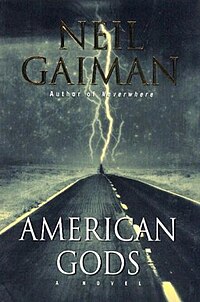
American Gods by Neil Gaiman.
Without a doubt, one of the best books I have ever read, there is a reason why Neil Gaiman is one of the heavyweights of fantasy. I was familiar with Gaiman in general, though sadly I had not read anything of his until this book; he is credited with writing what is probably the best episode of Doctor Who of all time (The Doctor's Wife). This book is complex and thoughtful with a large mythology but enough magic that suspends my need to have all my questions answered. Shadow, the main character, has just been released from prison after a few years and is trying to make his way in the world once more. Along the way he meets the mysterious Mr. Wednesday who wishes to hire Shadow as a bodyguard, more or less. Wednesday, a prolific con man, takes Shadow across country, introducing him to his incredibly colorful friends. Eventually the crux of the novel is revealed to Shadow, though the audience has already caught on. Mr. Wednesday and his friends are gods from the old world, transplanted to America by immigrants and travelers because--quite simply--they believed in them. People carry their gods wherever they go and thus gods from Viking mythology (Mr. Wednesday is a specific iteration of Odin), Egyptian myth (Mr. Ibis and Mr. Jaquel), Slavic myth (Czernobog), African folklore (Mr. Nancy), and even Native American traditions are scattered across the American landscape. But the old gods, as they call themselves, have a problem: they are dying in the face of the new gods of technology and media. America, we are told, is a bad place for gods. What ensues is a cosmic con and battle in which Shadow is part hero, part sacrifice. As a student of religion, the take on how the gods still survive in a land such as America was fascinating. How are mythologies and the figures of those myths transformed in new places? Can myths of the old world that so informed a people and a culture of long ago survive in land fueled by "new" and "innovative?"
Overall grade: A+ (Just read it!)

The Fault in Our Stars by John Green
If you look at any list of the top YA fiction for 2012, you'll find this book. Chances are if you look at several lists for the best books of 2012, this book is on there. For a time, you couldn't turn the corner in a bookstore without running into TFiOS. I have to admit, I was already predisposed to like anything John Green wrote, even though I was rather late in the game with reading this book. When he's not writing compelling young adult fiction, John Green is one half of the YouTube channel, the Vlogbrothers with his brother Hank, who have been trying to decrease world suck since 2007. I've been a member of their community (the Nerdfighters) for sometime. Communicating with mainly teenagers and young adults a few times a week, it's no surprise that Green knows how to write a book that is both funny and heartbreaking and altogether real. TFiOS tells the story of two cancer patients, Hazel and Gus, who meet in a support group. Sounds depressing, I know, but this not a cancer book. A cancer book would have our two young heroes struggle through their disease, coming to accept it and learn the value of living life to the fullest before quietly making peace with their inevitable death. No so with Hazel and Gus who are sarcastic and quick witted and who hate everything about their cancer. Life is not a platitude and knowing pain does not increase your feelings of joy. Hazel recognizes that someday, after she dies, she'll be forgotten, just as everyone else will. Oblivion is there, accept it. But along the way, these two souls find one other and even though they know that their deaths will affect the other in horrible ways, the choice to love one another was a simple one. You will laugh and you will cry and this book will stay with you.
Overall Grade: A

Divergent by Veronica Roth

In the wake of wildly successful and popular Hunger Games, it seems that post-apocalyptic dystopia novels are everywhere, and mostly found in the Young Adult section of the bookstore. The Divergent series follows in that wake. Dystopian literature is a personal favorite, Brave New World being one of the high school books that I actively remember and one that stayed with me. However, I remember hesitating before finally picking up this book: how could it be better than the Hunger Games (which is simply phenomenal, even though I don't agree with the ending)? However, Roth takes a different approach than Collins with her heroine; where Katniss knows that her society is tragically flawed and wrong, Beatrice Prior (Tris) spends the first half of the novel in passive acceptance of the society in which she lives. Somewhere in the not too distant future in Chicago, humanity has divided itself into factions based on virtues: candor, erudite, amity, dauntless, and abnegation. At the age of sixteen, a young adult chooses to either stay in the faction of their birth or leave for the one they feel fits them. Factions rarely interact with one another, so choosing to leave the faction of your birth possibly means never seeing your family again. Tris, born to Abnegation, is torn when the test taken at school reveals that she could potentially belong to several factions. This "affliction" is known as Divergence and is feared and prosecuted. Tris is told to keep it to herself for fear that she'll be harmed. What follows is a coming of age story as Tris struggles to accept her differences, her new faction, but also as she uncovers a plot that seeks to rip the society apart. Naturally there is a romance, though thankfully we are spared the typical love triangle that so often accompanies young adult literature these days. The concept itself is interesting though I found myself often wondering how someone could possibly be just ONE of those virtues and I have a sneaking suspicion that might be Roth's point, what drives her novel. Trying to separate out those virtues is next to impossible not only because of how hard they are to define but also because, for example, being brave can also mean being selfless or honest or smart. It's amazing more characters aren't Divergent. This is the first of three books, the third due out this year. The second book picks up where the first leaves off and then turns everything upside down so that the wait for the final book is close to excruciating. The middle section where Tris is learning how to be a member of her new faction drags on a bit and the secret plan she uncovers is a bit confusing, but it is well worth the read.
Overall Grade: B+

Miss Peregrine's Home for Peculiar Children by Ransom Riggs
An unbelievably strange book that combines myth, fantasy, time travel, pocket universes, and vernacular photography, this is a very interesting debut from Riggs. After the death of his grandfather, Jacob Portman is convinced that something terrible happened to the old man. His grandfather's stories of monsters and special children on a magical island seem the ravings of a senile mind until Jacob begins investigating. On a small isolated part of Wales, Jacob discovers a place pocketed away from time, where children who are "peculiar" live in a time bubble during World War Two. Some children can float, some can control fire, some have bees covering their face, and one child is even invisible. There are creepy monsters and an entertaining plot, but what really makes this book worth the read are the black and white photos sprinkled throughout. At first, I thought I would find them annoying but it's amazing how well they work with the narrative, fitting into the story at just the right moments. It was obvious that Riggs spent countless hours hunting down these photos to use, pouring through garage sales and personal collections. The photos are strange (like the cover photo of a girl floating) and are obviously "faked" but that is washed away in the explanation of who the children in the photos are. A very delightful read, I look forward to the sequel.
Overall Grade: B+

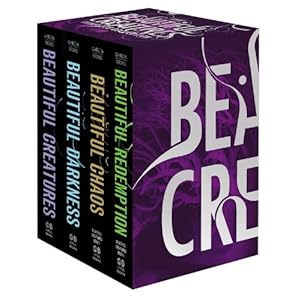
The Beautiful Creatures Collection by Kami Garcia and Margaret Stohl

 Vampires, werewolves, succubi, inccubi, magic, witches, prophecy, and Southern manners surround this series of four supernatural novels. Typical gender roles are reversed in this series; instead of the guy being the supernatural creature with whom the young girl falls madly and inconsolably in love, Ethan Wate is a normal guy living in the deep south, in a tiny town where nothing exciting ever happens and all he can do is hope to escape. That is until Lena Duchannes comes to the town of Gatlin. Lena, it turns out, is a Caster (witch) and a super powerful one at that. On her 16th birthday she will be claimed (against her will) for either the Light or the Darkness. If she goes Dark, chances are she will not remember her love for Ethan. On top of the world's worst birthday present, Lena's mother is out to make sure her daughter goes Dark. The series is supernatural mythology run amok. Every conceivable supernatural trope you can think of is present and at times not well put together. It felt, occasionally, like the authors simply inserted crucial new information at just the right moment for our heroes, but information which had never been even so much as hinted at in earlier pages. The first book--Beautiful Creatures-- is interesting and gets the series off to a good start. However the middle two--Chaos and Darkness--suffer heavily from "middle book syndrome," especially the former which I had to force myself to "just get through." The final book brings back some of the things I liked about the first book. Supernatural books are in high demand right now and there are stronger series out there, but setting the series in the deep south and then making the ideals and customs of that local like another character in the book does make this series stand out. Lazy summer day or beach read at best.
Overall Grade (as a whole): C

This is just a small sampling of some of the books I've read. I think I'll try to review most of them sporadically as I continue blogging. In the meantime, just go out and buy American Gods already!