Showing posts with label Star Trek. Show all posts

Tuesday, July 26, 2016

In Which I Review Star Trek: Beyond

Time; it marches on. Three years ago, one of my very first blog posts and, really, first review, was of the second modern Star Trek movie, entitled Into Darkness. I was pretty harsh, reading the review again for the first time in a long while, but deservedly so. It remains a lackluster remake of The Wrath of Khan, easily the most beloved and well made of the original Trek films. My anticipation, then, for the latest installment, "Beyond," was mixed. On the one hand, this is still Star Trek and since I was eight years old, I have loved Gene Roddenberry's world. I have loved its characters, ships, themes, morals, philosophy, heart, and meaning. From the Original to Voyager, there are few science-fiction franchises that mean as much to me as Star Trek. On the other hand, the second movie demonstrated that the writers and directors have only a passing understanding of what made Trek, Trek. If the second movie had been a standalone, no fifty year history with which to grapple, it might have been a more solid film, but the fact is that this movie, and all subsequent ones, are going to be judged by the vision, writing, talent, and views of Roddenberry. There are two questions we need to examine when viewing any new Star Trek film; first and foremost, is it a good movie? And second, does it live up to what Roddenberry envisioned when he pitched a TV show about space exploration many years ago? Grab your favorite red shirt and let's go!


General Thoughts

Can you get lost in space? I suppose, in a literal sense, yes of course you can. You find yourself on the wrong end of a magnetized polar variation and bam, you're stuck in the Delta Quadrant for seven years (no offense Captain Janeway). But what Star Trek: Beyond wants to tackle is whether a person's identity can get lost in the vastness and sameness of space; whether it's possible that the day to day living aboard a vessel can leave people questioning their own purpose and general direction in life and whether the solution is a new tactic or the same shtick ad nauseum. In other words, when things begin to feel a bit episodic (pun intended), what keeps us, and the fearless crew of the Enterprise, going at warp speed toward the next horizon? Those types of questions are explored in Star Trek: Beyond. There is a throughline in the movie that should the crew of the Enterprise break up, the individuals of the ship would cease to be the people they need to be. Uhura tells the main antagonist that there is strength in unity and the film goes to many great lengths, via both intense action sequences of everyone working together and quiet musings, to demonstrate that the team, the crew, and the sum total are greater than the parts. But what happens if individuals were to carefully remove themselves from the equation? Take away the linchpins and slowly people lose themselves. Kirk contemplates taking a Vice Admiral position; Spock wonders if he should aid in the re-population of New Vulcan. As fans of the Original Series, and just Star Trek generally, we know, of course, that Kirk and Spock (and Bones, Sulu, Checkov, Scotty, and Uhura) all belong with each other aboard their beloved Enterprise. We know that in another timeline Kirk did achieve the Admiral status and gave it up because his true love, passion, and reason for being is Captaining the Enterprise. In another life, Spock left Vulcan (twice!) to be with his friends. However, the crew members themselves are not privy to the same history that we have; they are living it, making the history we already love. They have to figure out for themselves that there is beauty in the episodic, a sort of mundane glory in wearing the same shirt day after day and recording the same sort of stories time after time; that while chaos gets the blood thrumming and the heart racing, it's the day to day adventures, twists, turns, and sometimes negotiations gone horribly wrong that are their first and best destiny. With that in mind, it's easy to see how Star Trek: Beyond is a coy wink and a nudge from the writers to the fans. This "episode" might be on a much grander and more blockbuster scale, but the script and plot could have come, broadly, from any individual episode of Star Trek (take your pick for series; they all have episodic one-offs). While the crew of the Original Series Enterprise never engaged in this many space battles, the crew landing on some far off planet and dealing with someone who's own ideas stand opposed to the Federation, but is dealt with by Kirk and company, feels all too familiar. The broad strokes of the story could have played on a smaller screen and been a perfectly fine episode and that's what we're dealing with here. The writers want us to love the episodic, to embrace the formula that their Star Trek series is going to stick to. Just like Kirk accepts the glorious mundane, so too we accept and love the comfort of the known. It may not be fresh, innovative, or groundbreaking, but it will feel like the Star Trek you watched as a kid. Even with the many space battles and inexplicable lens flairs.

While the interpersonal relationships between the crew and the broad strokes of the plot might be served by this episodic approach, it fairs less well with its main villain, Krall. So far, in all three new Trek movies, the villains have been fairly uncomplicated, barely fleshed out baddies with a penchant for growling lines, quick sob stories, and in every case, a Magical MacGuffin weapon that simply must be stopped before it destroys the Federation, the ship, the crew, ect. This is where the new Trek runs aground; the villains in the many TV series tend to be much more complex than simply "bad guy;" this is usually because their villainy is couched in some sort of understandable humanity. They worship a computer thinking it a god because they do not know better; they were chemically poisoned by a flower to experience euphoria and forget their Starfleet or scientific mission; they are trying to save their race; they are trying touch their creator and feel that humanity stands in the way. There are "bad guys" who do what they do fully understanding that they might take a life or harm another, but their motivation behind said action is sympathetic if not empathetic. The Cardassians are bigoted nationalists who colonize other races, but is their spread through the galaxy, trying to instill their way of life, all that different from humanity's; is Gul Dukat nothing but a black hat baddie? That's the nuance of Star Trek. To bring this back to Star Trek: Beyond, Krall is about as rote and transparent as it gets. He wants to destroy the Federation because he's a solider and because he's angry. Going into details would constitute a major spoiler, but having a villain that is like all the other villains that came before him only makes him fall even flatter than would have on his own. The episodic nature might be great for some parts of Star Trek: Beyond, but I wish the writers would have pushed themselves in the Krall-regard. Why might someone loathe the Federation? In Roddenberry's world, the Federation was akin to a utopia; everything worked in harmony because humanity learned hard lessons from its past--slaughter, eugenic wars, famine, greed were all overcome--and had made a better place that the Federation wanted to share with everyone else among the stars; that is all well and good when you're inside the system but for those outside looking in, the Federation can seem insidious (like Root Beer, if you ask Quark and Garak at the DS9 station) and just as much a colonizing swarm of insistent bees as any other. Here in 2016, it's great to have a classic Trek episode to watch when it comes to the how the crew understand themselves and each other, but it's past time that this new franchise begin to explore villainy in all its complexities. A person's reasons for wanting to destroy a race or an organization should never be boiled down to just one root cause; it's a disservice to the complicated and multi-layered reasons and psychology behind not only conflicts but the people embroiled in them and to be perfectly blunt, Star Trek is better than that.

What I Liked And Did Not Like

--If this movie did one thing exceptionally well, it was mixing up the normal pairings of crew members to allow those not often seen together a chance to play off each other. The heart of the franchise will always be the incomparable trio, but too often the other crew members are sacrificed for the relationship between Kirk, Spock, and Bones--and quite often even my dear Bones gets the short stick. The movie took a chance by having Kirk working with other people and keeping Bones and Spock together for a change. It worked! One of my favorite episodes from the Original Series is "Bread and Circuses" in which Spock and Bones have some time apart from Jim and you really see that while they might be wholly different in terms of philosophy, they still care for each other a great deal and would die for one another if they had to.

--"You gave your girlfriend a tracking device?"
"...that was not my intent."

--The moment when Spock opens up Spock Prime's belongings and finds a picture of the Original Crew tore my insides up and it was all I could do not to cry in the theater. It keeps with the throughline of being your best self with others but it was also a very nice acknowledgement of the past history.

--Modern day science fiction has a nasty habit of thinking that it needs big battle sequences in order to be classified as Science Fiction. Nothing could be further from the truth and if you go back and watch many episodes of Star Trek (again, any series) you'll see that big battles in space are few and far between. Star Trek is more philosophical and introspective than constant torpedoes. While I understand that a big summer blockbuster is going to have at least one action sequence, having more than 4 in a two hour movie wears on the eyes, the ears, and patience.

--Props to Simon Pegg, who co-wrote the movie, for putting the humor back into Star Trek. There have always been witty exchanges among the Star Trek crew; in the last film that felt decidedly lacking.

--I suppose I need to address the Sulu controversy. Yes, in a very brief scene it is established that Hikaru Sulu is gay and has a husband and child. This was done to honor George Takei, the original Sulu and outspoken LGBT advocate. I have no problem with Star Trek having a gay character and, frankly, it's really about time. But I don't think, in this case, it was done for the right reasons. Star Trek is all about progressive views on society, showing the audience how humanity could be if it could just overcome its pettiness concerning religion, race, gender, sexual orientation, and ethnicity. While having a gay character is progressive (sort of, it is 2016 after all) it wasn't done as a demonstration of progressive attitudes but to honor one man and his lifestyle. It's not supposed to be about Takei, but about Roddenberry and his world view. Next time, create a whole new character, gay and fleshed out, so that we might see the progress.

--I think the film writers want me to be impressed with the Jaylah character but while she's a "tough female character" she's also in the mold of what men think a tough female character should be. In other words, they give them hallmark male characteristics--fighter, handy, intrepid, tough--and expect us to applaud their feminism. While women are certainly all those things, feminism isn't about taking male characteristics and simply putting a vagina on them. It's about who controls the female's agency--her or a man. Jaylah might be a pretty tough fighter and she certainly plays a part in the grand plan to get off of Krall's planet, but she's heavily reliant on the male Starfleet officers to progress her story off the planet and, in the end, into the academy. Cool makeup, though.

--Some nice canon touchstones like reference to the Xindi wars and Jim Kirk not wanting to celebrate his birthday (but Bones really should have presented him with some Romulan ale and Spock gifted him a copy of A Tale of Two Cities).

--I honestly have no idea why this movie is called "Beyond."

--For the next Star Trek film, should there be one, I'd like more exploration before the problem falls into Kirk's lap. One of the best things about the franchise is the creative imagination that spawns brand new worlds, new races, and let's us traverse a new landscape. Going along with this, please stop destroying the Enterprise. It doesn't have the same emotional impact as when Kirk blew it up in "Search for Spock" because unlike that ship, this rebooted one doesn't feel like one of the main characters. The original ship, in all its NCC-1701 glory, was "a lady. You treat her right, and she'll always bring you home."


Final Ratings for Star Trek: Beyond: B

It's very much a summer blockbuster but because the story feels more like a classic episode of a most beloved franchise, it evens out all the very tedious fight scenes and dull villain. It's still Star Trek, after all, and that will always mean something.

Saturday, May 25, 2013

In Which I Review Star Trek Into Darkness

Confession: When I was eight, my dad introduced me to Star Trek. It was our bi-monthly weekend together and he asked if I wanted to watch his favorite TV show with him. I wasn't sure what to expect but ten minutes into The Devil in the Dark I was hooked. It was weird and kooky and strangely compelling. As an eight year old I doubt I was able to grasp the deeper meanings and philosophical discourse Roddenberry was trying make, but the monster and storyline were cool--which is really all an eight year old needs. We spent the rest of the weekend held up in the basement, several large pizzas at our disposal, watching the original series. That was my first introduction into the world of science fiction. 


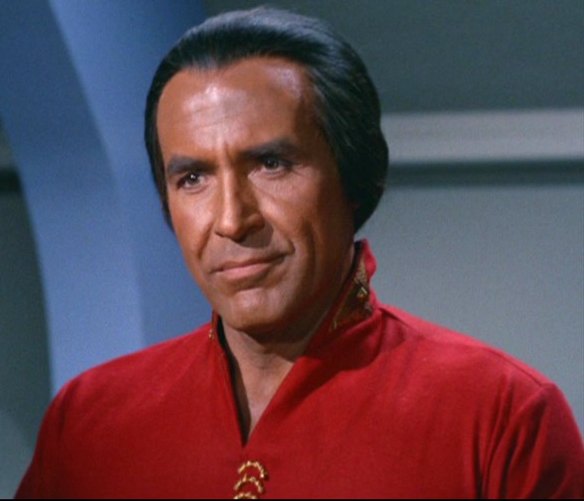
Unless you've been living under a rock the past few months, there was no escaping the news that a new Star Trek movie was hitting theaters early summer 2013. This newest installment in the now 45+ year old franchise is entitled Star Trek Into Darkness staring Chris Pine, Zachary Quinto and Benedict Cumberbatch. In the months leading up to its release, the big question remained: who was the villain? Given that this movie follows the 2009 Abrams movie Star Trek, in which we meet the main cast--the original crew of the Enterprise with shiny new toys-- many of the fans expected the sequel to follow the original iterations of the franchise, meaning that the villain for this movie would be Khan Noonien Singh--a genetically enhanced ubermensch who attempted to kill Kirk and his friends and steal the Enterprise.

I can't be the only one who didn't want Cumberbatch to play Khan. It's not that Cumberbatch wouldn't do a standup job; his talents as an actor are many--from creepy pedophile in Atonement to the high functioning sociopath detective Sherlock Holmes in the BBC's brilliant modern adaption Sherlock--Cumberbatch steals every scene he's in. His deep tenor voice, piercing stare, and ability to deliver lines in a cold, calculated manner made him the ideal candidate to play Khan. But when the 2009 movie came out and Orci and Kurtzman's excellent script set down a new timeline, one full of new possibility to again go where no man had gone before, I fully expected they would live up that potential. Instead of rehashing old stories that, let's face it, are never going to compare to the original simply because the originals came first and are thus indelibly imprinted on the hearts of fans, they had a whole new world to play with. This movie strikes a blow to all that creativity.


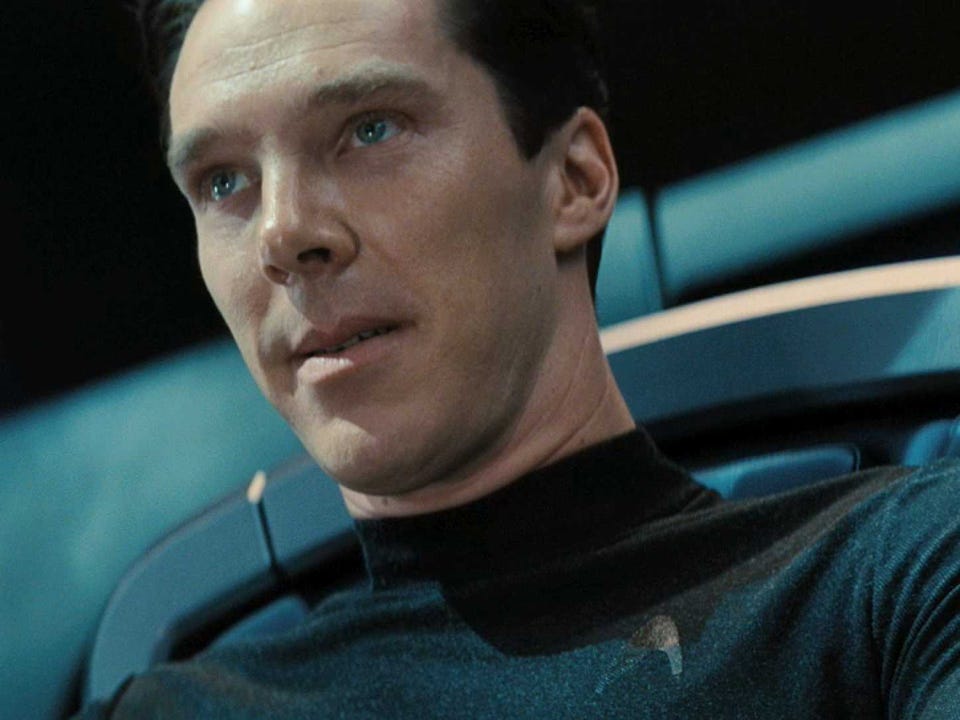
For the first third of the movie it looked like all the rumors that Cumberbatch was playing Khan were unjustified. His character, John Harrison, was simply a rogue Starfleet officer who blew up buildings and stole things but also saved dying little girls. Fleshing out this original character would have been far more interesting than the (predictable) revelation that John Harrison was a pseudonym and this cold and calculating individual who could remain standing after Kirk's attempt to beat him to a pulp... was Khan.


The second two thirds of the movie attempted to put Space Seed and Star Trek II: The Wrath of Khan into a blender and produce a smooth mixture of the two. It didn't work. None of the ideas present in the original TV episode or movie were developed fully. The TV episode is about the dangers of genetic enhancement, about trying to become god-men and how human beings need their flaws rather than to become Supermen. The movie demonstrates the importance of sacrifice (more on that below), ideas of power and technology, creation and destruction, and the simple yet powerful notion that simply being cleverer, thinking outside the box and in more than one dimension are enough to conquer foes. In the end of the original movie, Kirk defeats Khan by, yes firing at his stolen spaceship, but more importantly, by out thinking him. In the 2013 version, Spock defeats Khan by beating him senseless, breaking his arms, while Uhura repeatedly fires a phaser at him.

When did science fiction become all about explosions, gun fights, space fights, and violence? To be sure, in Space Opera, a good fight scene has always been a part of the genre. But did they always last for 10 minutes? Where are the quiet moments of philosophical reflection? One of the best parts of the classic Star Trek are the moments between Kirk, Spock and Bones in which they discuss what is morally right versus what is legally right and how best to serve multiple masters. Spock's logic and Bones's compassion--while at times antithetical--serve as guide posts for Kirk in his quest to be the best captain possible. These new Stark Trek films (the first one I loved) focus more on the relationship between Spock and Kirk and leave Bones as the awkward third wheel, who's only job is to provide snarky comments. His character has been so reduced, I struggled to see the original Bones. And while the writers can claim "new timeline, new character traits" they are clearly not following their own sage advice as this movie was simply a remake of a previous character. Cherry picking pieces of canon and not other is a bad move to make.


In an attempt to make a not-so-thinly veiled reference to the original Khan movie, one of the climaxes of the movie finds Spock and Kirk on opposite sides of a glass door, radiation contaminating one side. If this sounds familiar, it's because it is. It is one of the most poignant, heart wrenching, shocking scenes in Star Trek--the full scene can be viewed here. By this point in Wrath of Khan, the relationship between Spock and Kirk is 15 years strong and an important element in popular culture. As a young girl, seeing Wrath of Khan for the first time, I was floored. I did not understand how they could kill Spock. Watching that beloved character die was traumatic. Not so in this new iteration. Instead of Spock dying, the movie writers switched our principle's, letting Kirk do the dying. It failed on multiple levels. While Pine and Quinto do William Shatner and Leonerd Nemoy credit, they've only been playing these iconic characters for 4 hours on screen--2 of which were spent loathing each other. The relationship between these two is not strong enough yet to warrant such a death scene. But perhaps the most irritating thing about this scene is not the bastardization of the classic, but how Kirk is revived (you didn't think they'd really kill him did you)? In the original, Spock's rebirth is carefully thought out--science and technology going hand in hand to give life where there was lifelessness. This new movie uses one of the worst plot devices known to modern man: the Deus Ex Machina.

In Ancient Greece and Rome, the Deus Ex Machina was perfectly acceptable. Lowering a god down to solve all the problems of the common man played into the overall outlook of life. However, I am deeply disappointed in how Kirk's death was resolved: magic blood provided by Khan himself (taken forcefully of course). It's poor writing. Does this mean death is forever cured? That Starfleet can now bring back anyone from the dead? Did they use it to revive all the souls killed when the ship crashed into San Fransisco? This is the problem with the Dues Ex Machina; it raises more questions than it solves.


The magic blood and death scene were my two biggest complaints overall. But controversy surrounding one scene should also be brought up. At one point Carol Marcus, played by Alicia Eve, is changing into new gear, preparing to go outside the space craft. As she is changing, she repeatedly tells Captain Kirk not to look--an order he fails to obey, ogling Carol, scantly clad in her black underwear. In the original series, Kirk is a bit of a ladies man. It's annoying, but it's 60s science fiction. Things have progressed since then--you may have heard of something called the feminist movement? What I found disquieting about the scene in question is not Carol in her underwear, it's Kirk's looking at her when she has told him not to. In that moment when he turns around and stares at her, Kirk has removed Carol's own agency to have control over her body and who gets to look at her. He has reduced her to an object that he gets to find pleasure in--whether she wishes it or not. It's a dangerous precedent, especially in a culture where rape and objectification have yet to--quite simply--go away.

Other complaints about Star Trek Into Darkness (briefly)
--The Nibiru expedition at the beginning of the movie would have been a better plot for this movie. THAT scene felt like a classic episode of Star Trek in which our crew finds new civilizations and explores them (it's almost as if that's the entire point of Star Trek in the first place....*sarcasm*)
--The Enterprise underwater. Because it's okay to ignore science in science-fiction now, apparently.
--Klingon's for no apparent reason, other than say "Hey! Look! We gave you Klingons!" (in battle helmets!)
--Time jumps. Did Starfleet do anything about the plot Admiral Marcus concocted that would bring about war with the Klingons? We'll never know because the film suddenly jumps a year.
--"Where no ONE has gone before" *sigh* Writers, I'm sorry but until you get Next Gen it's "where no MAN" has gone before. Ok? Leave the saying alone.

Things I liked about Star Trek Into Darkness (briefly)
--It is funny. While Bones may be tragically underused, he does get some of the best lines.
--As simply a movie, it's decent. It's fast paced with great acting and fantastic visuals.
--Simon Pegg as Scotty. In the 2009 film he was given very little to do. This time around they used Pegg brilliantly. 
--Cumberbatch, Cumberbatch, Cumberbatch, Cumberbatch. Even though I wish they had made him an original villain, Benedict Cumberbatch shines in this film.


Overall Grade: C (see it because it is Star Trek after all but then go home and watch Space Seed and Wrath of Khan on Netflix)