Sunday, May 7, 2017

In Which I Review Doctor Who (10x4)

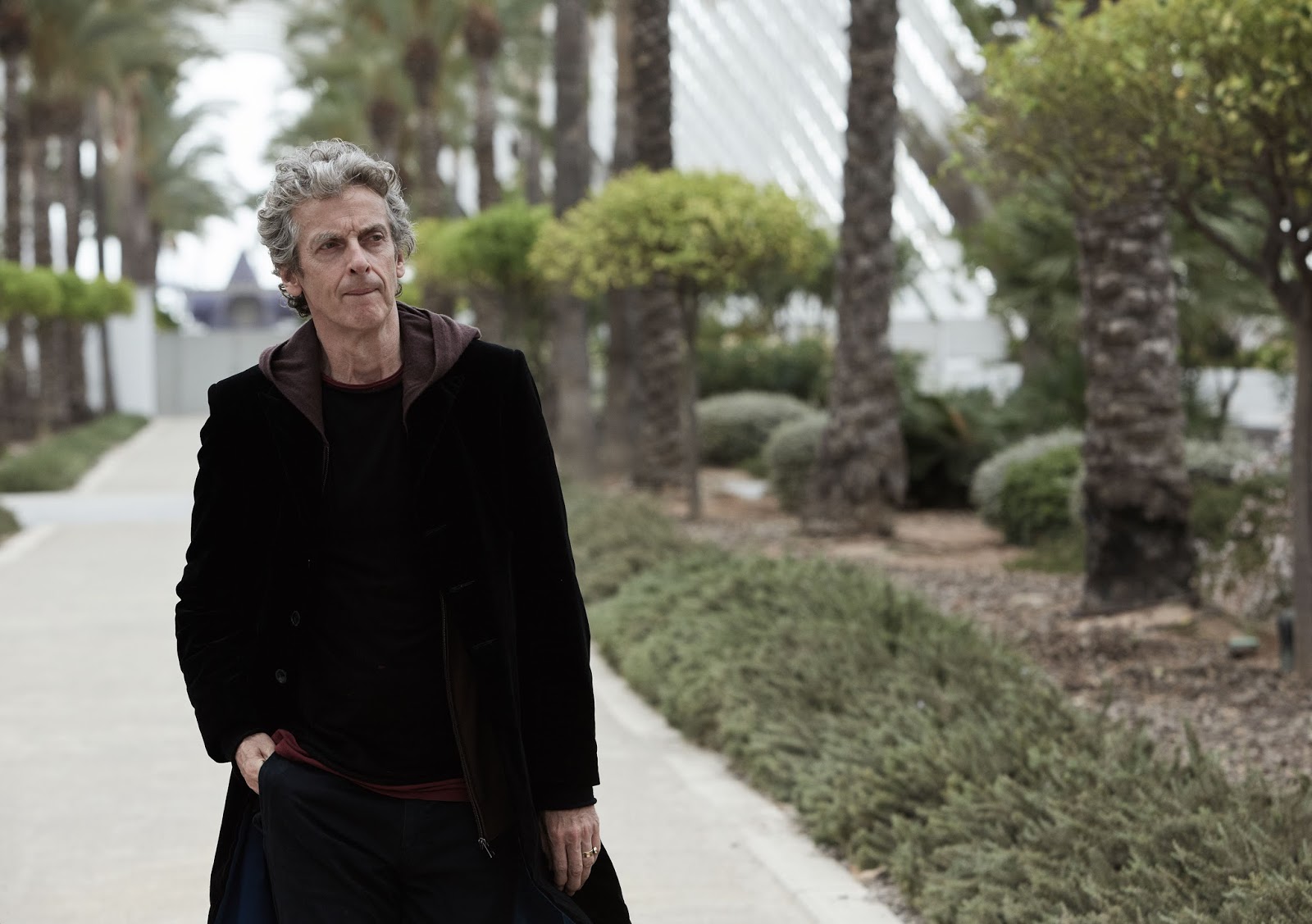
So, to review, in the first three episodes this season, the Doctor and Bill have had a modern day introductory and opener, a futuristic space romp, and a journey into the past. In other words, all the classic formats Doctor Who is well versed in when a new companion enters the scene. It sounds like it's time for the Doctor and his companion to head home and touch base with the here and now and that's exactly what this week's episode "Knock Knock" does. This is another good, solid and canon compliant episode that is filtered through still another classic lens: the haunted house trope. This isn't the first episode, even in modern Who, that tackles ghosts, ghouls and a house that creaks an inordinate amount. Doctor Who likes to flirt with horror as much as is it does science-fiction and fantasy; like the Doctor and his blue box, it doesn't need to stay in one place for very long to make an impact. It's a fun and spooky ride this week so let's stare hard at those wooden fixtures and go! 


Like the episode "Smile," this week's story does not need to be overthought. All the hallmarks of any good spooky haunted house caper are here: a giant empty home, a creepy undertaker who's probably at fault when it comes to whatever the attractive, unsuspecting, and young adults find within the walls of said house that, on the surface, just seems to good to be true. Honestly, all that's missing is a talking brown dog and someone yelling "zoinks!" There isn't anything revolutionary here and certainly this type of episode has been done before, like season seven's "Hide." "Knock Knock" does have a bit of twist with the denouement of how the landlord and the wooden figure, Eliza, are related to each other. One would suspect the landlord to be a father trying to preserve his young daughter, not only because it's what the landlord actually tells the audience but also because it's an easy TV trick to gain sympathy for someone made out to be a villain. The fact that the family ties are opposite--a mother and her son--is a nice neat turnabout that, likely, most of the audience wouldn't have seen coming. If there's one major complaint--and to be fair, it's not a major major complaint--it's that this episode separates Bill and the Doctor for too long of a period. This prolonged separation does show how the burgeoning chemistry and combined quick wit of the two are an integral part to making a solid episode into something more but Bill on her own--or the Doctor with someone else--is nothing to scoff at because both characters are pretty well defined as is. If there is one nice through line, it's in the comparison of the Doctor and Eliza, the wooden mother who is living off the matter and energy of the tenets her son brings to the house (yes, there's a bit of a heavy-handed metaphor here that the Doctor is "living off" the young companions that the TARDIS or fate bring him). But tellingly, it's the Doctor's plea to the wooden woman that there's no point in surviving if you're going to lock yourself away that directly proceeds the Doctor telling the figure behind the Vault that he's a prisoner of this planet. There's no point for the Doctor to survive forever if he's locked away in an Earth-based university. For whatever reason, the Doctor has made a really out of character oath to stay put on Earth and not use the TARDIS--an oath he's since broken with Bill. Much like Eliza, the Doctor is living half a life, not a full one. But where Eliza chooses to move on, to end the horror she and her son have inflicted on poor students, the Doctor is grasping the TARDIS consoles with both hands, going back out there to the vast and wonderful tomorrows and yesterdays like he was always meant to.

Miscellaneous Notes on Knock Knock 

--The figure behind Chekhov's Vault seems delighted that several university students got eaten by space lice. Definitely the Master, then! But which one--Simm or Gomez?

--I think I shall say this every week until we get an answer but what exactly is the point of Nardole? Especially when the Doctor and the Vault seem to be enough to keep the figure locked in the Vault?

--This episode makes clear that Bill did not know what a Time Lord is or that they regenerate. She does learn about the former but the latter remains elusive. Since Peter Capaldi is leaving, I guess Bill is going to get the "surprise!" regeneration.

--Speaking of, Peter Capaldi is such a delight especially with his awkward and quiet humor, like crunching a chip at an inopportune moment.

--Yes, Bill. The Time Lords did wear funny robes and big hats.

--"I'm scared." "Don't be." "Why not?" "It doesn't help."

--The bugs were creepy as hell; like bedbugs on steroids.

Tuesday, May 2, 2017

In Which I Review American Gods (1x1)

Do you have a book that you can't escape? I mean that in a good way; I mean a novel that stays with you, one that you find yourself thinking about at odd moments, no matter how long it has been since you read it? There are several books like that for me but unquestionably and without stretching out this preamble, one of them is Neil Gaiman's American Gods. I picked up a copy of the book several years ago, being a fan of Gaiman's work in general and thinking the book would serve as a palate cleanser since, being in grad school at the time, I needed breaks from the academic books I was pouring over. I read the entire novel in less than a week and only glanced occasionally at my thesis. It was that good. The novel, and now the TV series, explores gods, myth individuality and cultural belonging and the relationship between all of those and America, a land where old and new gods rise and fall, rise and fall. The opening episode, "The Bone Orchard," invites the viewer in, to take them on a wonderfully weird journey. It's well worth our time to follow Mr. Shadow Moon and his new friend Mr. Wednesday. Let's go! 


What is a god? When I was graduate school, we had to try and tackle this question one day. You'd be amazed at the amount of tongue tying that happened as people attempted to define something that is largely undefinable. Is it a person? An object? A concept? For example, if I were to try and define god by saying "a god is a person..." then does that take away something of the majesty and grandeur that goes alongside the word god? Or if I were to define god by saying "a god is an object that is worshiped by a person or persons" then how does that fit into a religious idea that gods help, hinder, and, at the very least, interact with the other non-god people? Can an object actually have agency in your life? Okay, you might be thinking, then god is a concept representing a higher plane of existence completely outside the realm of human understanding and, to quote one of my favorite discussions on godhood from the TV show "House," penguins might as well contemplate quantum physics." But, I retort, if god is so outside of human understanding, how can we worship something that doesn't at least resemble the human condition and experience? And is god on the same level as other intangible concepts like love, justice, truth? And what about all those tales--both of a Christian and non-Christian tradition--that have a god or gods entering the human realm and interacting with mortals in very human ways. God as a concept is easy to accept because it's easier than trying to parse it out, but when we do try to parse it out, we fall woefully short; and, of course, we haven't even begun to tackle the super heady question of is/are god/gods even real or are they merely a metaphor for or simply a natural byproduct that happens when humans need someone to blame, believe in, argue about, or be the answer to the questions we have about the world and universe. American Gods wants to tackle these questions though it's less so the question of being real and more the question of what being real means to a god and how they define their realness and, very importantly, how they fight to stay real. In the western world, our definition of god usually includes an idea about immortality and being forever but for the gods that populate this America--the very real, walking, talking, smoking, cursing, fucking, obscene, profane and sacred gods--mortality is an all too real thing, breathing down their necks with every forgotten prayer and sacrifice. I do not want to get too ahead of myself or the show since I know I may have readers who have not read Gaiman's novel (what are you waiting for??) so let's actually move past this attempt to understand the metaphysical and dive into what the pilot episode is presenting.

“Nobody's American," said Wednesday. "Not originally. That's my point.” The idea that America is--and always has been--a country of immigrants is central to the main conceit of American Gods. There is a very popular metaphor that America is a melting pot but this has always rung false to me. America is not a homogeneous mixture but more of a fruit salad. Put all the ingredients together and you get a fruit salad but you can clearly pick out the lettuce from the apples from the orange slices. We like to think that America is blended to the point that each individual portion is unrecognizable from others, but we have always divided Americans by a variety of facets: race, gender, sexual orientation, ancestry, and, most importantly, in the case of American Gods, religion. In this country, even if you aren't looking very hard, you can find Christians, Jews, and Muslims (these first three having various subsets found within), atheists, agnostics, Buddhists, Hindi, ect. If you move back into the far past, you'll find the religions of Native Americans and various original settlers, even if those were just passing through. Every time one of these immigrants came to the shores of America, they brought with them more than just the clothes on their back. They brought their gods. The pilot episode doesn't want to give away much about this idea except in noting that when the Viking settlers came back to the shores of America one hundred years after the first visit "they found their god waiting for them." The episode, instead, prefers (wisely) to stay with our protagonist Shadow Moon, and so I too shall follow in the show's footsteps but the pilot is not totally without overt godly imagery. A tall Irish bloke named Sweeney claims to be a leprechaun (that midget idea is just a vicious rumor!) and somewhere out in Hollywood a beautiful woman named Bilquis swallows a man with her vagina which is pretty inhuman. However, let's focus on Shadow since we have acknowledged that the gods are waiting, biding their time out on the edges of our story. Shadow Moon is a hardluck hero if ever there was one. He's spent the past three years in jail; his wife dies while screwing his best friend and it turns out that he has neither money nor job to go home to. Shadow's meeting with the strange (and delightfully cheeky) Mr. Wednesday on an airplane is about as unromantic a call to adventure as they come, but that's what it is. The hero's journey begins the same: a divine force, or an agent of the divine, invites the would-be hero to come enter their world, which by default is not the same as the one the hero is currently suffering through. In this case, Mr. Wednesday needs an errand boy, someone to use violence when called for and (oddly) someone to sit vigil for him, should he perish in his whatever-they-are-endeavors. It's not exactly Princess Leia's plea for help in droid form. Shadow himself isn't a typical hero; he's an ex-con! He's clearly done bad things in his life; he's not a wide-eyed noob and he does not find this new world of blood, guts, weird dreams, and technology boys who smoke synthetic frog skins amazing. If anything, Shadow's introduction to the world is really alarming and like any sane human being, he wants to run from it. He finds Mr. Wednesday neither charming nor endearing; he sees Wednesday for what the old man is (sort of): a too-talkative grifter. Shadow's a good salt-of-the-earth kind of guy which really makes you root for him automatically, complicated flawed past and all. Shadow only becomes Wednesday's errand boy because he lost a bet. He's a reluctant hero and that's smart, both on Gaiman's part and on the show's part. No one wants to enter this world, especially when the world comes with this level of bloodshed. Even if you don't know about the gods, there's clearly something off about a man who is a self proclaimed cheat, thief, and trickster needing your help and making you swear (over mead of all things) to sit his vigil if he dies. I'd run far away too. Shadow, in other words, becomes a really good surrogate for the audience who are all probably just as confused as he is here in the opening act of our story. Hang on, Shadow. It only gets weirder.

Miscellaneous Notes on The Bone Orchard 

--I don't think I've been this excited to review a show in forever. I hope to have these reviews up after every episode, but it may be every other week (sort of a la Westworld).

--The opening credits were perfect; a harmony of new and old bringing together classic religious iconography (the Buddha, the crucifixion) with the new (neon, machines, drugs).

--The Bilquis sex scene was spot on.

--Ian McShane is doing god's own work as Mr. Wednesday and Ricky Whittle isn't far behind.

--"Even a salad would do."

--Mr. Wednesday is right...Shadow Moon is "one outlandishly improbable name!"

--There's a lot of social commentary woven into this episode. It's not subtle but the show doesn't need to make their visual cues into text by having characters comment on it, which is welcome since other TV shows are using some of the same motifs but going out of their way to talk about said motifs. For example, the episode is book-ended by two heavily violent scenes against some sort of "Other." To open we have Viking immigrants who come to the new world, hungry and miserable, and met with hostility and violence. To close we have a black man strung up a tree, lynching style, by "men" who appear to be Caucasian.

--I am thrilled that this opening episode included one of my all time favorite quotes from the novel: "We have reprogrammed reality. Religion is the operating system and prayers are just so much fucking spam."

--"You're just the first person I've talked to who wasn't an asshole." "Give me time."

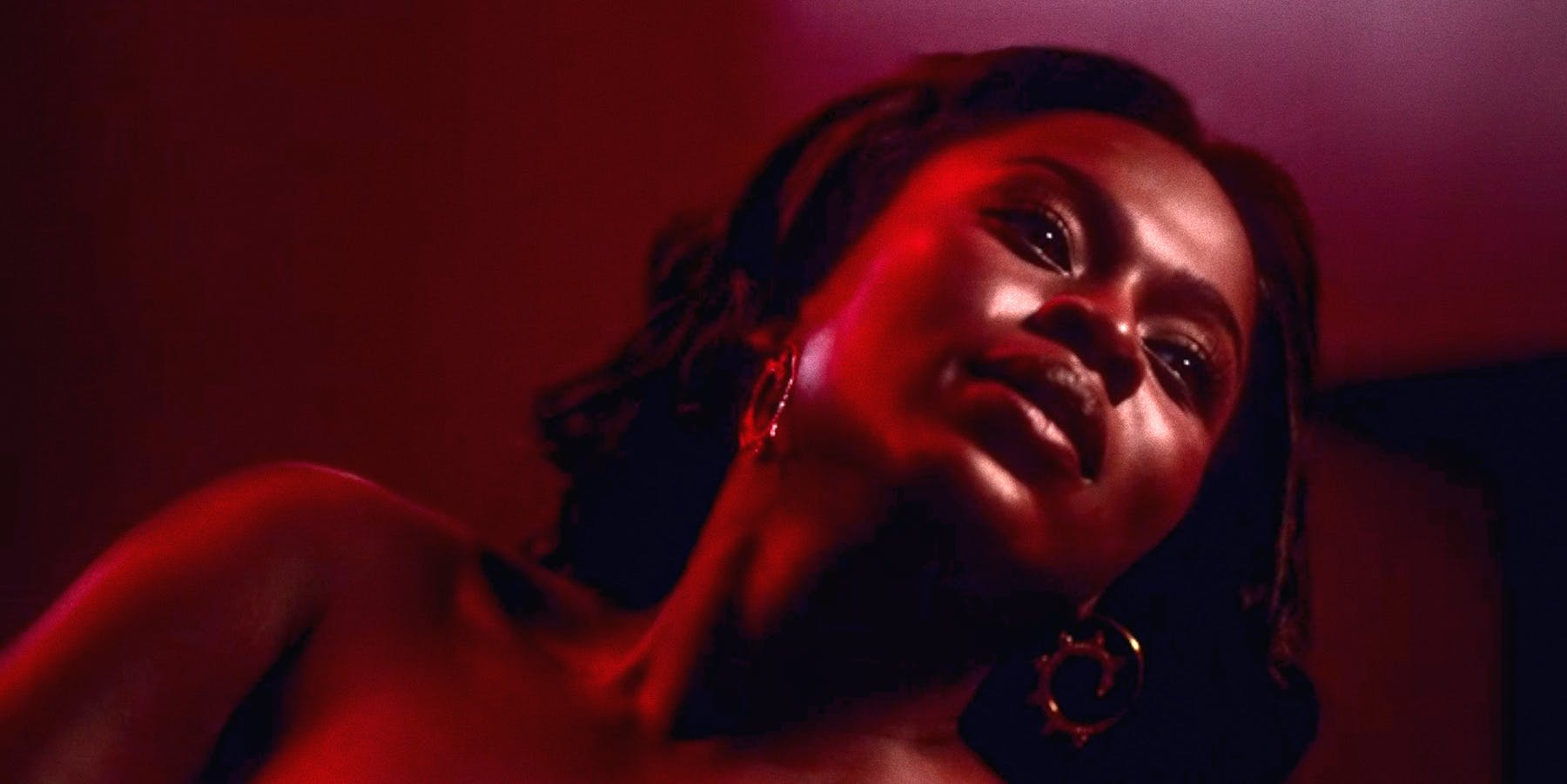
--Know Your Gods: I'd like to try something in these reviews since my background is in comparative religion. Every review, I'm going to pick a god who was featured in the episode and highlight some of their stories. I am not an expert in all world's religions but I have enough in me (I hope) to talk a bit about each of the characters. This week is Bilquis in what was easily the most memorable scene of the pilot. Bilquis is probably known to you by a different name: The Queen of Sheba. She's found in Jewish, Christian, Islamic, Ethiopian and Coptic traditions and has become one of the more well known female figures, known for her wisdom, her faith, and her riches. Her stories differ but the one that usually stands out is of her one night of passion with King Solomon. The story goes a little something like this: King Solomon needed materials to build his grand Temple in Jerusalem and upon hearing reports about all the fabulous things in the capital city, Sheba went to see them (and Solomon) for herself. The two apparently got on like a house on fire and (because this is how these things normally go) she converted to his religion before spending a magical night together though it's all done through clever trickery. She is given a ring as a token and, naturally, gives birth to a son on the way back to her own kingdom. Some myths have her as also being half-jinn which might explain the almost demonic, all consuming (pun!) need that comes over her worshipers when offered a chance to pay her homage. Because her most well known story involves sexual love, she becomes associated with other love goddess, someone who is worshiped as a sexual deity which obviously Neil Gaiman and Starz delightfully took up.

Monday, May 1, 2017

In Which I Review Once Upon a Time (6x19)

Rumplestiltskin says it best tonight when he points out that the fate of his family rests on a dark wheel of parents and children constantly torn apart and separated from each other. Malcolm sent young Rumple back to the Enchanted Forest alone; Rumple let go of Baelfire's hand; Henry grew up without Neal and Gideon spent the first 28 years of his life with a really demented and terrifying grandmother. In other words, Rumple certainly isn't wrong in this. One of the strongest, and to be fair one of the most overused, storylines on OUAT is the constant internal angst between parents and their children usually going alongside abandonment issues. Neal had them, Emma has them, Rumple, Henry, Hook, Charming, and even Regina have issues with mommy or daddy dearest. When it comes to this week's episode, "The Black Fairy," it shouldn't surprise to anyone that it too comes down to parents, children, the struggle to maintain power and abandonment. It's a song OUAT knows well, and giving credit where credit is due, it's a song they know to sing (no, this is not a clever tongue in cheek joke about what's happening next week.) Grab your fairy wand and let's go!


Will The Real Savior Please Stand Up (Please Stand Up? Please Stand Up?) 

I have pros and I have cons. Let's start with the pros, shall we? The main thrust of this episode is explaining why Fiona, aka Future Black Fairy, gave up her only child, Rumplestiltskin. It comes down to a messy prophecy about how Rumple was destined to become a Savior (yes, this is a big what the f....moment) but accompanying that is that fate of Rumple, the Savior, is to face off against a truly evil force with a crescent shaped birthmark and die defeating them. Because Fiona loves her son--putting it rather perfectly that this tiny babe can make you soft and sharp all at once--she tries like mad to prevent her son's ultimate fate by finding the child with the mark upon its skin. I'm surprised the show didn't go for broke and make the mark a 666 on the forehead, but I digress. All of this is of apiece with other parent/children relationships on the show in which parents are willing to sacrifice anything to make sure their children grow up loved and protected. Everything, as it usually tuns out, except their power which has long been used as a drug metaphor on OUAT. It doesn't take a genius to figure out where this iteration of the story ends up going. It's almost Greek in its conclusion: by trying to prevent the prophecy from coming to pass, Fiona turns herself into the Black Fairy, complete with a crescent shaped scar, and consequently into the great evil Rumple was supposed to face down. Unable to live with this idea, Fiona uses the Sheers of Destiny on Rumple and cuts his Saviorhood from the young baby rather than giving up her power, claiming she needs it to protect Rumple. The sudden appearance of the scar on Fiona's arm is a nice literal representation of the often quoted tagline from the show that "evil isn't born, it's made." Fiona made herself the Black Fairy by going to extremes to prevent a prophecy that never would have come to pass if she hadn't tried so hard to get around it. Like I said: it's all rather Greek. If this push and pull of parenthood vs power sounds familiar, that's because it is supposed to feel familiar. It's a very clear and neat parallel with Rumple and Baelfire or Cora and Regina or Rumple and Gideon. Power corrupts on OUAT; the more you have the more it corrupts until the character is addicted to it and can't see the forest for the trees. This circular storytelling isn't a bad thing largely because Robert Carlyle and Jamie Murray act their socks off to sell what really is a six year old story. It also reminds the audience that Rumple's strongest stories have always been as a desperate father; he's not truly evil and while he has qualities of a trickster trope, it's not his ultimate arc. He's become addicted to the darkness but everything he did was for his son, to prevent Baelfire (and Gideon) from having to suffer a worse fate than growing up with a Dark One father--death. It's villainy and it's heroism all wrapped up in a confused, angry, abandoned package (complete with a yellow knit blanket). It add another dimension to Rumple's angst that instead of just having a mother who abandoned him, he has a mother who changed his life, cut him off from "good" and because of that, Rumple's made choices to walk in the darkness.

However. While all the intent is good, the execution is sloppy, sloppy, sloppy. I continue to think that the writers aren't talking to each other or reading each other's scripts before sending them off to the cast and crew to shoot because there is a pretty big disconnect between what was telegraphed to the audience a few weeks ago and what we're seeing this week. Let's start with the timeline (an evil and vile word if ever there was one). We've been told by characters on the show, both with their words and with their reactions to any mention of the Black Fairy, that she's the most dangerous and most evil creature we've ever encountered. It seemed pretty apparent by Blue's reactions that Black was on the same level as she; that they, if this is even possible, grew up fairies together, that if Blue is the original (good) power then Black is the original (evil) power. And yet, based on the timeline we saw tonight, Fiona is only about two hundred years old, younger than Hades and the Dark Ones, including the first Dark One, Nimue, and only became a fairy about a week after Rumple was born by waving a wand around and saying some gibberish. Not only that but while the show has made it clear that power can corrupt, Fiona got awfully powerful awfully fast. Based on what Rumple looked like when Blue brought the baby back to Malcolm, Fiona had only been out looking for a crescent marred babe for about a month or two. And yet, Tiger Lily is unable to stop Fiona from going crazy or creating the Dark Curse? Also, we're supposed to believe that Fiona and Rumple are parallels in more than one way, namely that everything Fiona has done was for Rumple and she never stopped loving him; she even shouts that back to baby Rumple in the final flashback moment before she's sucked off into a glowing portal of doom. And yet this whole season, in the present day, she has come across as having no affections whatsoever for her son, being immune to any love she may have once felt. But once Fiona learns that Rumple has discovered the truth of his life, suddenly she want to join forces? This is to say nothing of the fact that we're only given a very brief glimpse of Fiona's own internal angst and we're not allowed to sit with her, inside her head on her terms, for longer than half an episode. I believe I've used this word a lot this season but it's all rather haphazard. It's sloppily put together and the writers are depending on the audience remembering the dilemmas faced by Rumple, Cora, Regina, ect who had similar stories that were done in a more developed way. But, just to end this on a positive note, I think this does bring us one step closer to Rumple's true moment of heroism (not redemption, just heroism) in which he chooses to die, even though it's no longer his destiny as a Savior. He said, at the very end, that everything he does is for Belle and Gideon and just like how he died fighting Pan for his family, he'll die fighting Mommy Dearest for them too.

Miscellaneous Notes on The Black Fairy

--"That’s the problem with Saviors, isn’t it Ms Swan? Not quite as helpful as advertised."

--Emma talking to Rumple about the pain of abandonment was well done. It brought to mind some moments from Manhattan when Neal tried to say the same thing.

--To wit: "No curse, no monster, is ever going to be as terrifying as finding out why you were abandoned."

--Storybrooke has an Ikea?

--Every time the writers say “many years ago” it basically means “we don’t know nor do we care”

--Tiger Lily's dress might be the ugliest of all the fairies.

--How is “Rumplestiltskin” a perfect name for this situation, Malcolm?

--“It’s a vile, dangerous world, son.” “Because of villains like you. And me.”

Sunday, April 30, 2017

In Which I Review Doctor Who (10x3)

It's inevitable. At some point during their time together, the companion must lose the rose tinted glasses they don when looking at the Doctor. Their favorite time traveling mad man with a box goes from quirky and amazing to terrifying. I touched on this in my opening seasonal review but it's worth mentioning here again in this week's episode, "Thin Ice." The Doctor is not all fuzzy feelings and warm; he can be (pardon the pun) ice cold, a god among mortals. He may serve at the pleasure of the human race but when it comes down to it, he's less manservant and more magical and powerful wizard who finds himself, more often than not, at a crossroads where hard decisions about life, death, and the universe must be made. And, sadly, there are times when those decisions mean lives are lost. Bill discovers this first hand this week when she's confronted with the Doctor's own godhood; but with every live lost, Bill also learns that the Doctor values human (and giant sea serpent) life. Grab your meat pie and let's go!


Of the three episodes aired so far, this week's installment is my favorite because of how timely it feels. Yes, this is a point of irony given that the entire episode takes place in 1814 but what's Doctor Who if not cheeky and winky in its irony. This episode is really about Bill discovering three different kinds of monsters: the one that is not really a monster at all, the one that tries his best to not be a monster, and the one who is the definitive monster in spite of (or perhaps because of) his privileged place in society. The first one, a giant fish that lives beneath the Thames, is no more a monster than a grizzly bear in the woods is. It's a predator and predators are going to eat their food source whether we want them to or not. Yes, it's eating children but it's also being held captive in chains and while the consuming of children is not a good thing, what else can the poor creature do to survive? The second monster is the Doctor, a god trying to not be godlike. There comes a moment when Bill realizes that the Doctor has seen people die; in fact when questioned the Doctor doesn't know how many people he has seen die; too many faces spread out over too many years. If that were not bad enough, the Doctor has also killed others, again too many to remember, too many to count and all he can do is move on. He does not have time to dwell on the outrage or the injustice because if he stops for one he can never do good elsewhere. It's a hard lesson for Bill to learn. In her mind, the Doctor is a wizard, complete with a magic wand and a flying carpet and thus in her fantasy the Doctor zips around time and space, saving innocent lives and brokering peace between warning factions. She never stops to consider that sometimes the Doctor is faced with an impossible choice and that his best possible solution is to let others die. We place heroes on pedestals but, as I said above, it's inevitable that they will fall down. What's matter more than the fall, however, is watching those heroes right the wrongs and rise in our eyes once more which brings us to the true monster of this week's episode, the rich and privileged Sutcliff.

A villain like Sutcliff on a TV show like Doctor Who is born from the outcomes of several key political movements of 2016. Make no mistake, Doctor Who and this episode join a long list of shows--both in America and abroad--which have found a way to cast a Trump-esque (or, I suppose, Farage-esque) villain at the center of their narrative to take a stand against what those two figures represent: white privilege. Like both the American president and the leader of the Brexit movement, Sutcliff is a white male who sees himself above all other manner of men and women. To him, Bill--a black woman--is not a person at all, but a lesser creature who does not deserve even a chair to sit upon. His status as a man, as rich, and as part of the upper class grant him leave to act as he sees fit, even if it means feeding children and other innocent souls to his great beast below. The idea of a character like Sutcliff isn't new in the TV landscape, especially lately, but what does feel fresh is who is standing in the cross-hairs and who fires back on all cylinders: Bill. She, unlike the companions who directly proceeded her, is set apart by gender, by race, and by sexual orientation. Bill is one of the "other;" if not exactly an outcast in 2017, for sure one in 1814 who is trampled upon by those who believe themselves to be her betters. The Londoners of 1814, like Sutcliff, might not know that Bill is gay but the color of her skin and gender are enough. Where the show really nails down this week's thesis is in the Doctor's wonderfully impassioned speech about how human progress is not measured by industry and the titans who control it, but by the importance placed on a seemingly unimportant life. In other words how those born into privilege treat those who are not. The speech itself is wonderful and of course Peter Capaldi gives it his all, but had this moving sentiment been given with any other companion--like Amy or Clara, two white, heterosexual women--it would have fallen short because how can a show like Doctor Who state such a position while it's still maintaining the status quo in companions. Having it be Bill--in all her queer and black glory--standing next to the Doctor, refusing to be kowtowed and treated as an inferior, makes it all the more special and poignant. This week's episode wants us to remember that monsters are real; they are not of the giant sea monster kind, but exist when we let titans of industry, the rich, and the privileged make themselves the standard bearers of what it means to be human.

Miscellaneous Notes on Thin Ice

--"You don't steer the TARDIS. You reason with it." "How?" "Unsuccessfully most of the time."

--I like how Bill vocalizes to the audience her own fears over entering London 1814 because of her black skin and the fact that, at this point, slavery is a very real factor. Often times, Doctor Who eschews those very real world issues.

--"It's not really wrestling unless it's in zero gravity. With tentacles."

--Whatever is behind the vault is alive and, at the very least, has the ability to knock. I suspect we all know where this is going (hint: knocking has been used to foreshadow someone before! Though I hesitate since the figure only knocked 3 times and not 4)

--I'm still very unsure what to make of Nardole and his role on the show. So far, he's gone on no adventures and only served as a scold. Hopefully the writers step up to the plate with him soon.

--R.I.P Pete and the Butterfly

--"He's got your magic wand." "Sonic screwdriver." "How is that a screwdriver?" "In a broad sense." "How is it sonic?" "...it makes noise."

Monday, April 24, 2017

In Which I Review Once Upon a Time (6x18)

What makes a person special? Is it their innate magical abilities or is it what they choose to do with magic? I know this isn't exactly a hard question. If Einstein was still Einstein but he never did anything with this genius brain, then he wouldn't be remembered or cherished by those who came after. If you have gifts and choose not to use them for good and the benefit of all, then it's a lot like you don't have gifts or abilities at all. This is a moral we all learn fairly early on in our lives; it might actually be a Kindergarten lesson, right after sharing is caring and the ABCs. "Help others when you can" is plastered on schoolrooms across the world. Of course, we know nothing of the Oz education system so I guess Zelena missed out on that life lesson. The rudimentary lessons found in this week's episode "Where Bluebirds Fly" make for a boring flashback and doubly so when the character in question is one who's never managed to get a proper foothold in the series outside of the one year she was the Big Bad. But, hey. There were no earth shatter retcons, so I'll take it. Grab your baby pink heart and let's go!


Green Is The Loneliest Number

I honestly don't have a lot this week. There is a definite throughline with Zelena in this episode; much like all the other villains on the show, such as Rumple and Cora, Zelena sees magic as a way to set her apart from others around her. It makes her special when before all she felt was alone. This serves as a piece of irony because it's this magical ability and superiority complex that really causes Zelena to be alone. It doesn't hurt the parallel that also like Rumple and Cora, Zelena's two closest links to magical "parents," she was a poor and under privileged child of misfortune. There's a bit of nasty classism that runs through OUAT if you look for it. When it comes to anyone who serves as a villain, either for an arc or just an episode or even series long, there's a pretty good chance they were once poor and downtrodden. Rumple, Cora,, Zelena, Arthur, Jafar, and even Jekyll all start off life as part of the working class. They use magic (or science in one case) to set themselves apart believing the actual having of talents makes them special, but it's also more than that. Magic and science are also used to gain control of one's life. Zelena might tell Stanum that using magic for wickedness is more fun but it also allows her control over her life, something she dearly lacked when she was in rags and living in a hovel. It's the same for Rumple and Cora. Both of them were dirt (literally) poor and at the mercy of a rich and powerful overlord, either a Duke or a King. Neither of them were able to rise above their station and were constantly fearful that this overlord could end their existence with a flick of his tiny finger. Thus their villainy is linked to their desire to control their own destines and lives. It's hard to tell if the writers making their villains originally deprived financially is a lack of creativity or if there is a classist argument at play that being poor breeds resentment and hostility. At any rate, Zelena's attempt to seize control of her life and set herself apart magically also made her life a lonely one. Few people are blessed with magic and when you believe that your gift makes you better than those who are ungifted, you're naturally going to find yourself eating at an empty table. Thank heavens for random friends who were once a passerby to make you realize your misfortune and that abilities don't make you special, what you do with them does!

This, of course, leads us into the present day storyline where Zelena once again takes control of her life but this time uses that control to give up the one thing she has felt always defined her. I won't lie Zelena sacrificing her magic is a pretty big move, though--as one of my readers, I'm sure, would like me to point out--it doesn't put her in the column of redeemed because giving up something doesn't fix the problems Zelena has caused for people. For example, I'm pretty sure Stanum is still a tin man in the woods and Oz is still without a wizard and goodness who knows how many munchkins died when Zelena got restless and bored. However, the idea of a villain trying to make atonement by giving up a vital part of themselves is a long standing tradition on OUAT. Rumple gave up his life in season three; Regina gave up Henry; Hook gave up his ship and now Zelena has given up her magic. All of these things are tokens or talismans that are vital to the psychological makeup of these characters and bit by bit they break down their former selves and become someone else. It'll be quite interesting to see just how Zelena manages to navigate motherhood and Storybrooke as just Zelena and no longer the Wicked Witch of the West.

Miscellaneous Notes on Where Bluebirds Fly

--The flashbacks this week felt very incomplete. Did Zelena and Stanum hang out more than just for a few moments on the Yellow Brick Road as kids? Cause if not, it's really strange that he'd go to the Wicked Witch of the West for help after having only met her once.

--Also, we can add the Crimson Heart to the list of idiotic MacGuffins in season 6B.

--I understand the writers wanted to wrap up the Regina and Zelena hostility but, man, Regina was downright nasty to Zelena in this episode. So, Regina would be totally fine with Zelena taking her and Robin Hood's daughter to Oz forever?

--"Your mother has a key. Good to know.”

--Emma’s coat is obnoxiously ugly.

--Hey it's Belle! Oh, she's a babysitter again.

--The visual of the Black Fairy standing up, laughing, and walking against Zelena’s magic was very effective.

--"You really want to pick out centerpieces on the eve of the final battle?”

--“Why is it that even when your sister isn’t the villain we’re fighting…she's the villain we're fighting?”

Sunday, April 23, 2017

In Which I Review Doctor Who (10x2)

It's a bit of a tradition on Doctor Who that one of the new companions of a Doctor will, not only go into the future for their first real adventure, but will somehow encounter the human race in a transitory point in time. This serves two purposes; first it's a way to let the companion in on the secret of what happens to humanity in the far flung future and, secondly, it gives the show a chance to telegraph what kind of man (erm, Time Lord) this current incarnation of the Doctor is. For example, the Ninth Doctor took Rose to the end of the planet and she watched it blow up. It was thoroughly depressing for Rose but given the state of the Ninth's Doctor's psyche--war damaged and in pain--it made sense. The Tenth Doctor, newly reborn and having been healed by his time and experience with Rose took her to the city of New New (New New New New New New New New, ect) York on New New Earth where actual hugs and physical contact save the day. The Eleventh Doctor, who had lost so much and wanted to keep running so the pain wouldn't touch him, took Amy to a spaceship full of humans still on the move, but using the heart and soul of an ancient and alone beast to do so. Subtly has never been Doctor Who's strong point. In this week's episode, "Smile," Bill gets her first official journey out into the future and we land smack dab in the middle of how the Twelfth Doctor would like to be seen: The Peacemaker. Grab your favorite poop emoji and let's go! 


Let's not over analyze this one too much. At its heart, "Smile" a good old fashioned space romp with robots and there is certainly nothing wrong with that. The episode does good work in presenting humanity's current problems in broad strokes (the book Bill finds shows war and conflict on a massive scale) and it's really no surprise that, like all good science fiction, those problems call back to the current situations we, the 21st century audience, are experiencing presently. To wit: a bunch of humans fleeing from an evacuated Earth awake to find that they are in danger of being massacred by a hostile force that, at the end of the day, isn't evil but rather just thinks differently than they do. These erstwhile humans have two choices: war or smile and let the the Peacemaker go to work. The current human race might not be fleeing into outer space but there is something to be said about awaking from a deep slumber (read: complacency) to find an enemy combatant that you truly do no understand. This episode used emojis quite effectively but those emojis should have been used in tandem with slang or some common parlance. For example, in this day and age people talk about being "woke" to problems; they stay "woke." I don't think it's a stretch to say the writers of this episode had that lingering in the back of their minds given the socio-political climates of both the UK and America. This fictional human race is decidedly not woke, both literally but also metaphorically when they cannot heed the Doctor's good sense that the robots are not evil but simply understand emotions differently; they are not out to kill humans senselessly but honestly believe they are serving human kind by destroying the enemy of happiness--grief. The Doctor, here, plays the roll of peacemaker he also played last season between two rival factions; obviously the Doctor has always been a peacemaker, able to bring different sides to a table and make them talk but this the second time in two years that the Twelfth Doctor has taken on that roll so obviously. It's a remarkable change from his first season out when he constantly questioned if he was a good man and even Clara wasn't able to answer truthfully. The Twelfth Doctor has settled into who he is: he may not be a good man all the time, but he tries and that's what matters. This week finds him as our archetypal hero who is smart enough to figure out the problem and the solution before any more serious and permanent damage can befall his ward or the innocents that live on the ship. It's equally nice that this is the version Bill sees. Her wonder at the universe is only matched by her relentless need to understand it all on a practical level. Her first questions inside the TARDIS are about steering wheels and the seats! Bill is flabbergasted at the idea that the Doctor has two hearts--a time machine and an ability to chase down monsters almost unfaze her at this stage, at least more so than the idea that the Doctor has two hearts or never installed seat belts into the TARDIS. Bill is a charming individual who manages to bring an extra sparkle to the Doctor's journey because of how...ordinary she is. She is not a puzzle to solve--in fact the Doctor becomes the puzzle once more with his mysterious oath not to travel--and her desire to normalize her experience while loving the abnormality of it all makes her wonderfully, perfectly, and altogether human and a fantastic way to cast her as the audience's surrogate. After several years of "special" companions, it really is a delightful change of pace.

Miscellaneous Notes on Smile 

--"You never thought to bring the seats closer?"

--So what is going on with the Doctor, Nardole and this suspicious oath not to travel? We have virtually no information outside of that so it's really anyone's guess.

--Is it a bit depressing that of all the languages on planet Earth it's emoji that survives? Or do we take it like a universal language, meaning that particular barrier is gone?

--"Don't sentimentalize me. I don't just fly by helping people out."

--The Doctor is really just a "scary, handsome, genius from outer space."

--So there's an elephant on the Thames. Cool.

--"Between here and my office, before the kettle even boils, is everything that ever happened or ever will."

Monday, April 17, 2017

In Which I Review Once Upon a Time (6x17)

I have been thinking a lot about the DNA of this show. I know I've done this before--broken down the basic premise of Once Upon a Time to get at what the core really is. It's a simple show, at its heart, and I have no desire to repeat myself, though if it's at all possible that the writers read my blog maybe I need to. There are a few DNA links that are important to understand about season one of OUAT. Mainly it involves an Evil Queen, a cursed realm, and an orphan girl named Emma Swan who just so happens to be the Savior and will save everyone. If that is all I told you about season one of OUAT, you would have the bare bones but a good enough understanding of the premise of the show. Except, then, this week's episode, "Awake," happened and now I have to reexplain that while, yes, there was a Curse that caused everyone to forget their memories, Snow White and Prince Charming actually accidentally woke up this one random time because of a flower on the side of the road but then they took magical memory potions to go back to the way they were so they could hold off on being saved for another eighteen years. I just complicated everything and now the show looks haphazard which, let's fact it, it is. Grab your true love flower and let's go!


The Writers Are Really Hoping You Burned Your Season 1 DVDs

In the broadest sense, I get what the writers are hoping to elicit from their audience with this episode. The notion that Snow and Charming gave up their only child, sent her into a strange land, and sacrificed their chance to be a family has always been powerful and emotionally resonate. It's why those last few moments of the Pilot are so strong; you see the hope in Snow's eyes as she realizes that Emma got away; the new hope, the Savior went into the wardrobe and because of that the kingdom has a sliver of belief that someday they will be rid of the Evil Queen's curse. The writers are hoping to cash in on those feelings by setting up a roughly similar scenario once more, only this time ten years into the future and not in the Enchanted Forest. It's a sort of emotional manipulation in which they hope you don't notice that while they tug at your feelings of nostalgia they are, at the same time, destroying the very basic DNA of the show and replacing it with a watered down, convoluted, overly complicated piece of narrative that simply doesn't work because of how powerful the original story was. Think about this way: what's more powerful? Snow and Charming meeting on the Storybrooke streets as Snow and Charming for the first time in twenty-eight years because their daughter shared a true love's kiss with her child or Snow and Charming meeting in a cold and isolated hospital room, having been woke up because of a random heretofore unmentioned flower that has some vague magical properties and not because of Emma at all? Take Snow and Charming out of the equation totally and look at Rumple. Which scene works more--the one where Emma gives her name and a light goes off in Rumple's head or the one where Charming mutters Emma's name as he turns to leave the shop and suddenly Mr. Gold is Rumple again only until he takes a memory potion to erase his memories of having woken up? I would argue that in both cases the original moment far outstrips the first. Is the moment in front of the door where Snow and Charming decide that they have to let Emma grow up without them, believe that she's strong enough to grow up alone and find them, a powerful one? A bit,  yes, especially on Snow's end since it's the most in character she's felt for a long time. But it's a rehash of an already powerful moment, the one where Snow, having just given birth, lies in bed with her husband and begs Charming to take their daughter and get her to the wardrobe before it's too late. That moment I'll remember long after I've forgotten this paltry new one. The first question any writer should ask themselves before they put pen to paper is, "why should I write this? Is this really something that the world needs?" If your answer is no then scrap it and come up with something else. I get that from a seasonal standpoint this episode needs to resolve the curse upon Snow White and Prince Charming but there are other ways to do that without having to likewise show this tortured flashback that undoes so much of what made the first season so great. The entire town drinking a part of the sleeping curse and diluting it enough to wake up Snow and Charming? Yes, all sorts of illogical but a sweet enough moment that keeps with the idea that Snow and Charming are heroes and the people of the Enchanted Forest/Storybrooke love them and respect them. At this point I am beginning to conclude that the writers simply don't care about any sort of consistency. They just want to turn in 22 episodes, get renewed and start all over. Snow and Charming, season one, and even we deserve better than this.

Miscellaneous Notes on Awake

--It’s really nice seeing Granny, Archie, the dwarves and Marco. It reminds me of when SB felt like a real lived-in town.

--“We were destined to clash since the dawn of time.”

--I didn't make any mention of it in the review proper but apparently Tiger Lily used to be a fairy and feels responsible for not stopping the Black Fairy when she had a chance.

--Neverland is looking rather Vancover-y.

--Not only is there a potion to remove the darkness in one's heart but a curse is now akin to darkness in a heart!

--Why did it take ten years for the flower that reunites true loves to grow in Storybrooke? And why didn't it pop up when other big baddies (Cora, Pan, Zelena, The Queens of Darkness, Dark Swan, Hades, all the Dark Ones ever, the Evil Queen) come to town?

--Emma was always the Savior. She didn’t need to be 28; that’s just when she came to town. She was born the Savior because she was born of Snow White and Prince Charming and because of Rumple’s machinations. It was not because she was “of age.” That is nonsense.

--Snow is willing to risk a forever-coma and leaving her second child an orphan if it means Emma can have her boyfriend back. While I know that parental sacrifices for their children is a major theme of the show, I honestly think the writers have forgotten that Snow and Charming have a second child. We also really need a scene of Emma's internal angst here to make her look less callous and cold in choosing Hook over her parents as easily as it appears.

--Hook's shadow had a little shadow hook. That is hilarious and little bit adorable.

--Pongo is in a bad mood because he’s off gluten.