Showing posts with label books. Show all posts

Friday, September 27, 2013

In Which I Return to Literature Again

As the year (more quickly than I would wish) draws to a close I finally reached my goal of reading 50 novels this year. I started in December of 2012 and as of last night I closed the cover of book number 50. Doesn't mean I'll stop reading of course; I actually plan to see how long I can keep this trend of intense novel reading up. But I take a moment to pause and review a few of the books I've read since my last literature posting. 

Gameboard of the Gods by Richelle Mead

This book caught my eye as I was hurriedly walking through my local library. My mother was waiting in the car and my only goal was to pick up a few things that had come in.  The words "gameboard" and "gods" are like triggers for me: they caused my fast paced walk to slow to a crawl as my head turned and I literally went, "oooooh." The inside cover only fueled my desire to read: post apocalyptic future, somewhat of a dystopia, and a land where all religion has been banned or is under careful scrutiny from government officials. This is the first book in the "Age of X" series and while it has some pitfalls, the over all story is decent enough to warrant my investment in future books.
Mae Koskinen is part of the elite supersoilders who guard and protect the Republic of North America, a technologically similar, near future, utopia. The Republic is set up like a beacon to the rest of the world, the so-called provinces where religion is in decline but has neither been outlawed nor strictly regulated. The novel opens with Mae being reassigned as "guard dog" of an exiled "religious hunter" (for lack of a better phrase). Justin March was sent to Panama several years ago when he began to question the job he was doing. He was always the best at enforcing the Republic's anti-religious laws but after an odd experience he begins to wonder if the universe is really totally devoid of mythic beings. If Mae is the world's best solider, then Justin is the world's best scholar. He can see solutions to puzzles; he has an excellent memory (except for one tiny very annoying thing that I'll get to) and despite being a gambler, a womanizer and a drunk, has a caring if slightly rouge-ish side. He also has two ravens inside his head that talk to him at all times. Mae and Justin are forced to work together when a string of ritualistic murders show signs of mysticism and magic that require Justin's trained eye. Mae is sent to get him out of exile, bring him home, and make sure nothing happens to him while he's investigating. That is the general plot but underneath all that is prophecy and interference from gods who bide their time on the fringes of the world. The murders take the whole book to solve but you can tell they have little bearing on the series except as proof of the gods work in our world. The writing is easy enough that you don't have to focus solely on each word and parse out its meaning. It flows nicely, with some humor, some sex, and some intrigue. I really enjoyed the scenes where Justin and Mae went to religious temples and spoke to the priests. The book is far from perfect, however. First, while Mead keeps her excess characters to a minimum, the ones that are highlighted are presented as very important but actually contribute little to the overall plot. Tessa, for example, is Justin's protegee from Panama. A provincial who is supposed to be--in many ways-- the reader and demonstrate the kinda of awesome wonder and fear of this new Republic world, Tessa's given very little to do except go to school and show how bigoted the children of the Republic are and occasionally provide plot changing information through happenstance. Her role is somewhere between child deus ex machina and to show that Justin has compassion and love in him, just hidden under a lot of alcohol. My second problem was world building. For the most part, Mead's world is believable but it is as if she gives you a taste of the whole world and then sticks you in only one part of it. I want to know more about the barbarian places and provinces. And come to think of it, more about the wealthy places that seem to be their own duchy or kingdom. The way the world is set up was never fully explained to my satisfaction. And finally, Justin "conveniently" forgets something no die hard religious scholar would. I may only have a masters in religion but even I could figure out who was controlling Justin from the start. Justin has two ravens inside his head with modernized versions of their Nordic names. Of course he owes allegiance to Odin. That is billed as the greater mystery but honestly it wasn't and Justin should have known that. Instead it gets written off as Justin learned about Odin and his ravens somewhere along the line in his studies but just forgot. But this whole book has billed him as someone with an excellent memory and the world's greatest religion scholar.
Overall Grade: B

The Shades of London (books 1 and 2) by Maureen Johnson

I've known about Maureen Johnson for a few years now. She is one of John Green's best friends and writing buddies and she'd subbed for him on the Vlogbrothers channel a few times. Also, I follow her on Twitter mostly for the photos of her dog Zelda and because she's pretty hysterical. But until recently I never bothered to pick up any of her books. Honestly, nothing stood out to me as particularly interesting. Then I read a brief synopsis of this first book of the "Shades of London" series titled The Name of the Star and it finally piqued my interest enough. Before an actual review, however, I want to clarify a few things about how I perceive Johnson's writings. Johnson has been a writer for 10 years and has published 11 books. While I'm not questioning her work ethic, it does show that she's the sort of writer who can churn out stories, one after the other without needing much time to put them together. It's not bad per se but it's also not conducive to really thought out detailed literature. Reading her was a breath of fresh air as the book I was previously engrossed in was almost 1000 pages in length and required most of my mental faculties to get through. There is certainly a market for Johnson's style of writing. While we might call Green and Cassandra Clare "young adult" I would put Johnson into just the "young" category. Less developed, less compelling, it may be, but it can be fun reading. In my head, you read Johnson when it's a dreary rainy day outside and you just want to cuddle up on the couch with a book. Her characters are more cardboard cutouts that don't endear themselves to me, for the most part and are simply there to provide narration, or because the central character needs them for other purposes. For example, at this point I couldn't even tell you the name or any sort of characterization of the supposed love interest for the first book and half of the second. It's not because that character alone was that unmemorable, the same is true for the roommate and most of the others. Johnson's writing has its place to be sure but it's also not the greatest most life changing book you'll ever read.
To begin, The Name of the Star follows Aurora (Rory) as she and her parents move to England. Rory will be starting a private school--getting the full London experience as it were. The first half of the novel is mostly about Rory finding her way around, her classes, the cultural divides that separate Americans from the British. Her roommate and her get on smashingly but again I couldn't tell you anything about the roommate other than she's British and seems to be laced with stereotypical upper class British traits--polite to a fault, never shouts, cordial, likes tea. With her lead character Rory, it's also obvious that she piled on as many types of stereotypes as she could. Rory's from the south so she a lot of quirks--she loves food, she talks super fast, she's a little zany (you can see Johnson's own sense of humor here which was nice) and she has a host of odd family members and neighbors though I have to wonder how people in the south react to this sort of stereotypical treatment. The meat of the book begins as a string of murders happen around London. Unlike other murders, these seem to be copycats of the famous Jack the Ripper murders a few centuries ago. The history of Jack the Ripper is really nicely laid out, rather piecemeal, by the supposed love interest (still can't remember his name). Along the way, Rory (as we might expect) gets caught up in these murders because it turns out that she can see ghosts. It's important to note that Rory was not born with this ability--at least not really. Rory's ability is rather sheer dumb luck: she won the genetic lottery by having the right genes that lead to this but then she also chocked on a piece of food at dinner one night, almost died, and thus her superpower abilities came into their own. That's it. It's never rationally explained and is almost too comical to take seriously. Because of her new ability she meets the ghost squad, a group of top secret police officers whose job it is to track down the Jack the Ripper ghost and destroy him. The last 50 pages are as intense as I think Johnson is capable of writing and it has a nice cliffhanger.
This leads to the second book The Madness Underneath. This book is less than 300 pages which should probably tell you something already. Nothing really happens. Or maybe that's not totally accurate. Stuff happens, basic plot driven things: more murders, a sort of conspiracy, some school stuff. But a lot of the book is devoted to the internal struggles and feelings of Rory post trauma of book one. Rory is the most developed character, as she should be, but we spent way too much inside her head in this book. I suspect it was to make up for the lack of development in every other person. Rory has returned to Wexford, her school, and is trying to get on with her life and deal with new pressures as the ghost squad wants to use her and the abilities she gained at the end of the first book. Rory goes to therapy, she hunts down clues, she talks to ghosts, she doesn't do her homework. It's a typical middle book that only serves as a bridge to the third book--which isn't out yet. As harsh as I may be coming across, this series is perfectly fine and does have some positives. Johnson is pretty funny. I laughed out loud quite a bit during the first book. She makes some fun popular culture references to the Spice Girls and Doctor Who. Rory is a fun character even if she's more a caricature than a character. Johnson spends a lot of time in London and it shows; her love and knowledge of the city it totally palpable and as someone who has been to London, it made me want to go back. Absolute easy reading that you won't remember a few weeks after you've read it, but still perfect rainy day material.
Overall Grade: C+

The Golem and Jinni   By Helene Wecker

This is a beautifully written debut novel from Wecker. It's part mythological fantasy and part historical fiction. The amount of historical research she had to do must have been staggering and for that alone I take off my proverbial cap. The books presents the idea of two mythical figures--a golem (a Jewish clay person who is ruled by a master) and a jinni (a nomadic fire spirit most closely aligned with the Arab world)--in New York city the height of the second wave of immigration. During this wave, millions upon millions of culturally diverse immigrants flooded America, mostly coming from areas such as Poland, Eastern Europe, Italy and the Near East. They set up little neighborhoods in big cities, coalescing as a people, maintaining their own cultural autonomy while trying to integrate into American society. In a great many ways that is what this book is really about. Yes, there is myth and mysticism and magic, but I think (for the most part) it's more of a metaphor for life in the Americas for the immigrants who were really looked down upon by the natural born. Chava is a golem--her only desire is to serve her master, protect him at all costs and be the perfect wife. But on their crossing to America her master dies only a few hours after she awakes. Masterless she may be but this does not prevent her from picking up the desires of every other person with which she comes into contact. Ahmad is a jinni trapped for several hundred years in a flask until one day he is released by a workman. He is a hot blooded spirit who resents having to be cooped up in buildings and longs for the life when he could come and go as he pleases. Along the way both creatures try to fit into their new lives, one in the Jewish neighborhood and one in the Syrian. What I really admired in the book was how natural it felt for the two creatures to have the struggles they would be having trying to fit in. Chava, by her nature, is steadfast and at times unyielding. Her whole nature is to cater to the whims of others, but because of the danger of anyone finding out what she is, she must hide it. She is restless and bored and is only content when given tasks to do. She is stoic and solid but has no idea how she is supposed to adapt--she works too fast and too well; she doesn't sleep; she doesn't know how to mourn or what the customs are; she anticipates peoples needs before they can speak them. Like many immigrants she tries very hard to become one with her surroundings but somehow always manages to stick out. Ahmad, by contrast cares little for convention or custom or tradition and only wants to be able to live the way he chooses. He is rash and headstrong and rarely thinks of others. Like fire, his temper can burn you if you get too close. One fated night they meet and from there attempt a very uncertain friendship, trying to understand the others point of view on life. There are other characters that fill out the narrative quite nicely--the rabbi who has compassion on Chava, the tinsmith who offers Ahmad a home and work, the social worker who has socialist sympathies, the coffee shop owner who lends a sympathetic ear and then tucks away all the information until it can be shared, the former doctor reduced to living as an ice cream seller, and the mad magician who seeks life eternal. One of the most endearing aspects of the book is the way that the American life is shown and lived with very few appearances from the WASP New York set. The story of America isn't just of the white Anglo-Saxon male rising to the top of his heap, but it's the story of those who crossed oceans and were humiliated at Ellis Island and then still tried to make a living in America where they were treated as second class citizens. The book reads well and is both fun and philosophical. The last third, however, is where I had issues. Suddenly the book gives way to its mythic undertones and forgets the realness that Wecker set up. Magic formulas, past lives, incantations, it all gets to be a bit hectic when so much of the book has felt real. Much of the final action needed to be simplified and reduced as it started to drag. The ending itself was a little too "happily ever after" but maybe that can be forgiven since it is a fantasy mythic type. The characters are colorful and well written and even if minor, Wecker brings them to life with very interesting and diverse backstories.
Overall Grade: A-
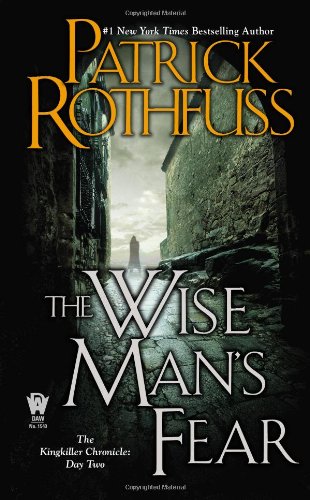
The Wise Man's Fear by Patrick Rothfuss.

This book is 1000 pages long. I think when I finished, I took two Tylenol and went to bed. This is the follow up to Rothfuss's first "Kingkiller Chronicles" book The Name of the Wind, which I've reviewed already and really loved. I honestly don't even know where to start with this one. First off, Mr. Rothfuss, you have some brilliant ideas. Your use of myth and storytelling and the idea of how stories change over time and adapt to the people who are telling them is compelling and interesting and speaks to me on a scholarly level. But oh man, do you need a better editor who is capable of telling you "no." The first 400 pages of this book is almost an exact retelling of the your entire first book. I don't mean that Kvothe reminds the reader of what happens--I mean it happens all over again. Kvothe is poor, Kvothe goes to school, Kvothe plays music, Kvothe is clever, Kvothe and Ambrose do not see eye to eye, Kvothe shows how smart he is, Kvothe spends time with Deena, Kvothe narrowly escapes punishment. It's the exact same structure and plot of something I've already read. Instead of focusing on developing the mystery that is the central focus of this book, it is bogged down in repetition--even if it is well written repetition. When Kvothe finally leaves school to set out on his own for a bit, the story becomes even more weighted. First there is the time he spends proving how clever he is to some major lordling. Then there is the time he spends proving how clever he is walking with bandits. Seriously, an awful amount of walking to nowhere with a lot of pointless moments of learning to interact with people--or something. And then they capture the bandits (I guess that was the point of the walking) with some really cool magic and then Kvothe gets sucked into the land of the Fae and has sex for 64 pages. I'm not kidding. There are some cool bits of Fae magic and a lot of intrigue but most of the time he's just having sex. And then he goes on another tangent to become a super ninja, where he maybe picks up ONE valuable piece of information and then goes on ANOTHER tangent involving more bandits and THEN finally go home. The mystery of who the Chandrian are and why they killed his parents is what is supposed to be driving this. But instead Kvothe goes on a huge circular journey where we learn really nothing more, and then he ends up back at school as if the whole thing never happened and now we wait for the final book. Which I fear will be closer to 2000 pages. And still I can't outright hate this book. The writing is spectacular. And the mystery and levels of symbols and interpretation and how stories change over time is really phenomenal, but Rothfuss has got to edit himself.
Overall Grade: B-

Friday, August 23, 2013

In Which I Return to Literature

We now interrupt your regularly scheduled TV reviews to bring you book reviews! 


Unlike some of my other book reviews, these pieces really have no thematic link outside of "I've read them recently" and frankly I need a bit of a palate cleanser from all my Under the Dome blogging as of late. I continue my quest of reading 50 books from December 2012-December 2013. 41 down. Nine to go.

Code Name Verity by Elizabeth Wein

Nazi's and spies. One of Hollywood's favorite tropes and time periods, Wein takes the typical spy novel and turns it upside down. For instance, her spies are not James Bond-esque men who wear tuxes, have nifty little gadgets, and can hold up under any kind of physical or psychological torture. Her spies are women and feel very real. Code Name Verity is broken into two parts; the first part centers on the English spy "Verity," known back in the real world has Lady Julia (Julie to her friends). Verity has been taken prisoner by Nazi interrogators in 1943 France (aka: not a great place to be).  We are spared some of the more maudlin details, but after several weeks in the care of her captors, Verity agrees to tell her story, to write it out in piecemeal. She has only a few weeks to divulge her secrets before she is to be shipped off to a lab where she will be a specimen for the Nazi scientists. The story she tells, which she claims all throughout, is the absolute truth, is of how she met her best friend, Maddie, and how they came to be in France. Their story is at times touching and a little heartbreaking. The two are almost totally polar opposites and yet they fit together like pieces of a puzzle. Julie is strong and take-charge with an uncanny ability to deceive and lie; her ability to speak both French and German made her an ideal spy and interrogator for the Brits, and she is damn good at it. Maddie is from the countryside and is a nervous gun shy pilot who only truly feels free and courageous when she is in the air. They work together, pilot and spy, in a war that changed the landscape of the world and of what it meant to be female. The second half of the book, in which "Kittyhawk" takes over, tells the other side of the story and then meets the first half in the middle so that the two weave together. The narration style of the first takes some getting used to, though once you do, Wein's ability to not only write properly but as a woman under that kind pressure really comes through. Verity's tale is punctuated by real life moments that exist outside of the Julie/Maddie story, whether it be the status of her fellow inmates or explaining her living conditions or detailing the facts about her captors. The first half of the novel is truly captivating but the second half fails to meet it. The beginning of the "Kittyhawk" section is a tad underwhelming after you've finished Verity and are on the edge your seat wondering what would happen to the spy. It's slow and rather plods along at an unacceptable pace. Instead of being plot driven, it's more internal. Kittyhawk must be hidden away and is thus given very little to actually do. Once the second half beings to pick up threads of the first half, however, it moves along at a much nicer pace. Here, events from the first half that were never really explained or stood out as odd are revealed and a plan and narration in full begins to form. The question of: what is truth and how much of the story can we really believe come into focus. The ending is truly heartbreaking, though it again drags after the climax. Wein obviously spent a lot of time researching this time period and women spies and it does her credit; the story of Verity and Kittyhawk felt as though it were more biography and fictional.
Overall Rating: B


The Infernal Devices Trilogy by Cassandra Clare

Cassandra Clare is everywhere lately, isn't she? When she's not answering questions on Twitter or her Tumblr, she's at Comic Con promoting the release of the movie City of Bones (which I swear I will see and review if it kills me). The Infernal Devices trilogy is the second (of five) series concerning the Shadowhunters. Previously, I reviewed the Mortal Instruments series, the original series in the Shadowhunters saga. The Infernal Devices is a prequel and takes place in London around 1880. Despite being a prequel, I would recommend reading the M.I. series first as the final book of the I.D. series picks up some of those strands. Like the original series, the I.D series revolves around the Shadowhunters--part angel, part human fighters who defend the Earth against demons, rouge vampires and werewolves, and more often than not, restless Shadowhunters with big egos. I was taken back at first by how similar Clare had written her two main characters to her previous ones. Tessa Gray seemed a bit too much like Clary (barely knew her parents, ignorant of the Shadowhunter world, oddly powerful); Will Herondale was clearly a take on Jace but with dark hair instead of light (both sarcastic and little asshole-y, both too afraid to let people get close). However, what makes them different from their predecessors are their stories and like The M.I series, Clare knows how to craft a narration. The series opens with Theresa Gray (Tessa) coming to England from America to meet her brother, Nate. She is abducted by two very sinister sisters who force her to "Change." This ability, being able to shapeshift into another person by simply holding an object that belonged to them, was unknown to Tessa before her abduction. She is rescued, in due time, by Will and his best friend Jem Carstairs, seventeen year old Shadowhunters. Once rescued, Tessa's eyes are opened to the Shadowhunter world. What makes Tessa different is that no one can quite figure out what she is. Her abilities show her to be a demon, yet she has no demon mark. It's a full three book mystery, only revealed at the end. Along the way, a love triangle forms between Will, Tessa, and Jem and while it gets more attention than maybe it ought, it's a hallmark of Young Adult Fantasy Literature (side note: I have read that for the next part of this sage, Clare will be doing away with love triangles altogether). The main plot is stopping a man only known as the Magister who has constructed horrible clockwork creatures to destroy the Shadowhunters and the British Empire. I found these creatures a tad unbelievable; I had to really suspend disbelief that mechanical creatures, yes imbued with magic, could wreck the kind of havoc they did on London. However, the real villain, the Magister, is delightfully insane and evil. One of the things that I like most about Clare's work is that she enjoys giving you characters who it is perfectly ok to hate, if you are so inclined. Jessamine Lovelace, for example, had my ire directed at her more than once. But while she is making you hate one character, Clare also gives you a great deal of depth into others, perhaps making you like them against your will. I really did not want to like Will because he was a bit too much like Jace but in the end I, of course, did. A few of the characters from the M.I series make an appearance, specially Magnus Bane because a Shadowhunter book without Magnus makes no sense as he is, in fact, totally awesome. On the whole, anything Clare writes isn't exactly groundbreaking. She stays safely in the confines of the Young Adult Escapist/Fantasy genre; her heroes are a bit too handsome, her heroines a bit too pretty, even if they themselves cannot see it (I will say, though, that the way Tessa saves the day--as heroines do--is very unexpected and new and I enjoyed that part wholly). Everyone gets matched up with a romantic partner; good always wins. So while it's not revelatory, it is far superior to other series of the same vein. It is perfectly fun, relaxing, and enjoyable.
Overall Rating: B+

The Name of the Wind by Patrick Rotfhfuss

If Harry Potter, Lord of the Rings, and Game of Thrones had a love child, it would look something like this first book of the Kingkiller Chronicles. It is a mix of "boy wizard goes to school" and "epic/slightly historical fantasy" and it is wonderful. The book opens on a small inn in a village; in typical epic style, men have gathered around the hearth and are telling mythical tales of giants and magic and wizards. The innkeeper, Kote, is a pleasant fellow who keeps the mead flowing and occasionally knows more about the story being told at his table and the actual storyteller (spoiler: this is your first hint that there is more to Kote than meets the eye). The fun is interrupted by a man claiming to have seen a demon on the road and the customers reveal themselves to a be a superstitious lot. These events come together rather quickly when a scribe, calling himself Chronicler, comes to the inn having discovered that Kote is really Kvothe (pronounced Quothe), one of the most powerful wizards in memory. His deeds are legendary and the Chronicler wants an accurate retelling. After much haggling and threats, Kvothe gives in and they sit down at a table where he begins his tale. Book one takes us from his earliest childhood days with his performer parents to his midteens studying at the University.  Forewarning: this is a long book, though I find it reads very quickly. Young Kvothe is highly gifted; he is able to grasp tiny bits of magic being imparted on him by his first teacher very quickly. He is a talented musician, actor, and storyteller. He is not, however, perfect. He is a bit arrogant, a bit cocksure. And he is not without tragedy. After the devastating loss of his family, a significant middle of the book is devoted to his life on the streets as a beggar and homeless wanderer. He lives by his wits, which are considerable. Naturally, he does find a way out, but only after Rothfuss has shown that Kvothe isn't a perfect boy wonder. Even at the University where he excels academically, Kvothe remains poor and is troubled by his very own Malfoy.  Looking back, the parts I relished most were the stories within stories. Rothfuss knows how to write mythology; the tales told to Young Kvothe about the gods and saviors felt like any other myth I've read or studied. The story is occasionally interrupted to take the reader back to the present day of Kote sitting in his inn, sometimes explaining his actions of the story thus far. This works well for the whole narrative and gives deeper insight into the man Kvothe became. This book is not without fault however; the last 100 pages dragged for me. I grew a little weary of Kvothe's adventures and the episode with the dragon felt a little forced. The world of Kvothe felt so real that the appearance of the dragon (though it is never called a dragon and in fact Rothfuss goes to great lengths to have Kvothe explain why dragon is not a proper term) was a little too fantastical. The leading lady, Denna, is not fully fleshed out, though I suspect that this criticism will fall once I read the next two books. However, for the moment she is a little vapid and self-centered, thought I greatly appreciate that Kote acknowledges that she can be cruel and unfair. Rothfuss has stacked mysteries well; there is a lot of water to be had from this series and the reader is eager to return to the well for answers: will Kvothe and Denna end up together; will Kvothe ever graduate; will Kvothe ever defeat his school nemesis, Ambrose; will he ever find the begins who killed his parents; and what exactly lies behind the great stone door in the school's Archives and why do I feel as though finding out the answer to that will have lasting repercussions? If you're a fan of fantasy and epic, I highly recommend you pick this up.
Overall Rating: A-

The End Games by T. Michael Martin

I really wanted to like this book. I did. I'm not normally a Zombie girl, but having recently gotten into The Walking Dead, I've been eager for more Zombie Apocalypse pieces. This book was recommended by two YouTubers, NerdyandQuirky and John Green of the Vlogbrothers. My love of John Green is pretty well known and when he recommends books, I pay attention. I'm sorry to say that while this book had a great premise, it quickly dissolved into a typical zombie novella of little substance, not mention some really bizarre writing. The book opens with brothers Michael (17) and Patrick (5) camping out in the woods when the Bellows (Zombies) find them. The book does get you off to a fast start; the beginning is action packed, though given how Martin wrote it, it was really hard to visualize. Once safe from the Bellows (so called because they yell back at you when they hear you speak), the main plot opens up a bit more; the brothers are existing in a sort of game, where the Game Master has told Michael that if he can get to the end with his brother, there will be a victory party. Along the way they collect points and have missions, all laid out by the Game Master. It's very Assassins Creed meets WoW. Sounds really intriguing right? I thought so too. Too bad it's all completely turned over by the author by the end of chapter six. Once the illusion of the Game is totally destroyed, the book looses that which made it unique. It becomes just another Zombie book, though I must credit Martin with building the sibling relationship as believable. There are some interesting elements post chapter six; I rather liked the religious aspect brought in. The main characters are semi-likable; Michael is obviously a tortured soul but has such a a hero complex that it's hard not to get frustrated with him. Patrick, the little brother, would be fun to read if Martin could make up his mind about how to characterize him. At times he is a five year old making fart and poop jokes (too many for my taste) and then at other times it is as if he has aged 10 years and is making rather profound statements. Holly, the supposed unexpected romance promised in the book jacket (not unexpected, in fact totally obvious given that she is the only girl of Michael's age in the whole novel) is mostly the damsel in distress who yells a lot and has overly convenient information. Don't even get me started on the "Captain" who is never fully fleshed out and is just evil for the sake of evil.  The narration switches from third person to internal monologue which is in first person, which is altogether distracting, especially because the internal narration vacillates from sounding like someone on drugs to someone trying to write in the voice of a teenager by writing as if all teens talk and think in LOLs IRL. I fail to see why John Green recommended this book when his entire corpus is about showing that teenagers are just as capable and thoughtful and intelligent as their adult contemporaries. No one actually talks like this, apart from Tumblr but that's because the internet is very much its own world with its own language. It's like traveling to Mexico and being expected to speak Spanish. In real life, no one says "obvs" and Martin's deliberate misspellings for "internet" type lingo is just plain horrible. You do not need to spell it "rawk" when someone is said to "rock." It is not clever, it's distracting. Other problems with narration included the way the Bellow speak, which at first might have been frightening but then just turned uninteresting the more it continued. For the whole book they speak LIIIIIIIIIKE THIIIIIIIIIIS, and because it's too young boys they are echoing, it's often butt jokes. I feel as though the ending was setting up a sequel but I'll be skipping it.
Overall Rating: D+

Saturday, July 6, 2013

In Which I Review Still More Books

Confession: I recently finished a new series and felt very strongly that I needed to review it. Couple that with my lack of book reviews as of late, and I figured I could churn out one of these. Sometimes stand-alones are better than series; resolution is one of the most important aspects of a series. I am not one of those people who expects everything to be wrapped up nicely in a neat little package and topped with a bow. In life you never get all your questions answered, so why should literature be any different? However, I do expect a certain amount of resolution. You have to complete at least one arc, one narrative, in order for me to consider it "finished." The books I review below--two stand-alones and two series--either failed miserably at resolution or managed to finish their characters arc and stroy. 

The Book Thief by Markus Zusak
Death narrates this book. I'm going to repeat that: DEATH narrates this book. Let that sink in for a moment. When was the last time you read something where Death is given a voice? And, more to the point, where Death wasn't the cliche, robed, scythe wielding bad guy? In this novel, Death is sympathetic, humorous, and hates his job. He cares for the souls he carries and desperately wants a vacation. Sadly, the narrative takes places on the eve of and the beginnings of World War Two, so his vacation is probably a long way off; and even then, there is no one to replace him so his vacation will never come. Death is reflecting back to those years and the three times he encountered a little girl named Liesel. Death also has in his possession a copy of the book Liesel herself wrote about her life and is thus able to tell her full life story, even if he was not present at all of it. We begin when Liesel is a very young girl and, while on a train with her mother and brother, witnesses the death of her sibling. This is the first meeting of Liesel and Death; the funeral for her brother is very short and unattended and, so haunted by her brother's death, Liesel steals a book dropped in the snow by the gravedigger. She is uneducated and cannot read but holds onto the book at a final memento of her brother. Her mother is giving her child up to foster parents in order to distance them from their parents strong communist sympathies. Liesel comes to the Hubermann house, in the care of Rosa and Hans, where she will live out her childhood. When her foster father, who quickly becomes more of a father to her than her biological one, discovers Liesel's secret book, he offers to help her learn to read and write. Thus in secret, every night, they struggle through the book together. Liesel comes to love words and their power and soon desires more books to read. From many twists and turns, Liesel continues to read while all around her the world falls to pieces. This is perhaps best exemplified by the arrival of Max, a Jew who asks for Hans' help in hiding from the Nazi party. The Hubermann's hide Max in their basement; he and Liesel strike up a friendship, both relishing the power of words and literature. There are a lot of different threads in this book; at times it's a coming of age story with typical childish antics like stealing (though always under the guise of necessity in war time); at times it's a moral tale of doing what is right even when you could get into trouble (Hans Hubermann does not agree with the Nazi Party, for example). In the middle of the book it becomes a story-within-a-story as Max writes a book for Liesel that is a fable of the Nazi's rise to power and the importance of words. But through it all, it is haunting. Because the reader, more or less, knows the history of this era, you're constantly on edge, waiting for all hell to break loose. Death's perspective and sometimes interjection into the narrative is jarring--especially as he recounts what his work was like during the war, how busy he was kept. Unlike in other narratives where Death seems to relish his work and is a good friend of War, the Death of this book is "haunted by humans" and does not understand why this is his job. There are some scenes that break your heart, like the day you are reminded how despicable human beings can be as Liesel witnesses the march of the Jews to a concentration camp. It's a very sad book, but there is hope woven within. Little Liesel loves Max and protects him, despite living in a society that reinforces the otherness of the Jew. Liesel's relationship with books is very familiar to anybody who has an equally voracious appetite for the written word. I wish there had been a bit more of Liesel's life into adulthood, but that has more to do with my fondness for the character than any flaw in Zusak's writing, which is complex and intricate and very interesting.
Overall rating: A

Before I Fall by Lauren Oliver
What happens when you die? This is one of those questions that has been asked--and will be asked--by countless individuals for as long as death has been happening. Religion, science, and philosophy have all entered into the conversation, and now Lauren Oliver offers up her own take on the question. The opening of the novel finds our main character Samantha Kingston dead on the side of the road--victim of a drunk driving accident in which her best friend, Lindsay, was driving. Sam is part of a four girl group of seniors who essentially run their tiny school. We all went to high school with girls like these. They are the "Mean Girls"--popular, pretty, and able to get away with just about anything because they are popular. They go to parties, wear the latest clothes, and torment those less fortunate than themselves, in particular Juliet Skyes whom they label as Psycho. In high school, you were either were one of these mean girls or you were on the receiving end of their taunts (I was the latter). One of the strong points of this novel is how Oliver is able to create a believable high school setting. I could have easily switched out the names of the four popular girls with names from my own high school and it would have been the same situation. The novel is broken into 7 chapters, which correspond to the seven chances Sam has to relive the day of her death. The opening chapter is "what really happened" on that day for the first time. Sam, Lindsey, Elody, and Ally go to a party on February 12th where they drink and dance and have what is, for them, a typical Friday. The only untypical thing that occurs is confrontation with Juliet who shows up at the party to tell the four girls how terrible they are before storming off. That night, Lindsay drives them home, drunk but insisting that she's fine, when disaster hits and the car flips and crashes, killing Sam. The next thing Sam knows, she is waking up in her bed on February 12th, apparently getting a second chance at the day of her death. It's a lot like the movie Groundhog Day. Sam tries her hardest to first prevent her death--by avoiding the party, by insisting that the four girls stay in that night--and then, even when she manages to avoid death, but still wakes up on February 12th after a "safe" night, how to escape her time loop. Along the way, several revelations about the characters are given: Lindsay may be the Queen Bee of the school (a Regina George if ever there was one) but she is also incredibly insecure and frightened; the torment the four girls inflict upon Juliet has caused heavy emotional damage, the lonely girl contemplating suicide the night of the party. The character development in this book is pretty astonishing, even if it resets for some characters when the day starts over. Character development is often seen as a straight line, up or down. But that's not how it works in real life, people stumble and falter. Sam wakes up on the 12th during one cycle and is bitter, hostile, and mean. She decides she doesn't care about who she hurts or what happens to her this time around, but this is right after she has a relatively good cycle in which she manages to prevent her own death. The ending is not surprising as the major theme of the book is self sacrifice coupled with living your life to the fullest with no regrets. The one issue that I did come up against was that because it is essentially the same day over and over, many parts get repeated and can drag on after awhile, even though Oliver does her best to put Sam in different situations each cycle.
Overall Rating: A-

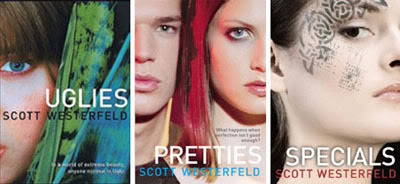
 The Uglies Series by Scott Westerfeld
We are an image driven culture. We uphold certain figures as "the most beautiful" and idol worthy. This series, another post-apocalyptic dystopian, takes this concept to the far extreme. In the far future, society has decided that if everyone looked the same--looked Pretty--conflict would be all but erased. Because our society already seems like it is headed in this direction, which cosmetic surgery on the rise, the world built in this series reads eerily familiar and recognizable. At the age of 16, young boys and girls are given "the Surge" which is cosmetic surgery in the extreme. Everything about you is changed: your eyes, your skin, your bones, and your brain. You are made to look Pretty and you are made to look like everyone else. From the age of 16 to about 30 you live in New Pretty Town and are expected to do nothing but be pretty and party. Until you are turned Pretty, you are referred to as an Ugly and exist on the fringes of society. This is where we find our main character and protagonist, Tally Youngblood--15 years old and waiting. Tally cannot wait until she is made Pretty. Through a series of events, Tally finds herself sent on a mission before she is allowed to become Pretty to destroy the Smoke, a refuge center for Uglies who wished to stay themselves. As one might expect, while out on this mission, Tally sees the dangers of her own society for herself and joins the cause. What's interesting about this series is that Tally's decision to join the cause isn't cemented once she makes it, in fact it changes. Tally goes back and forth a lot between being Pretty and being an Ugly. The first two books are good, although I find Tally as a character to be overly annoying. The third book was almost impossible for me to get through. Tally as a "special" was hard to read for many reasons, but mainly for the way Tally keeps her mind clear to focus on being "special" which just seemed to violent and horrifying. The ending is not satisfying; I was disappointed in the decisions Tally made.  The world is what makes this series; everything is superficial where being pretty also means being Pretty-minded, robbed of the ability to focus and see things as they truly are. I have not read anything else by Scott Westerfeld, but the writing felt a bit underwhelming. I never truly felt sympathy for any of the characters, even Tally. Her love interest is banal and their story is equally boring. As much as I like sci-fi, there was almost a bit too much in this book: hoverboards, cosmetic surgery that gives you heat vision and tattoos that glow with your moods. Everything in the book--except the characters--was turned up to 100, but it wasn't that effective. The first two books are worth an attempt but the third fell flat.
Overall Rating: C

The Delirium Trilogy  by Lauren Oliver
Warning: this review is going to contain a rant. If I were to pick one example of "how to not end your book series" it would be this unfortunate series. This series started off as incredibly good and promising. The first two books had an interesting world constructed around the idea of  love-as-disease, a believable and relatable main character, an obvious conflict, and great character development in book two. And then it all came crumbling down so hard and so fast that it pretty much negates everything good about the first two books. But I'm getting ahead of myself. Sometime in the future (but not too far because the cities still have their original names and there are still cars) society has decided that love is the root of all evil. People who fall in love are diseased. This is actually pretty understandable; the symptoms of love espoused in the movies--can't eat, can't sleep, can't focus--are real and so much so that there is an entire ban on love in this world; the word love is taboo in fact. For most of the first novel, when referring to love, it is called delirium and the disease itself is amor deliria nervosa. At the age of 18 young men and women are taken in for brain surgery that removes their ability to love strongly. At the center of the story is Lena, 17 years old and counting down the days until she can undergo the surgery. Lena, like Tally in Uglies, cannot wait to become part of her society. This is due in large part to her mother's suicide several years earlier; her mother was unable to be cured and that stigma hangs over Lena in the first book. Lena is automatically a likeable character and I really related to her. She is shy and boys terrify her; she has no desire to talk to one or interact at all with them. She's a good girl who does as she is told. However, as it happens in these books, she meets a boy who changes her mind. This is the first rant I have. While, I applaud Oliver's gender changing of this trope, the love interest Alex is every inch the Manic Pixie Dream Girl. We learn very little about his life and his only ambition seems to be in helping Lena escape the society's mindset that love is a disease. His character is almost totally blank and in the end, like MPDG are wont to do, his purpose to impart some sort of wisdom onto the main character before sacrificing himself. The MPDG is an overly annoying trope that I find I have little time for. However, because the world Oliver created was so interesting, I was willing to overlook it. The second book is split into two perspectives, the "then" (which finds Lena escaping her old life for the life of freedom in the Wilds as an uncured) and the "now" (which finds Lena working with the rebellion and eventually falling in love with Julian). Julian, the new love interest, is a bit more developed than blank Alex but still only serves to bolster Lena's own self awareness. The second book, despite it's rather bizarre structure of then and now, really pushes Lena's character and helps her become self sufficient. It has a pretty impressive cliffhanger which leads directly into the third book. And here is my biggest rant for this series. The third book, Requiem, erases all that character development very quickly. Lena, who had become a bit of a warrior, is reduced to a whining petulant child who's only narrative arc is to vacillate between Julian--the boy she loves but not enough--and Alex--the boy who came back from the dead. It is utterly frustrating. Julian is only around to provide conflict and Alex has become a jealous asshole. Most of the book is spent moving from one location to the next, almost indiscriminately. I'm not sure if there was a "plot" besides "don't get killed." The rebellion wants a war against the loveless society but they take forever to stage one. Most of the novel is Lena's own internal conflict about which boy she loves more. In the last 75 pages or so, the uncureds decide to invade Lena's former hometown of Portland and a battle ensues, though Lena spends most of it looking for Alex who has run off and losing track of Julian! I think when she hit page 390, Lauren Oliver suddenly realized that her book was long enough and she decided that nothing needs to be resolved. And I mean nothing. Parts of this book are given to Lena's former best friend, the now cured Hana and her upcoming wedding, but the book doesn't resolve what happens to Hana. Did she make it out of Portland? Did the bomb planted in her fiancee's house go off? When we last saw her, she was just walking without a purpose. And with regards to the war: the final image is off the rebels tearing down a wall but there no mention if this ends society or even if they win. And the most damaging thing of all: Lena doesn't make a decision between Alex and Julian. I'm not saying that she chooses to be an independent women without a male lead, I'm saying that Oliver doesn't let her choose. Lena has one final conversation with Alex where she says that she loves him but it's complicated because of Julian and then the book ends with a totally cliche and overwrought, breaking of the fourth wall, obvious author imperative to "tear down" our own walls. It's so over done that I was actually rolling my eyes while reading the final pages! I kept flipping back and forth trying to figure out if there were pages missing or if it was really a four part series and there was another book to come. But no. Just three and the third is a hot mess. People often complain, fairy I think, about Mockingjay's final epilogue which was almost too perfect and too "fairy tale" but at least it wrapped up Katniss and Peeta's story. This didn't even do that--we don't even know if Julian is alive! How do you end a series without at least your character ending the romantic triangle? I could go on, there was plenty to be unhappy about but the utter lack of resolution stuck in craw something awful.
Overall Rating: D

Saturday, June 22, 2013

In Which I Reivew The Ocean At The End Of The Lane

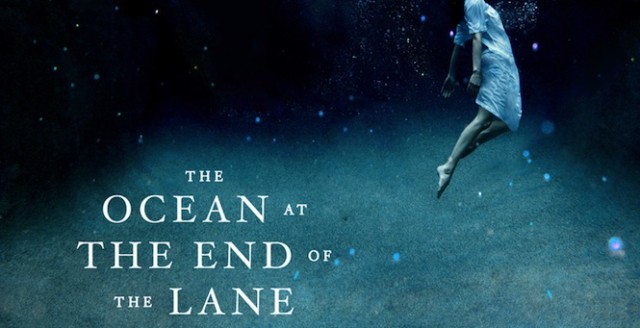
Confession: myths, fantasy, fables, archetypes. If you were to ask me to make a list of things I like in books, those four words would top it. Ever since I was little, I've liked stories that are otherworldly. Children editions of Homer's Odyssey, Disney's fairy tales, epic poems of knights and heroes and dragons--these sorts and more lined my bookshelves and were the recipient of that most magical of gift, my public library card. From the Animorphs to Harry Potter to Kushiel's Legacy to A Song of Ice and Fire, I wraped myself in a mythic blanket, seeking shelter and warmth from the cold harsh and decidedly unmagical world. Among the greats of fantastical magical mythic storytelling, Neil Gaiman has always stood out as one of the quintessential--dare I say archetypal and elemental--best. The Ocean at the End of the Lane is the first Gaiman adult novel in almost a decade. Following in the wake of his landmark American Gods, I bought this book with a sort of desperate need, an unyielding desire to be transported out of the mundane and in to another world, one that only Gaiman can create. I have never felt so close to a protagonist than when our little seven year old narrator utters, "I liked myths. They weren't adult stories and they weren't children's stories. They were better than that. They just were."


Typically, before recommending Gaiman to anyone, I feel the need to point out a few things. First, magic exists. Don't argue with the author on this; it is a fruitless uphill battle and you will lose. Second, magic exists and neither you nor I have the mental ability to understand it. How does one sit down and try to apply any kind of law or logic to magic? It's nonsensical. The mere attempt of explaining magic--sussing out its "hows" and "why"--only renders the magic as nonmagic and in doing so you've ultimately lost the poetic beauty of the magical act. What this means in the course of reading a Gaiman book is that, by the end, you will probably walk away with very little in the way of answers. There is no grand exposition in which the central character is given a revelation of everything that has occurred in the book proper, boiled down into an easy-to-understand bullet point list. The magic will not explain itself to you; it doesn't have to. It's magic.

The "plot" (oh, such an ugly word that means almost nothing in good honest storytelling) is fairly straightforward once you release any reservations you have that by the end you will posses a clear line of progression of beginning, middle and end. Time doesn't work that way and neither does memory and thus why should storytelling. However, a bare bones sketch to at least entice you.  A man in the middle of his life returns home for a funeral. Our unnamed narrator, wishing to delay the uncomfortable and awkward wake of the dead relative, drives around his former hometown, unknowingly searching for something to make him whole. His childhood house was demolished many years ago, modern uniform neatly trimmed houses replacing the romantic sprawl. He finds himself driving toward the end of the lane, where he remembers the Hempstock family lived--a triumvirate of females (grandmother, mother, and daughter). He recalls, vaguely, that he was friends with the little girl, Lettie, who insisted that the duck pond out back behind the farmhouse was really the ocean. Having gained permission to visit the non-ocean/duck pond from the still living grandmother, our narrator sits by the waters edge and, much like Narcicuss from the Greek myths he loved to read as a boy, examines his reflection and dips into the past, back to his childhood where magic and myth collided in his own backyard.


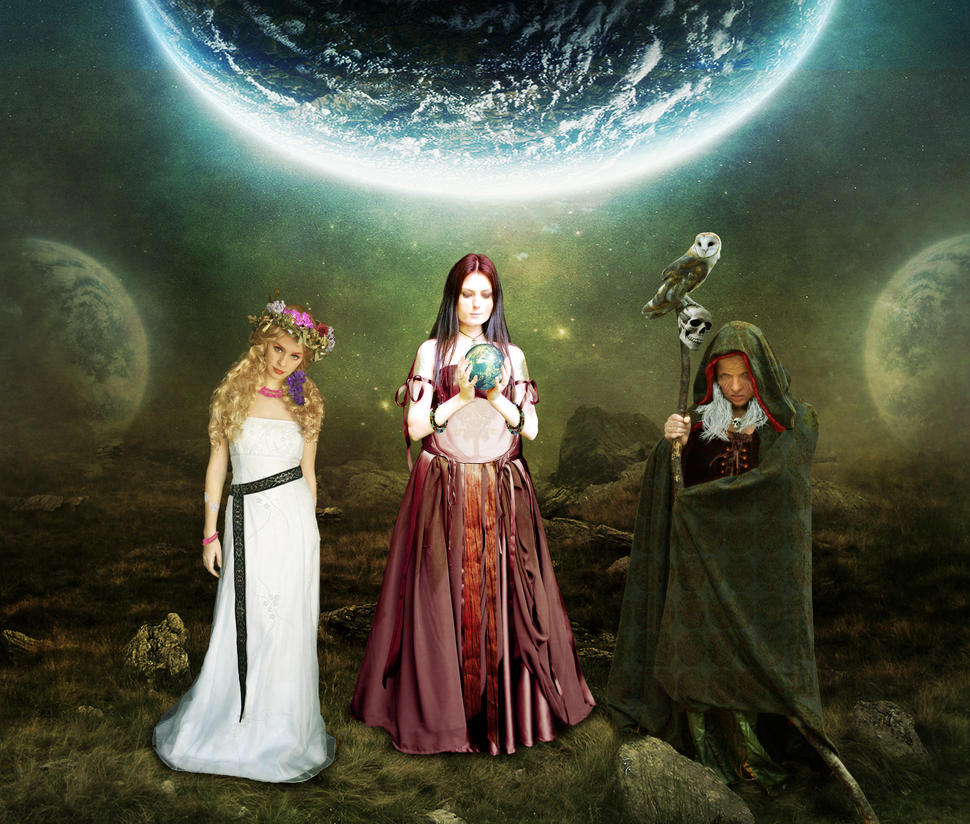
Our narrator is a very lonely seven year old boy, the kind that doesn't even realize the extent of his unhappiness. He rarely makes friends, no one comes to his birthday parties. Instead he has found solace in fantasy and myth; his prized possessions are his books.  One fateful day he and his father discover a dead body and that one event sets off a chain reaction, magic having slid into our world where it proceeds to cause all sorts of havoc. At this time our little narrator meets the Hempstock family for the first time (all Maiden/Mother/Crone overtones are deliberate and intentional). Like Gaiman's other works wherein our main character finally meets the magical beings, the conversations are riddles that are hard to puzzle out--but again, don't try. Just let the magic flow. The narrator trusts them almost implicitly, but he's seven, he has no reason not to trust the very kind women. They seem to know more about what is happening than they care to explain, but they've also come up with a plan to send the magical spirit (referred to as a flea) back to its world. As one might expect, the plan goes wrong--due in large part to our narrator's inability to follow instructions--and the situation only gets worse. The magical being decides it wants to reshape our world to match its own, and uses our narrators family as a means to do so. The family is turned upside down and the horror of this is almost too real. While Gaiman uses magic and myth to examine what happens, somewhere in the back of my mind I wondered if these events were real to Gaiman--reinterpreted, like so many traumatic events are, in language that is more accessible and more easy with which to grapple. What follows is the meat of the story, so I won't spoil it, but it comes down to sacrifice and eventually memory and how clouded the latter can be, how no two stories are the same and that part of growing up is learning to tuck those memories away in the nooks of your mind, rationalizing them as the distant echos of a childhood long since past. Bu as Gaiman writes, "The truth is, there aren't any grown-ups. Not one, in the whole wide world." On the inside, we are all still children.

The non-ocean/duck pond is perhaps the biggest symbol of the book, bookending two of the more prominent moments in the story. The non-ocean/duck pond (that is really an ocean and barrier between our world and the universe that exists beyond this world that is populated by myth and monsters and magic) serves as anchor for our narrator, his inexplicable return to the shore never fully understood to him. It is a home where he can return but where he cannot stay. The ocean is bigger on the inside in more ways that one. It severs as a vessel for rebirth and as a link to answers we all seek: who am I? How did we lose that magic inside of ourselves? Where do I belong? Where is home? It is always just outside our grasp and just when we think we have latched onto it all, it slips--like so much water--between our fingers. This feeling of happiness beyond the pale is articulated best by this line:
“How can you be happy in this world? You have a hole in your heart. You have a gateway to lands beyond the world you know. They will call you, as you grow. There can never be a time when you forget them, when you are not, in your heart, questing after something you cannot have, something you cannot even properly imagine…” Something always calls him back, something always calls all of us back, that hole in our heart that yearns to be filled.

If this book does one thing specifically well--and it does a great many things well--it is in calling up some long forgotten distant pain of your past. Whether you had a happy childhood or not, this book will drudge up some memory that has alluded you in the years since, tugging at your minds eye, beckoning to be revisited. It could be a traumatic one--the fear of adults and adulthood, loneliness--or a good one--the joy of a new book, the act of playing with your first pet on a sunny afternoon. All memories are painful, because of the memory itself or because of the pain of loss, of knowing that you aren't that child anymore. At one point the older narrator waxes nostalgic about how he may not miss childhood, but he does miss how he never took anything for granted: the small wonders we experience as children that our jaded adult selves blindly toss aside as common and normative.

In the end this book flows wonderfully; I easily read it in four hours because the sheer act of putting it down meant I was no longer in that world where I so desperately belonged, that has called to me since I was a little girl. Gaiman's words are lush, you can taste the honeycomb and cream on the porridge. The villain of the story is cruel and petty for the sake of being evil, and I relished it. She was perfectly terrifying--the mythic monster that seeks to destroy a family by her mere presence.


I fully recognize that this is not a typical review. I will not analyze any elements that were "bad" because there were none. I'm sure others will find fault in the pacing or the narration or certain deus ex machina plot devices. Not so with me. This is a panegyric, a paean, a sacrifice lovingly offered up to Neil Gaiman as a token of appreciation for yet another hauntingly beautiful book that moves and tugs at the soul. This book is unquestionably Gaiman and I would not have it any other way.

Overall rating: A

Wednesday, May 29, 2013

In Which I Review More Books

Confession: I read a lot of young adult fiction. I don't believe there is a time in which you're supposed to stop reading young adult literature; so long as the quality is there who is to say you're too old for such works. I find the characters in YA much more relatable  (I am only 26 after all. I was a young adult in the not too distant past) and that the authors of YA are able to express the conflicts of becoming an adult more accurately than jaded "adult" literature authors. The only caveat is that most of the young adult fiction I read is either supernatural or dystopian in nature, but that genre is merely a vehicle for discussing the realities of growing up. 

The Mortal Instruments by Cassandra Clare
I was first drawn to this series after seeing a movie trailer for the upcoming City of Bones film, based on the first book. In many ways, it follows normative supernatural young adult fiction tropes: young girl meets mysterious (overly gorgeous) boy who is not what he appears; love triangle; vampires, werewolves, fairies, warlocks; mustache-twirling, black hat wearing-type bad guy. The series follows Clarissa (Clary) Fray as she encounters and then becomes a Shadowhunter. Now here's where my interest was first peaked: Shadowhunter's are the Nephilim of the Hebrew Bible (and external legends/texts). Part human, part angel, Shadowhunters protect mundanes (us) from the Downworlders (the supernatural typical baddies) who break the Accords and kill humans. The overarching plot of the first three books finds Clary, her obvious love interest (and potential brother) Jace, her best friend Simon (and third side of the triangle), and fellow Shadowhunter's Isabel and Alec fighting to preserve the Shadowhunter way of life while the devious Valentine plots to end the Accords and subsequently destroy all the Downworlders. Along the way there are revelations and battles and demons and lots of teenage coming of age angst before the second half of the series (books 4-6) changes direction ever so slightly. Besides the interesting religious aspect, what makes this series well worth the read is the way Clare wrote her hero, Jace. While Jace is typical leading man material (beautiful, talented, and special) he is far from polite or courteous or respectful. Most the books best bits of dialogue come from Jace making inappropriate comments which are sarcastic and caustic at the same time. Jace recognizes that he is incredibly special and plays that up but at the same time he is a very troubled soul, rushing into battle faster than his comrades. Jace has what would amount to a death wish based very heavily on how he grew up, who raised him, and the guilt he feels over his feelings for Clary (which is very hard to read until the third book). Overall, Clare is a very good writer and she keeps my interest for the entire series.
Grade (overall): A-

The Matched Trilogy by Ally Condie
 Imagine a future society where you could not pick your future spouse but instead the society in which you lived matched you with a stranger. Such is the world in which Cassia lives, where the Society dictates her every move: who she marries, her career, what music she can listen to, what movies she can watch, what activities she can participate in, and the type of poetry she can read. It has all been dictated by the Society. Like Tris in the Divergent series, Cassia spends the first bit of the first novel oblivious to the fact that her world is inherently flawed. Cassia, in the opening chapters, attends her Matched banquet where she is matched with, surprisingly, her best friend Xander. It is only later that Cassia questions this choice when a brief "error" is made whilst she is viewing Xander's electronic profile: the Society matches her with a different boy, Ky. This is the start of Cassia's journey into figuring out free-will, love, and poetry. Unable to resist exploring the idea of loving Ky, Cassia is soon awakened to the evils of her society. This mostly comes through getting to know Ky (who has a rather tragic story) but also through poetry, which Cassia is drawn to because of its beauty and its forbiddeness. Cassia's love of poetry is reflected in Condie's novels, her words are lush and have a certain kind of movement to them. The first book is undoubtedly the strongest and does a great job of setting up the world and the central conflict. Sadly, the second and third book do not reach their full potential. The third book in particular felt as though I was reading a different series; while it was a good book, the idea of resistance--a heavy theme in the first two books--is relegated to a secondary position when the resistance itself happens in a few pages and it is the aftermath that is given more weight. For people who like stories to be wrapped up in nice tidy packages, they will find the ending of book three frustrating: the future of the world is left up in the air and the love story is the only aspect of the three stories that is fully completed.
Grade (overall): B-

The Diviners by Libba Bray
The 1920s are probably one of the most talked about (in print and media) eras in American history. There is something about the 1920s that screams: freedom, sex, drugs, alcohol, loose women, loose morals. Probably because that how the 1920s were for those who had the means. Evie is a young flapper; she loves parties, drinking, fashion, and generally having a good time. She has been sent from her dull town in Ohio to the Big Apple to live with her uncle. Evie is not a normal girl, however. She has the ability to see people's memories when she is holding one of their possessions, a secret Evie keeps to herself (except for drunken party tricks, of course). New York City isn't all fun and games, though.  A dark force has been brought back after years asleep and is performing ritualistic killings on New York men and women. Evie's uncle, an occult specialist, assists the policemen investigating the deaths, and with Evie's help they discover a supposedly dead religion that wishes to bring about the end of the world by fulfilling these murders. The book is character heavy at times; Evie is not the only one with special powers and we meet several others who do not play an integral part in the murder investigation but clearly set up future sequels. This book is both creepy and fun; Evie is a swell character and she makes the reader wish that they too lived in the 1920s. The author nails the feelings of the 1920s with dancers, drinks, and debauchery. The mystery itself (and the killer) are very frightening and the book itself reads very quickly.
Grade: A-


Saturday, May 25, 2013

In Which I Review Some Books

Confession: Back in December, before what was potentially my last Christmas break, I realized I missed reading. I was so caught up in academia and all the work that goes into being a full time Master's student, I had neglected fun reading, which was doubly sad as it has always been a hobby of mine. As an undergraduate, my friends and I used to drive to the local "dirt mall" (so named because of how tiny it was) and I would spend a good half hour in the bookstore, arms full of books I didn't have the money to buy but bought anyway. My friend Jenny used to think it was funny to add to my pile and then convince me that I should spend more money. Fantasy, sci-fi, historical fiction, fantastical historical fiction, romance, classic: you name it, I read it. So, upon realizing that my Christmas break was going to be full of still more research and thesis writing, I made a pact with myself that it would also include some novels. Five months later and I've read 30+ books. 

American Gods by Neil Gaiman.
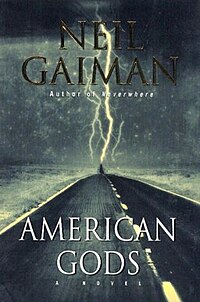
Without a doubt, one of the best books I have ever read, there is a reason why Neil Gaiman is one of the heavyweights of fantasy. I was familiar with Gaiman in general, though sadly I had not read anything of his until this book; he is credited with writing what is probably the best episode of Doctor Who of all time (The Doctor's Wife). This book is complex and thoughtful with a large mythology but enough magic that suspends my need to have all my questions answered. Shadow, the main character, has just been released from prison after a few years and is trying to make his way in the world once more. Along the way he meets the mysterious Mr. Wednesday who wishes to hire Shadow as a bodyguard, more or less. Wednesday, a prolific con man, takes Shadow across country, introducing him to his incredibly colorful friends. Eventually the crux of the novel is revealed to Shadow, though the audience has already caught on. Mr. Wednesday and his friends are gods from the old world, transplanted to America by immigrants and travelers because--quite simply--they believed in them. People carry their gods wherever they go and thus gods from Viking mythology (Mr. Wednesday is a specific iteration of Odin), Egyptian myth (Mr. Ibis and Mr. Jaquel), Slavic myth (Czernobog), African folklore (Mr. Nancy), and even Native American traditions are scattered across the American landscape. But the old gods, as they call themselves, have a problem: they are dying in the face of the new gods of technology and media. America, we are told, is a bad place for gods. What ensues is a cosmic con and battle in which Shadow is part hero, part sacrifice. As a student of religion, the take on how the gods still survive in a land such as America was fascinating. How are mythologies and the figures of those myths transformed in new places? Can myths of the old world that so informed a people and a culture of long ago survive in land fueled by "new" and "innovative?"
Overall grade: A+ (Just read it!)

The Fault in Our Stars by John Green
If you look at any list of the top YA fiction for 2012, you'll find this book. Chances are if you look at several lists for the best books of 2012, this book is on there. For a time, you couldn't turn the corner in a bookstore without running into TFiOS. I have to admit, I was already predisposed to like anything John Green wrote, even though I was rather late in the game with reading this book. When he's not writing compelling young adult fiction, John Green is one half of the YouTube channel, the Vlogbrothers with his brother Hank, who have been trying to decrease world suck since 2007. I've been a member of their community (the Nerdfighters) for sometime. Communicating with mainly teenagers and young adults a few times a week, it's no surprise that Green knows how to write a book that is both funny and heartbreaking and altogether real. TFiOS tells the story of two cancer patients, Hazel and Gus, who meet in a support group. Sounds depressing, I know, but this not a cancer book. A cancer book would have our two young heroes struggle through their disease, coming to accept it and learn the value of living life to the fullest before quietly making peace with their inevitable death. No so with Hazel and Gus who are sarcastic and quick witted and who hate everything about their cancer. Life is not a platitude and knowing pain does not increase your feelings of joy. Hazel recognizes that someday, after she dies, she'll be forgotten, just as everyone else will. Oblivion is there, accept it. But along the way, these two souls find one other and even though they know that their deaths will affect the other in horrible ways, the choice to love one another was a simple one. You will laugh and you will cry and this book will stay with you.
Overall Grade: A

Divergent by Veronica Roth

In the wake of wildly successful and popular Hunger Games, it seems that post-apocalyptic dystopia novels are everywhere, and mostly found in the Young Adult section of the bookstore. The Divergent series follows in that wake. Dystopian literature is a personal favorite, Brave New World being one of the high school books that I actively remember and one that stayed with me. However, I remember hesitating before finally picking up this book: how could it be better than the Hunger Games (which is simply phenomenal, even though I don't agree with the ending)? However, Roth takes a different approach than Collins with her heroine; where Katniss knows that her society is tragically flawed and wrong, Beatrice Prior (Tris) spends the first half of the novel in passive acceptance of the society in which she lives. Somewhere in the not too distant future in Chicago, humanity has divided itself into factions based on virtues: candor, erudite, amity, dauntless, and abnegation. At the age of sixteen, a young adult chooses to either stay in the faction of their birth or leave for the one they feel fits them. Factions rarely interact with one another, so choosing to leave the faction of your birth possibly means never seeing your family again. Tris, born to Abnegation, is torn when the test taken at school reveals that she could potentially belong to several factions. This "affliction" is known as Divergence and is feared and prosecuted. Tris is told to keep it to herself for fear that she'll be harmed. What follows is a coming of age story as Tris struggles to accept her differences, her new faction, but also as she uncovers a plot that seeks to rip the society apart. Naturally there is a romance, though thankfully we are spared the typical love triangle that so often accompanies young adult literature these days. The concept itself is interesting though I found myself often wondering how someone could possibly be just ONE of those virtues and I have a sneaking suspicion that might be Roth's point, what drives her novel. Trying to separate out those virtues is next to impossible not only because of how hard they are to define but also because, for example, being brave can also mean being selfless or honest or smart. It's amazing more characters aren't Divergent. This is the first of three books, the third due out this year. The second book picks up where the first leaves off and then turns everything upside down so that the wait for the final book is close to excruciating. The middle section where Tris is learning how to be a member of her new faction drags on a bit and the secret plan she uncovers is a bit confusing, but it is well worth the read.
Overall Grade: B+

Miss Peregrine's Home for Peculiar Children by Ransom Riggs
An unbelievably strange book that combines myth, fantasy, time travel, pocket universes, and vernacular photography, this is a very interesting debut from Riggs. After the death of his grandfather, Jacob Portman is convinced that something terrible happened to the old man. His grandfather's stories of monsters and special children on a magical island seem the ravings of a senile mind until Jacob begins investigating. On a small isolated part of Wales, Jacob discovers a place pocketed away from time, where children who are "peculiar" live in a time bubble during World War Two. Some children can float, some can control fire, some have bees covering their face, and one child is even invisible. There are creepy monsters and an entertaining plot, but what really makes this book worth the read are the black and white photos sprinkled throughout. At first, I thought I would find them annoying but it's amazing how well they work with the narrative, fitting into the story at just the right moments. It was obvious that Riggs spent countless hours hunting down these photos to use, pouring through garage sales and personal collections. The photos are strange (like the cover photo of a girl floating) and are obviously "faked" but that is washed away in the explanation of who the children in the photos are. A very delightful read, I look forward to the sequel.
Overall Grade: B+

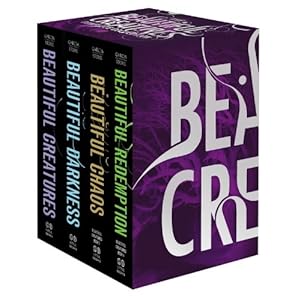
The Beautiful Creatures Collection by Kami Garcia and Margaret Stohl

 Vampires, werewolves, succubi, inccubi, magic, witches, prophecy, and Southern manners surround this series of four supernatural novels. Typical gender roles are reversed in this series; instead of the guy being the supernatural creature with whom the young girl falls madly and inconsolably in love, Ethan Wate is a normal guy living in the deep south, in a tiny town where nothing exciting ever happens and all he can do is hope to escape. That is until Lena Duchannes comes to the town of Gatlin. Lena, it turns out, is a Caster (witch) and a super powerful one at that. On her 16th birthday she will be claimed (against her will) for either the Light or the Darkness. If she goes Dark, chances are she will not remember her love for Ethan. On top of the world's worst birthday present, Lena's mother is out to make sure her daughter goes Dark. The series is supernatural mythology run amok. Every conceivable supernatural trope you can think of is present and at times not well put together. It felt, occasionally, like the authors simply inserted crucial new information at just the right moment for our heroes, but information which had never been even so much as hinted at in earlier pages. The first book--Beautiful Creatures-- is interesting and gets the series off to a good start. However the middle two--Chaos and Darkness--suffer heavily from "middle book syndrome," especially the former which I had to force myself to "just get through." The final book brings back some of the things I liked about the first book. Supernatural books are in high demand right now and there are stronger series out there, but setting the series in the deep south and then making the ideals and customs of that local like another character in the book does make this series stand out. Lazy summer day or beach read at best.
Overall Grade (as a whole): C

This is just a small sampling of some of the books I've read. I think I'll try to review most of them sporadically as I continue blogging. In the meantime, just go out and buy American Gods already!