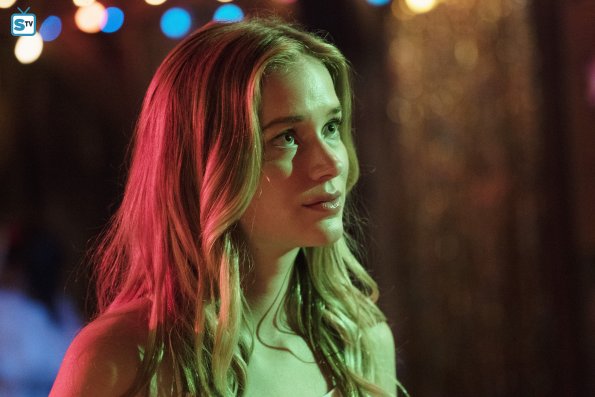
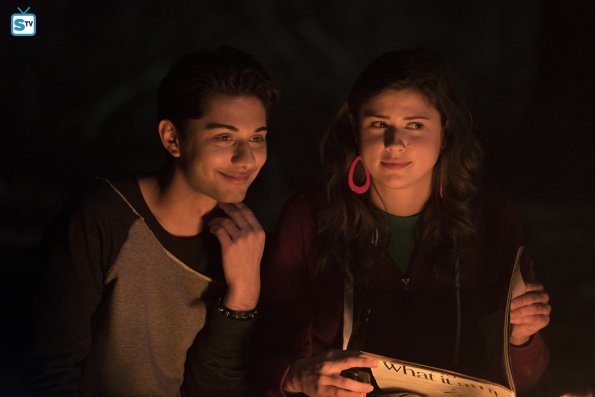
So, how do you stay alive in the woods? Easy; by not going into them! Obviously none of the campers in this week's episode "How To Stay Alive In The Woods" know this very basic rule that is made apparent in every horror movie made. If you suspect your childhood camp of housing Satanic rituals, murderers, and possibly demonic entities then Common Sense 101 means you stay in a public, well lit area with lots of witnesses. But of course, the gang ventured into the woods for "reasons." This show is one inorganic plot point after the next; it pushes its characters into situations for no logical reason other than the writers need something to happen to advance their plot. It's a shoddy writing practice because it means I can't trust what the writers tell me about a character from week to week. Cricket decided she wanted a mix tape type of relationship and had moved past Alex, accepting that a one night stand wasn't in her deck of cards. But this week, after this revelation and coming to terms with it, Cricket is persuaded to go meet Alex in the woods--not because it made sense for her character (she's barely interacted with Alex since their almost tryst) but because the writers needed to kill a character and her number was up. Oh, and Joel got a flashback this week. Grab your trusty video camera and let's go!
Do you feel like you know and understand Joel as a character? I don't. Very early on it was established that Joel is the "watcher" type; his video camera is never far from his hands and he delights in movies, direction, and trying to tell a story. All of those characteristics are intriguing enough to get a character off the ground but from there you need to flesh him out; you need to show me why videos, movies, and capturing the narrative through the medium of a lens is so important to said character, and that's where the flashback comes in. The narrative device of the flashback is a tricky one; often times they are vital and thus far "Dead of Summer" has actually tried to make the flashbacks relevant to their character work. Amy is a loner who lost her only friend; Alex is a con artist; Cricket is insecure and Drew cannot find acceptance for who he is. All of that works to explain their present day situations. The story for Joel should have added some much needed weight to his character but it simply failed to deliver. I still don't know why Joel likes to film as much as he does. Sure, you could argue that he was simply into movies and decided to give it a whirl, but for a kid to decide on their career path that early on--he was roughly 9 in our first flashback and already talking about Oscars--to the extent that he begin to film everything around them, there has to be more than just a passing curiosity. Joel's love affair with film and shooting his reality is given the rather dubious explanation in the present day that his camera is the only way he could know the truth after his brother Michael died via suicide but we already know that Joel was filming everything long before Michael died and Joel himself began to see the Tall Man. Instead of highlighting who Joel is at his core (maybe romantic artistic, maybe obsessed with perceptions and how people present themselves both when someone is looking and when someone is not and thus somewhat cynical of the world around him) we get a half-hearted truth that feels like an afterthought for both the writers and the character. There is nothing to grasp onto with Joel other than a love of film making, that goes woefully unexplored, and a bout of paranoia over visions that we, the audience, already know are very real because the first scene of the entire series is the death of Holyoake at the hands of the villagers. There is no narrative tension; we are not left wondering if maybe Joe has some sort of psychosis because all the episodes leading up to this one have already solidified the mythology that Holyoake as real and ever present. As for why Joel is seeing Holyoake, I have no idea but it's not a far leap in logic to notice that both Holyoake, Michael (who was seeing the Tall Man before his suicide), and Joel have one thing in common that no one else shares: their skin tone. Anyone wanna place some money on Joel being a distant relation to the Tall Man and thus linked to him because of blood? Don't really need a fancy video camera to find the truth in that; it seems all but inevitable.
Miscellaneous Notes on How To Stay Alive In The Woods
--Why does the Tall Man want Amy to die? I don't really know but it could have something to do with her needing to read a manual to roast a marshmallow.
--It is interesting that neither Amy nor Deb seem to remember their romantic encounters from the night before, though I suspect Deb is faking and Amy's confusion is genuine.
--So there are bear traps in the woods but these campers have been running around, in the dark, since day one and Cricket is the first to fall victim to it? Also, parents are letting their kids go to a summer camp that has bear traps cleverly hidden in the woods?
--"Have fun pitching Deb's tent." Ew.
--Garrett finds a ring in the cabin with the initials JS and instantly deduces that the ring had to belong to his father and was there because his father was investigating the mystery of Camp Stillwater. Sure, Garrett. Whatever gets you through the day.
--God bless those ugly 80s prom dresses. Oof.
Wednesday, July 27, 2016
Tuesday, July 26, 2016
In Which I Review Star Trek: Beyond
Time; it marches on. Three years ago, one of my very first blog posts and, really, first review, was of the second modern Star Trek movie, entitled Into Darkness. I was pretty harsh, reading the review again for the first time in a long while, but deservedly so. It remains a lackluster remake of The Wrath of Khan, easily the most beloved and well made of the original Trek films. My anticipation, then, for the latest installment, "Beyond," was mixed. On the one hand, this is still Star Trek and since I was eight years old, I have loved Gene Roddenberry's world. I have loved its characters, ships, themes, morals, philosophy, heart, and meaning. From the Original to Voyager, there are few science-fiction franchises that mean as much to me as Star Trek. On the other hand, the second movie demonstrated that the writers and directors have only a passing understanding of what made Trek, Trek. If the second movie had been a standalone, no fifty year history with which to grapple, it might have been a more solid film, but the fact is that this movie, and all subsequent ones, are going to be judged by the vision, writing, talent, and views of Roddenberry. There are two questions we need to examine when viewing any new Star Trek film; first and foremost, is it a good movie? And second, does it live up to what Roddenberry envisioned when he pitched a TV show about space exploration many years ago? Grab your favorite red shirt and let's go!
General Thoughts
Can you get lost in space? I suppose, in a literal sense, yes of course you can. You find yourself on the wrong end of a magnetized polar variation and bam, you're stuck in the Delta Quadrant for seven years (no offense Captain Janeway). But what Star Trek: Beyond wants to tackle is whether a person's identity can get lost in the vastness and sameness of space; whether it's possible that the day to day living aboard a vessel can leave people questioning their own purpose and general direction in life and whether the solution is a new tactic or the same shtick ad nauseum. In other words, when things begin to feel a bit episodic (pun intended), what keeps us, and the fearless crew of the Enterprise, going at warp speed toward the next horizon? Those types of questions are explored in Star Trek: Beyond. There is a throughline in the movie that should the crew of the Enterprise break up, the individuals of the ship would cease to be the people they need to be. Uhura tells the main antagonist that there is strength in unity and the film goes to many great lengths, via both intense action sequences of everyone working together and quiet musings, to demonstrate that the team, the crew, and the sum total are greater than the parts. But what happens if individuals were to carefully remove themselves from the equation? Take away the linchpins and slowly people lose themselves. Kirk contemplates taking a Vice Admiral position; Spock wonders if he should aid in the re-population of New Vulcan. As fans of the Original Series, and just Star Trek generally, we know, of course, that Kirk and Spock (and Bones, Sulu, Checkov, Scotty, and Uhura) all belong with each other aboard their beloved Enterprise. We know that in another timeline Kirk did achieve the Admiral status and gave it up because his true love, passion, and reason for being is Captaining the Enterprise. In another life, Spock left Vulcan (twice!) to be with his friends. However, the crew members themselves are not privy to the same history that we have; they are living it, making the history we already love. They have to figure out for themselves that there is beauty in the episodic, a sort of mundane glory in wearing the same shirt day after day and recording the same sort of stories time after time; that while chaos gets the blood thrumming and the heart racing, it's the day to day adventures, twists, turns, and sometimes negotiations gone horribly wrong that are their first and best destiny. With that in mind, it's easy to see how Star Trek: Beyond is a coy wink and a nudge from the writers to the fans. This "episode" might be on a much grander and more blockbuster scale, but the script and plot could have come, broadly, from any individual episode of Star Trek (take your pick for series; they all have episodic one-offs). While the crew of the Original Series Enterprise never engaged in this many space battles, the crew landing on some far off planet and dealing with someone who's own ideas stand opposed to the Federation, but is dealt with by Kirk and company, feels all too familiar. The broad strokes of the story could have played on a smaller screen and been a perfectly fine episode and that's what we're dealing with here. The writers want us to love the episodic, to embrace the formula that their Star Trek series is going to stick to. Just like Kirk accepts the glorious mundane, so too we accept and love the comfort of the known. It may not be fresh, innovative, or groundbreaking, but it will feel like the Star Trek you watched as a kid. Even with the many space battles and inexplicable lens flairs.
While the interpersonal relationships between the crew and the broad strokes of the plot might be served by this episodic approach, it fairs less well with its main villain, Krall. So far, in all three new Trek movies, the villains have been fairly uncomplicated, barely fleshed out baddies with a penchant for growling lines, quick sob stories, and in every case, a Magical MacGuffin weapon that simply must be stopped before it destroys the Federation, the ship, the crew, ect. This is where the new Trek runs aground; the villains in the many TV series tend to be much more complex than simply "bad guy;" this is usually because their villainy is couched in some sort of understandable humanity. They worship a computer thinking it a god because they do not know better; they were chemically poisoned by a flower to experience euphoria and forget their Starfleet or scientific mission; they are trying to save their race; they are trying touch their creator and feel that humanity stands in the way. There are "bad guys" who do what they do fully understanding that they might take a life or harm another, but their motivation behind said action is sympathetic if not empathetic. The Cardassians are bigoted nationalists who colonize other races, but is their spread through the galaxy, trying to instill their way of life, all that different from humanity's; is Gul Dukat nothing but a black hat baddie? That's the nuance of Star Trek. To bring this back to Star Trek: Beyond, Krall is about as rote and transparent as it gets. He wants to destroy the Federation because he's a solider and because he's angry. Going into details would constitute a major spoiler, but having a villain that is like all the other villains that came before him only makes him fall even flatter than would have on his own. The episodic nature might be great for some parts of Star Trek: Beyond, but I wish the writers would have pushed themselves in the Krall-regard. Why might someone loathe the Federation? In Roddenberry's world, the Federation was akin to a utopia; everything worked in harmony because humanity learned hard lessons from its past--slaughter, eugenic wars, famine, greed were all overcome--and had made a better place that the Federation wanted to share with everyone else among the stars; that is all well and good when you're inside the system but for those outside looking in, the Federation can seem insidious (like Root Beer, if you ask Quark and Garak at the DS9 station) and just as much a colonizing swarm of insistent bees as any other. Here in 2016, it's great to have a classic Trek episode to watch when it comes to the how the crew understand themselves and each other, but it's past time that this new franchise begin to explore villainy in all its complexities. A person's reasons for wanting to destroy a race or an organization should never be boiled down to just one root cause; it's a disservice to the complicated and multi-layered reasons and psychology behind not only conflicts but the people embroiled in them and to be perfectly blunt, Star Trek is better than that.
What I Liked And Did Not Like
--If this movie did one thing exceptionally well, it was mixing up the normal pairings of crew members to allow those not often seen together a chance to play off each other. The heart of the franchise will always be the incomparable trio, but too often the other crew members are sacrificed for the relationship between Kirk, Spock, and Bones--and quite often even my dear Bones gets the short stick. The movie took a chance by having Kirk working with other people and keeping Bones and Spock together for a change. It worked! One of my favorite episodes from the Original Series is "Bread and Circuses" in which Spock and Bones have some time apart from Jim and you really see that while they might be wholly different in terms of philosophy, they still care for each other a great deal and would die for one another if they had to.
--"You gave your girlfriend a tracking device?"
"...that was not my intent."
--The moment when Spock opens up Spock Prime's belongings and finds a picture of the Original Crew tore my insides up and it was all I could do not to cry in the theater. It keeps with the throughline of being your best self with others but it was also a very nice acknowledgement of the past history.
--Modern day science fiction has a nasty habit of thinking that it needs big battle sequences in order to be classified as Science Fiction. Nothing could be further from the truth and if you go back and watch many episodes of Star Trek (again, any series) you'll see that big battles in space are few and far between. Star Trek is more philosophical and introspective than constant torpedoes. While I understand that a big summer blockbuster is going to have at least one action sequence, having more than 4 in a two hour movie wears on the eyes, the ears, and patience.
--Props to Simon Pegg, who co-wrote the movie, for putting the humor back into Star Trek. There have always been witty exchanges among the Star Trek crew; in the last film that felt decidedly lacking.
--I suppose I need to address the Sulu controversy. Yes, in a very brief scene it is established that Hikaru Sulu is gay and has a husband and child. This was done to honor George Takei, the original Sulu and outspoken LGBT advocate. I have no problem with Star Trek having a gay character and, frankly, it's really about time. But I don't think, in this case, it was done for the right reasons. Star Trek is all about progressive views on society, showing the audience how humanity could be if it could just overcome its pettiness concerning religion, race, gender, sexual orientation, and ethnicity. While having a gay character is progressive (sort of, it is 2016 after all) it wasn't done as a demonstration of progressive attitudes but to honor one man and his lifestyle. It's not supposed to be about Takei, but about Roddenberry and his world view. Next time, create a whole new character, gay and fleshed out, so that we might see the progress.
--I think the film writers want me to be impressed with the Jaylah character but while she's a "tough female character" she's also in the mold of what men think a tough female character should be. In other words, they give them hallmark male characteristics--fighter, handy, intrepid, tough--and expect us to applaud their feminism. While women are certainly all those things, feminism isn't about taking male characteristics and simply putting a vagina on them. It's about who controls the female's agency--her or a man. Jaylah might be a pretty tough fighter and she certainly plays a part in the grand plan to get off of Krall's planet, but she's heavily reliant on the male Starfleet officers to progress her story off the planet and, in the end, into the academy. Cool makeup, though.
--Some nice canon touchstones like reference to the Xindi wars and Jim Kirk not wanting to celebrate his birthday (but Bones really should have presented him with some Romulan ale and Spock gifted him a copy of A Tale of Two Cities).
--I honestly have no idea why this movie is called "Beyond."
--For the next Star Trek film, should there be one, I'd like more exploration before the problem falls into Kirk's lap. One of the best things about the franchise is the creative imagination that spawns brand new worlds, new races, and let's us traverse a new landscape. Going along with this, please stop destroying the Enterprise. It doesn't have the same emotional impact as when Kirk blew it up in "Search for Spock" because unlike that ship, this rebooted one doesn't feel like one of the main characters. The original ship, in all its NCC-1701 glory, was "a lady. You treat her right, and she'll always bring you home."
Final Ratings for Star Trek: Beyond: B
It's very much a summer blockbuster but because the story feels more like a classic episode of a most beloved franchise, it evens out all the very tedious fight scenes and dull villain. It's still Star Trek, after all, and that will always mean something.
General Thoughts
Can you get lost in space? I suppose, in a literal sense, yes of course you can. You find yourself on the wrong end of a magnetized polar variation and bam, you're stuck in the Delta Quadrant for seven years (no offense Captain Janeway). But what Star Trek: Beyond wants to tackle is whether a person's identity can get lost in the vastness and sameness of space; whether it's possible that the day to day living aboard a vessel can leave people questioning their own purpose and general direction in life and whether the solution is a new tactic or the same shtick ad nauseum. In other words, when things begin to feel a bit episodic (pun intended), what keeps us, and the fearless crew of the Enterprise, going at warp speed toward the next horizon? Those types of questions are explored in Star Trek: Beyond. There is a throughline in the movie that should the crew of the Enterprise break up, the individuals of the ship would cease to be the people they need to be. Uhura tells the main antagonist that there is strength in unity and the film goes to many great lengths, via both intense action sequences of everyone working together and quiet musings, to demonstrate that the team, the crew, and the sum total are greater than the parts. But what happens if individuals were to carefully remove themselves from the equation? Take away the linchpins and slowly people lose themselves. Kirk contemplates taking a Vice Admiral position; Spock wonders if he should aid in the re-population of New Vulcan. As fans of the Original Series, and just Star Trek generally, we know, of course, that Kirk and Spock (and Bones, Sulu, Checkov, Scotty, and Uhura) all belong with each other aboard their beloved Enterprise. We know that in another timeline Kirk did achieve the Admiral status and gave it up because his true love, passion, and reason for being is Captaining the Enterprise. In another life, Spock left Vulcan (twice!) to be with his friends. However, the crew members themselves are not privy to the same history that we have; they are living it, making the history we already love. They have to figure out for themselves that there is beauty in the episodic, a sort of mundane glory in wearing the same shirt day after day and recording the same sort of stories time after time; that while chaos gets the blood thrumming and the heart racing, it's the day to day adventures, twists, turns, and sometimes negotiations gone horribly wrong that are their first and best destiny. With that in mind, it's easy to see how Star Trek: Beyond is a coy wink and a nudge from the writers to the fans. This "episode" might be on a much grander and more blockbuster scale, but the script and plot could have come, broadly, from any individual episode of Star Trek (take your pick for series; they all have episodic one-offs). While the crew of the Original Series Enterprise never engaged in this many space battles, the crew landing on some far off planet and dealing with someone who's own ideas stand opposed to the Federation, but is dealt with by Kirk and company, feels all too familiar. The broad strokes of the story could have played on a smaller screen and been a perfectly fine episode and that's what we're dealing with here. The writers want us to love the episodic, to embrace the formula that their Star Trek series is going to stick to. Just like Kirk accepts the glorious mundane, so too we accept and love the comfort of the known. It may not be fresh, innovative, or groundbreaking, but it will feel like the Star Trek you watched as a kid. Even with the many space battles and inexplicable lens flairs.
While the interpersonal relationships between the crew and the broad strokes of the plot might be served by this episodic approach, it fairs less well with its main villain, Krall. So far, in all three new Trek movies, the villains have been fairly uncomplicated, barely fleshed out baddies with a penchant for growling lines, quick sob stories, and in every case, a Magical MacGuffin weapon that simply must be stopped before it destroys the Federation, the ship, the crew, ect. This is where the new Trek runs aground; the villains in the many TV series tend to be much more complex than simply "bad guy;" this is usually because their villainy is couched in some sort of understandable humanity. They worship a computer thinking it a god because they do not know better; they were chemically poisoned by a flower to experience euphoria and forget their Starfleet or scientific mission; they are trying to save their race; they are trying touch their creator and feel that humanity stands in the way. There are "bad guys" who do what they do fully understanding that they might take a life or harm another, but their motivation behind said action is sympathetic if not empathetic. The Cardassians are bigoted nationalists who colonize other races, but is their spread through the galaxy, trying to instill their way of life, all that different from humanity's; is Gul Dukat nothing but a black hat baddie? That's the nuance of Star Trek. To bring this back to Star Trek: Beyond, Krall is about as rote and transparent as it gets. He wants to destroy the Federation because he's a solider and because he's angry. Going into details would constitute a major spoiler, but having a villain that is like all the other villains that came before him only makes him fall even flatter than would have on his own. The episodic nature might be great for some parts of Star Trek: Beyond, but I wish the writers would have pushed themselves in the Krall-regard. Why might someone loathe the Federation? In Roddenberry's world, the Federation was akin to a utopia; everything worked in harmony because humanity learned hard lessons from its past--slaughter, eugenic wars, famine, greed were all overcome--and had made a better place that the Federation wanted to share with everyone else among the stars; that is all well and good when you're inside the system but for those outside looking in, the Federation can seem insidious (like Root Beer, if you ask Quark and Garak at the DS9 station) and just as much a colonizing swarm of insistent bees as any other. Here in 2016, it's great to have a classic Trek episode to watch when it comes to the how the crew understand themselves and each other, but it's past time that this new franchise begin to explore villainy in all its complexities. A person's reasons for wanting to destroy a race or an organization should never be boiled down to just one root cause; it's a disservice to the complicated and multi-layered reasons and psychology behind not only conflicts but the people embroiled in them and to be perfectly blunt, Star Trek is better than that.
What I Liked And Did Not Like
--If this movie did one thing exceptionally well, it was mixing up the normal pairings of crew members to allow those not often seen together a chance to play off each other. The heart of the franchise will always be the incomparable trio, but too often the other crew members are sacrificed for the relationship between Kirk, Spock, and Bones--and quite often even my dear Bones gets the short stick. The movie took a chance by having Kirk working with other people and keeping Bones and Spock together for a change. It worked! One of my favorite episodes from the Original Series is "Bread and Circuses" in which Spock and Bones have some time apart from Jim and you really see that while they might be wholly different in terms of philosophy, they still care for each other a great deal and would die for one another if they had to.
--"You gave your girlfriend a tracking device?"
"...that was not my intent."
--The moment when Spock opens up Spock Prime's belongings and finds a picture of the Original Crew tore my insides up and it was all I could do not to cry in the theater. It keeps with the throughline of being your best self with others but it was also a very nice acknowledgement of the past history.
--Modern day science fiction has a nasty habit of thinking that it needs big battle sequences in order to be classified as Science Fiction. Nothing could be further from the truth and if you go back and watch many episodes of Star Trek (again, any series) you'll see that big battles in space are few and far between. Star Trek is more philosophical and introspective than constant torpedoes. While I understand that a big summer blockbuster is going to have at least one action sequence, having more than 4 in a two hour movie wears on the eyes, the ears, and patience.
--Props to Simon Pegg, who co-wrote the movie, for putting the humor back into Star Trek. There have always been witty exchanges among the Star Trek crew; in the last film that felt decidedly lacking.
--I suppose I need to address the Sulu controversy. Yes, in a very brief scene it is established that Hikaru Sulu is gay and has a husband and child. This was done to honor George Takei, the original Sulu and outspoken LGBT advocate. I have no problem with Star Trek having a gay character and, frankly, it's really about time. But I don't think, in this case, it was done for the right reasons. Star Trek is all about progressive views on society, showing the audience how humanity could be if it could just overcome its pettiness concerning religion, race, gender, sexual orientation, and ethnicity. While having a gay character is progressive (sort of, it is 2016 after all) it wasn't done as a demonstration of progressive attitudes but to honor one man and his lifestyle. It's not supposed to be about Takei, but about Roddenberry and his world view. Next time, create a whole new character, gay and fleshed out, so that we might see the progress.
--I think the film writers want me to be impressed with the Jaylah character but while she's a "tough female character" she's also in the mold of what men think a tough female character should be. In other words, they give them hallmark male characteristics--fighter, handy, intrepid, tough--and expect us to applaud their feminism. While women are certainly all those things, feminism isn't about taking male characteristics and simply putting a vagina on them. It's about who controls the female's agency--her or a man. Jaylah might be a pretty tough fighter and she certainly plays a part in the grand plan to get off of Krall's planet, but she's heavily reliant on the male Starfleet officers to progress her story off the planet and, in the end, into the academy. Cool makeup, though.
--Some nice canon touchstones like reference to the Xindi wars and Jim Kirk not wanting to celebrate his birthday (but Bones really should have presented him with some Romulan ale and Spock gifted him a copy of A Tale of Two Cities).
--I honestly have no idea why this movie is called "Beyond."
--For the next Star Trek film, should there be one, I'd like more exploration before the problem falls into Kirk's lap. One of the best things about the franchise is the creative imagination that spawns brand new worlds, new races, and let's us traverse a new landscape. Going along with this, please stop destroying the Enterprise. It doesn't have the same emotional impact as when Kirk blew it up in "Search for Spock" because unlike that ship, this rebooted one doesn't feel like one of the main characters. The original ship, in all its NCC-1701 glory, was "a lady. You treat her right, and she'll always bring you home."
Final Ratings for Star Trek: Beyond: B
It's very much a summer blockbuster but because the story feels more like a classic episode of a most beloved franchise, it evens out all the very tedious fight scenes and dull villain. It's still Star Trek, after all, and that will always mean something.
Wednesday, July 20, 2016
In Which I Review Dead of Summer (1x4)
Regular readers of this blog of mine will remember my review of OUAT's "Ruby Slippers" in which the writers finally dove into an LGBT relationship (or, rather, stuck their toe into the LGBT waters and then ran back to their safer heterosexual shores). When I reviewed that episode, I opened with a statement that because I am not a member of the LGBT community (just a committed ally) my feelings on the episode did not detract nor override in any way, shape, or form from the views and opinions of someone in said community. In other words, I self-identify as a heterosexual cis woman and because I do occupy a certain place of privilege where my type of romantic love is constantly given weight and a speaking voice in narrative, it is harder for me to critically analyze an episode of TV that is designed to speak to those who do not occupy my social and cultural sphere--who are marginalized, disenfranchised, maligned and altogether lacking in true representation on TV--without sounding like a pompous arse. The same applies to this week's Dead of Summer episode, "Modern Love." Drew is transgendered and, as such, I am approaching my review with a respectful but still critical eye. Dd the writers do right by the trans community? That's the question with which we need to wrestle this week. Also, if masquerade balls are really something people have at summer camp (hint: no). Grab your favorite mask and let's go!
The metaphor of the mask is not lost on me, nor probably on anyone who sat through a basic English high school class. Masks typically represent secrets, hidden identity, and a chance to play-act as someone else. It's not really shocking, then, that the masquerade ball comes at the same time as Drew's backstory, a character who has yet to be defined by any solid character traits except silent, sullen, and transgendered. This isn't to say that these qualities aren't traits to build a character on, but rather that the traits exhibited thus far were hiding the real Drew, the person he is underneath the sullen, silent, moody, reflective demeanor used to cover up his transgendered nature. The mask Drew wore for the first few episodes when we were getting to know the other campers did exactly what masks are literally and metaphorically supposed to do: it protected that which lay beneath. When you wear a mask (be it a plastic or less tangible one), you can become anyone. A mild mannered software engineer can become a hacker intent on taking down the capitalist society (yes, Mr. Robot is finally back on TV); a car insurance claim manager can open up an underground Fight Club (that I'm not supposed to talk about) for men to become men. A mask also gives you the chance to be whatever society wants you to be; in the privacy of home you can feel free to let your freak flag fly (so to speak), but out there in the judgmental and intolerant society, a nondescript mask can help you to blend in, which is what Drew was doing early on. But here's the question: is a mask still a mask if it is tailored made, perfected, just for you? Or can the mask you are wearing be a more true version of your internal, real self? To put it another way, as Drew's mother said and as was reiterated throughout the episode, "you can't hide what you are." For Jessie, the counselor who is quickly becoming the worst of the worst, and Drew's mother, the mask of Drew is simply covering up Andrea. The Drew "persona" is a cry for a help or a weird character tick that can be made fun of, taunted, and used as a tool for bribery. To the narrow minded, Drew cannot chose his sex (or more accurately, his gender) and the sex organs assigned at birth determined his gender and the way society expects him to act--i.e, as a girl named Andrea who wears dresses, speaks a certain way, and performs other "feminine" societal roles. I have to give the show credit for letting the audience sit with Drew in his 1989 flashbacks, trying to navigate his identity through a society that still doesn't quite grasp what transgendered means (and, hell, it's 2016 and we're still struggling with how to discuss and approach transgendered peoples). Maybe it's a little cliche to let the only flashback for Drew be about his transition, and it suggests that his only hallmark characteristic is as a trans person, but it was well done (in my eyes at least; if I have any trans readers, I'd love to know what you thought). The show didn't make Drew's transition into a Hallmark-made moment in which his mother lovingly opened her arms and accepted Drew, body and soul, but the show also didn't try to skip over the harsh realities; instead it kept Drew firmly grounded in the reality of trans people everywhere; this flashback and this episode fit with the outsider theme that is present in other characters so far like Amy, Alex, and Cricket. This outsider theme unites them slowly, episode by episode. To return to our mask theme, though, Drew isn't the mask. Andrea is. It's only by taking off Andrea--the skirt, the frilly shirt, the fancy shoes--that Drew can actually be who he is: a boy.
On the flip side of this internal and interesting Drew-centered episode, we have more mythology being played out slowly, which hear really does read as dull-dull-dull. The show can't settle into what it wants to be; it bit off more than it can chew, I think. While the characters are deadly dull and the mythology intriguing enough to keep watching one week, the very next week it flips on its head, as it did with this week's episdoe. The show could be a character study of different types of people have a summer of growth, a bit of a bildungsroman while engaging in camp fire stories and (apparently) smoking a lot of weed. Or the show could be a mythology based horror flick with lifeless, dull, non interesting characters that you don't care about but, instead, tune in just to be frightened by the things that go bump in the night. I know horror movies existed in the 1980s so haven't these idiots learned to not go walking in the woods by themselves? If they haven't yet then I hope a giant demon handing rising from the lake to say hi to Amy was enough. No, really. What was that? I guess Amy is the chosen one or something and I'm still learning toward the demon possessing Amy once it comes to the surface but this week none of this really mattered. What mattered was Drew trying to find acceptance for who he is, discarding his mask and asking others to see the real him.
Miscellaneous Notes on Modern Love
--I feel as though I would be remiss in my snark duties if I didn't point out that Adam and Eddy achieved a better LGBT narrative with Drew than they did after 5 years and a token romance over on OUAT with Red and Dorothy.
--Jessie is the worst and while she and Drew might both be "scared" the same can be said of Amy and Cricket and Alex. Jessie trying to compare her situation with Drew's is unnecessary and petty. Whatever went down with Jessie and her DUI was her choice and one she did not have to make. Drew declaring he's a boy is not a choice; it's a fact of his life.
--So Deb's box contains a....book? That apparently teaches the virtue of teenage sexual love?
--Drew has a some good taste in music with both David Bowie and Sonic Youth.
The metaphor of the mask is not lost on me, nor probably on anyone who sat through a basic English high school class. Masks typically represent secrets, hidden identity, and a chance to play-act as someone else. It's not really shocking, then, that the masquerade ball comes at the same time as Drew's backstory, a character who has yet to be defined by any solid character traits except silent, sullen, and transgendered. This isn't to say that these qualities aren't traits to build a character on, but rather that the traits exhibited thus far were hiding the real Drew, the person he is underneath the sullen, silent, moody, reflective demeanor used to cover up his transgendered nature. The mask Drew wore for the first few episodes when we were getting to know the other campers did exactly what masks are literally and metaphorically supposed to do: it protected that which lay beneath. When you wear a mask (be it a plastic or less tangible one), you can become anyone. A mild mannered software engineer can become a hacker intent on taking down the capitalist society (yes, Mr. Robot is finally back on TV); a car insurance claim manager can open up an underground Fight Club (that I'm not supposed to talk about) for men to become men. A mask also gives you the chance to be whatever society wants you to be; in the privacy of home you can feel free to let your freak flag fly (so to speak), but out there in the judgmental and intolerant society, a nondescript mask can help you to blend in, which is what Drew was doing early on. But here's the question: is a mask still a mask if it is tailored made, perfected, just for you? Or can the mask you are wearing be a more true version of your internal, real self? To put it another way, as Drew's mother said and as was reiterated throughout the episode, "you can't hide what you are." For Jessie, the counselor who is quickly becoming the worst of the worst, and Drew's mother, the mask of Drew is simply covering up Andrea. The Drew "persona" is a cry for a help or a weird character tick that can be made fun of, taunted, and used as a tool for bribery. To the narrow minded, Drew cannot chose his sex (or more accurately, his gender) and the sex organs assigned at birth determined his gender and the way society expects him to act--i.e, as a girl named Andrea who wears dresses, speaks a certain way, and performs other "feminine" societal roles. I have to give the show credit for letting the audience sit with Drew in his 1989 flashbacks, trying to navigate his identity through a society that still doesn't quite grasp what transgendered means (and, hell, it's 2016 and we're still struggling with how to discuss and approach transgendered peoples). Maybe it's a little cliche to let the only flashback for Drew be about his transition, and it suggests that his only hallmark characteristic is as a trans person, but it was well done (in my eyes at least; if I have any trans readers, I'd love to know what you thought). The show didn't make Drew's transition into a Hallmark-made moment in which his mother lovingly opened her arms and accepted Drew, body and soul, but the show also didn't try to skip over the harsh realities; instead it kept Drew firmly grounded in the reality of trans people everywhere; this flashback and this episode fit with the outsider theme that is present in other characters so far like Amy, Alex, and Cricket. This outsider theme unites them slowly, episode by episode. To return to our mask theme, though, Drew isn't the mask. Andrea is. It's only by taking off Andrea--the skirt, the frilly shirt, the fancy shoes--that Drew can actually be who he is: a boy.
On the flip side of this internal and interesting Drew-centered episode, we have more mythology being played out slowly, which hear really does read as dull-dull-dull. The show can't settle into what it wants to be; it bit off more than it can chew, I think. While the characters are deadly dull and the mythology intriguing enough to keep watching one week, the very next week it flips on its head, as it did with this week's episdoe. The show could be a character study of different types of people have a summer of growth, a bit of a bildungsroman while engaging in camp fire stories and (apparently) smoking a lot of weed. Or the show could be a mythology based horror flick with lifeless, dull, non interesting characters that you don't care about but, instead, tune in just to be frightened by the things that go bump in the night. I know horror movies existed in the 1980s so haven't these idiots learned to not go walking in the woods by themselves? If they haven't yet then I hope a giant demon handing rising from the lake to say hi to Amy was enough. No, really. What was that? I guess Amy is the chosen one or something and I'm still learning toward the demon possessing Amy once it comes to the surface but this week none of this really mattered. What mattered was Drew trying to find acceptance for who he is, discarding his mask and asking others to see the real him.
Miscellaneous Notes on Modern Love
--I feel as though I would be remiss in my snark duties if I didn't point out that Adam and Eddy achieved a better LGBT narrative with Drew than they did after 5 years and a token romance over on OUAT with Red and Dorothy.
--Jessie is the worst and while she and Drew might both be "scared" the same can be said of Amy and Cricket and Alex. Jessie trying to compare her situation with Drew's is unnecessary and petty. Whatever went down with Jessie and her DUI was her choice and one she did not have to make. Drew declaring he's a boy is not a choice; it's a fact of his life.
--So Deb's box contains a....book? That apparently teaches the virtue of teenage sexual love?
--Drew has a some good taste in music with both David Bowie and Sonic Youth.
Wednesday, July 13, 2016
In Which I Review Dead of Summer (1x3)
I went to summer camp when I was much younger and I don't remember all the kissing that this week's episode, "Mix Tape," had in it. Or maybe I was just never invited; or maybe the constant hooking up and sexual concerns present at Camp Stillwater were frowned upon while staying at Christian Bible Camp. At any rate, the mythology and surrounding mystery of Camp Stillwater took a bit of a break this week (until the end) and instead the show tried to sell me on numerous relationships. You might be able to tell that it was not a rousing success. It's a sign of the caliber of writing that the romantic entanglements are flat, uninteresting, and eye-roll worthy while the friendship between Blair and Cricket is far more rewarding and organic. I keep bringing up how cliche the show is and how it sticks to its tropes, lock stock and barrel; the gay boy and the overweight self-conscious girl are no exception but that doesn't mean that a trope can't be compelling or, at the very least, not as dull and rote as the never ending parade of love triangles/squares/whatever shape this show is making itself out to be. Grab a dear heart and avoid the lightening and let's go!
Cricket is a bit of an idiot, right? I say that as someone who identifies with the body and self-confidence issues that have manifested in Cricket and to which we were treated this week. Since she's the cliche overweight (in this shows eyes, at least), non-traditionally pretty character, of course she's got body issues and is attempting to rectify the problem by making others think she is something she's not. Cricket might be an idiot (and I'll get to that in a second) but there's a nice through line in her story this week about creating a myth around oneself. There are lies we tell ourselves to make us feel better and usually we hope like hell that others around us, those who don't know us all that well, will buy into the myth we spin. Tell the same story enough times and people will take it as gospel truth, believing in stories that have no basis in reality. For Cricket, it's about changing the reality of everyone around her: if people hear that she's a "slut" and believe the stories of her hookups, then they will see her as something she doesn't see in herself: desirable. It's perfectly normal to want others to see us as desirable and given Cricket's backstory of an overweight mother and cheating father, it's even more so. I have some issues with the end result of this story, however. Cricket realizes that she doesn't want to settle and that she deserves a mix tape type of romance (side note, but once again setting this story in 1989 and bringing up the concept of a mix tape isn't doing the show any favors given that most of the audience barely remembers CDs and life before downloads and shared playlists). This is all well and good except that her chance at said mix tape romance is currently....dead. Alex, our Russian who is fooling everyone into believing he's an all American good boy, just wants a hook up and another notch in his stolen belt, so Cricket is left to chirp alone. It's not that Cricket needs a reward for coming to her conclusion, but I think the show is drawing a rather stark dividing line. You know, there's nothing wrong, with just sex. The show felt a wee bit Puritan in this regard. Cricket may want a mix tape type of romance, but the two are not mutually exclusive. Having sex (because, shock, it feels good) doesn't mean that you won't get a mix tape someday, that sex can't lead to a mix tape, or that you have to forgo sex in order to have a more serious romance. Sometimes feeling good, no strings attached, is perfectly fine. Those weighty considerations aside, we're back to my beginning assessment about Cricket being an idiot. Not that any of her fellow camp counselors are any better, mind you, but in what reality do you get into a perfect stranger's car to go for a ride around the block? Yes, there's the myth that Cricket is spinning for herself about being reckless and adventurous but there's also common sense and Cricket had enough of it to know that Damon (cliche bad guy name for the demon worshiper!) is bad news. She turned him away twice before agreeing to get in to his car-of-love-and-death. Cricket still knows that she's spinning tall tales, she hasn't bought into her own false reality, but just because Jessie gave her some seriously bad advise, she goes off and takes a ride from Damon, a guy dressed head to toe in costuming bad mojo? Dumb, dumb, dumb. However, given that Amy is afraid of tether-ball (and got struck my lightening), Joel is trying to hook up with Deb (probably Queen of the Damned), and Blair can't tell that Drew isn't into him and only kissed him to shut up his never ending blabbing, maybe Cricket's actually ahead of the pack.
Miscellaneous Notes on Mix Tape
--Is Cricket having premonitions or is someone warning her from the other side?
--Yeah, Amy got struck by lightening while standing in the demon-lake. That'll end well.
--So, we did manage to get a bit more information on the Satanic cult. Apparently they sprung up in 1871 with their intention to commune with the dead and were led by the piano player.
--I'm worried that all the TVs around Camp Stillwater only play the same Satanic Documentary over and over again.
--Cricket may be an idiot, but Jessie is just the worst, ever.
--"Women like us, sometimes we have to settle." There are bad parents in every single Adam and Eddy show, aren't there?
Cricket is a bit of an idiot, right? I say that as someone who identifies with the body and self-confidence issues that have manifested in Cricket and to which we were treated this week. Since she's the cliche overweight (in this shows eyes, at least), non-traditionally pretty character, of course she's got body issues and is attempting to rectify the problem by making others think she is something she's not. Cricket might be an idiot (and I'll get to that in a second) but there's a nice through line in her story this week about creating a myth around oneself. There are lies we tell ourselves to make us feel better and usually we hope like hell that others around us, those who don't know us all that well, will buy into the myth we spin. Tell the same story enough times and people will take it as gospel truth, believing in stories that have no basis in reality. For Cricket, it's about changing the reality of everyone around her: if people hear that she's a "slut" and believe the stories of her hookups, then they will see her as something she doesn't see in herself: desirable. It's perfectly normal to want others to see us as desirable and given Cricket's backstory of an overweight mother and cheating father, it's even more so. I have some issues with the end result of this story, however. Cricket realizes that she doesn't want to settle and that she deserves a mix tape type of romance (side note, but once again setting this story in 1989 and bringing up the concept of a mix tape isn't doing the show any favors given that most of the audience barely remembers CDs and life before downloads and shared playlists). This is all well and good except that her chance at said mix tape romance is currently....dead. Alex, our Russian who is fooling everyone into believing he's an all American good boy, just wants a hook up and another notch in his stolen belt, so Cricket is left to chirp alone. It's not that Cricket needs a reward for coming to her conclusion, but I think the show is drawing a rather stark dividing line. You know, there's nothing wrong, with just sex. The show felt a wee bit Puritan in this regard. Cricket may want a mix tape type of romance, but the two are not mutually exclusive. Having sex (because, shock, it feels good) doesn't mean that you won't get a mix tape someday, that sex can't lead to a mix tape, or that you have to forgo sex in order to have a more serious romance. Sometimes feeling good, no strings attached, is perfectly fine. Those weighty considerations aside, we're back to my beginning assessment about Cricket being an idiot. Not that any of her fellow camp counselors are any better, mind you, but in what reality do you get into a perfect stranger's car to go for a ride around the block? Yes, there's the myth that Cricket is spinning for herself about being reckless and adventurous but there's also common sense and Cricket had enough of it to know that Damon (cliche bad guy name for the demon worshiper!) is bad news. She turned him away twice before agreeing to get in to his car-of-love-and-death. Cricket still knows that she's spinning tall tales, she hasn't bought into her own false reality, but just because Jessie gave her some seriously bad advise, she goes off and takes a ride from Damon, a guy dressed head to toe in costuming bad mojo? Dumb, dumb, dumb. However, given that Amy is afraid of tether-ball (and got struck my lightening), Joel is trying to hook up with Deb (probably Queen of the Damned), and Blair can't tell that Drew isn't into him and only kissed him to shut up his never ending blabbing, maybe Cricket's actually ahead of the pack.
Miscellaneous Notes on Mix Tape
--Is Cricket having premonitions or is someone warning her from the other side?
--Yeah, Amy got struck by lightening while standing in the demon-lake. That'll end well.
--So, we did manage to get a bit more information on the Satanic cult. Apparently they sprung up in 1871 with their intention to commune with the dead and were led by the piano player.
--I'm worried that all the TVs around Camp Stillwater only play the same Satanic Documentary over and over again.
--Cricket may be an idiot, but Jessie is just the worst, ever.
--"Women like us, sometimes we have to settle." There are bad parents in every single Adam and Eddy show, aren't there?
Wednesday, July 6, 2016
In Which I Review Dead of Summer (1x2)
Last week, I hypothesized that Dead of Summer is supposed to be a tongue in cheek satire of campy teen horror flicks. All the cliches and tropes are played to such an extent that they are ripe for taunting. In this week's episode, Barney Rubble Eyes, my theory takes the proverbial one-two punch and falls under the weight of the shows own tropes. I suppose the show was going for shock that all-American, preppy boy Alex is really Alexi from the Soviet Union, meaning he is labeled a Russian "commie" in the late 1980s, a time when being Russian wasn't met with much approval. Whether or not it's shocking in this show, though, is up for debate. We have little to no information about Alex/Alexi to begin with; last week he was just another camp counselor and I could barely tell them all apart. Had this revelation been kept until later in the season, after we got to know Alex without the Alexi component, then maybe I'd be more impressed at the sudden about face. As it is, the show blew the secret too early, leaving me underwhelmed. I have a sense that feeling with be reoccurring quite a bit. Grab your pocket knife and let's go!
With the second episode of the series, we are still building the mystery and fleshing out the campers, if both are coming in piecemeal and rather slowly at that. As with last week, I find myself baffled that the writers of the show chose to set this program in the late 1980s. It's hard to relate to a former Soviet Union kid turned all-American wannabee. I have no frame of reference for this sort of life which makes it difficult, to say the least, to really care about Alex/Alexi. Without some sort of commonality, how can I see myself in Alex's story? Sure, he's an outsider but the sort that you are hard pressed to make any inroads with an audience. Amy's story of being an outcast as the new girl in a new school who finds it hard to make friends was far more understandable. What is more interesting and potentially more relatable is the way the show and Alex's story are mocking and deconstructing the idea of the American Dream--a vague and opaque ideal that I couldn't define anymore than I could explain quantum physics. With Alex's story we see the American Dream's seedy underbelly. Fake, fraudulent and with a definite "ick" factor, the American Dream is really about taking what you want, when you want it, and pretending to live a good, upstanding, moral life, one you can throw in others faces. All while screwing the Russian mistress. No one is who they say they are, and someone living the American Dream is likely posing, using the stereotypes and ready made cultural symbols to sell themselves as the embodiment of the Dream. It's almost Don Draper-like. In 2016, the American Dream gets a good amount of derision, a bygone phrase of an age that doesn't exist anymore (if it ever existed at all). Alex's story shows how flimsy that dream is, and does it through the eyes of a foreigner who is told that the American Dream is something tangible, something he can grasp. The show so far has a way of casting everyone as an outsider--Amy's a loner, Alex's a Commie, Drew is transgender, Cricket is the odd girl out when it comes to boys and I'm sure we'll discover weekly outcasts with each passing flashback. Does this mean that the show is somehow fresher than I possibly imagined? Not really. There is something to say about the American Dream, about the romanticization of a childhood past (captured perfectly in a summer camp), how that romantic past cannot last and about outsiders finding like minded individuals to take on the horrors of the world, but I'm still not sure that the show is making efforts to discuss these topics through the use of satirical tropes. It's more like they stumble into them and then move on before really digging in their heels and working out the nuances of the topics.
The issue arises with connecting these themes of being an outsider back to the larger mystery of the show. Lest we forget (and how could we with the show giving us the obligatory string wailing and ghostly visages every few seconds), this show is really a slasher/horror teen romp. The present day internal developments should somehow thematically link back to the mythology. The piano-player ghost makes several appearances, praying on little Anton (a Russian stand in for Alexi, of course). Why Anton? Is it because he's a loner? Because he's friendless? Does the ghost sympathize with this, or is he using that trait to his advantage? Why is the ghost targeting anyone? What does he want? The mythology of the show is obviously going to build very slowly, being teased out in simple strokes so that the writers don't totally show their hand. Is the mystery worth waiting for? Maybe and maybe not. It's hard to tell at this point. I maintain the cliche nature of the horror mystery, but I also have always maintained that telling me an old story well is better than telling me a new story poorly. There's a bit of intrigue still in the mystery, especially since it is all being kept so close to the vest, that does make me want to tune in and pay attention. Whether or not that interest stays is contingent on how fast this plot moves and if the show keeps dropping eye roll worthy lines like "it's just begun!"
Miscellaneous Notes on Barney Rubble Eyes
--Maybe I'm not cool enough (or old enough) to understand the reference that gives us this week's title, but...it's an odd one right?
--Holy love quadrangle, Batman. So...Amy likes Alex and likes Garrett. Cricket likes Alex and Blotter likes Cricket. Jessie likes Garrett and Garrett likes Amy and possibly still Jessie. Blair likes Drew and Drew hasn't opened up everyone that she's trans. On top of all this, Joel is crushing on Deb and trying to film her with his ever present camera. Yikes!
--The bar where Garrett's mom works and where Garrett goes to read secret police files just happened to be showing a documentary on Satanism.
--Two boys making a bet on who can score with a girl first. Yes, just what this show needed.
--"Where are you from?" "The Soviet Union." Do the writers understand that the Soviet Union isn't just one place; that it's a conglomerate of many nations that have many different languages and cultures?
--What is Deb's secret? Is it that she can create magnificent ice sculptures or freeze people? Maybe it's that she is secretly working for Ben Linus to get the lights turned back on before the "V" aliens arrive. (Yes, this is a meta reference to all of Elizabeth Mitchell's most famous TV roles).
--I just realized that the lead cop is Blackbeard from OUAT.
--The visuals for the acid trip were well done.
With the second episode of the series, we are still building the mystery and fleshing out the campers, if both are coming in piecemeal and rather slowly at that. As with last week, I find myself baffled that the writers of the show chose to set this program in the late 1980s. It's hard to relate to a former Soviet Union kid turned all-American wannabee. I have no frame of reference for this sort of life which makes it difficult, to say the least, to really care about Alex/Alexi. Without some sort of commonality, how can I see myself in Alex's story? Sure, he's an outsider but the sort that you are hard pressed to make any inroads with an audience. Amy's story of being an outcast as the new girl in a new school who finds it hard to make friends was far more understandable. What is more interesting and potentially more relatable is the way the show and Alex's story are mocking and deconstructing the idea of the American Dream--a vague and opaque ideal that I couldn't define anymore than I could explain quantum physics. With Alex's story we see the American Dream's seedy underbelly. Fake, fraudulent and with a definite "ick" factor, the American Dream is really about taking what you want, when you want it, and pretending to live a good, upstanding, moral life, one you can throw in others faces. All while screwing the Russian mistress. No one is who they say they are, and someone living the American Dream is likely posing, using the stereotypes and ready made cultural symbols to sell themselves as the embodiment of the Dream. It's almost Don Draper-like. In 2016, the American Dream gets a good amount of derision, a bygone phrase of an age that doesn't exist anymore (if it ever existed at all). Alex's story shows how flimsy that dream is, and does it through the eyes of a foreigner who is told that the American Dream is something tangible, something he can grasp. The show so far has a way of casting everyone as an outsider--Amy's a loner, Alex's a Commie, Drew is transgender, Cricket is the odd girl out when it comes to boys and I'm sure we'll discover weekly outcasts with each passing flashback. Does this mean that the show is somehow fresher than I possibly imagined? Not really. There is something to say about the American Dream, about the romanticization of a childhood past (captured perfectly in a summer camp), how that romantic past cannot last and about outsiders finding like minded individuals to take on the horrors of the world, but I'm still not sure that the show is making efforts to discuss these topics through the use of satirical tropes. It's more like they stumble into them and then move on before really digging in their heels and working out the nuances of the topics.
The issue arises with connecting these themes of being an outsider back to the larger mystery of the show. Lest we forget (and how could we with the show giving us the obligatory string wailing and ghostly visages every few seconds), this show is really a slasher/horror teen romp. The present day internal developments should somehow thematically link back to the mythology. The piano-player ghost makes several appearances, praying on little Anton (a Russian stand in for Alexi, of course). Why Anton? Is it because he's a loner? Because he's friendless? Does the ghost sympathize with this, or is he using that trait to his advantage? Why is the ghost targeting anyone? What does he want? The mythology of the show is obviously going to build very slowly, being teased out in simple strokes so that the writers don't totally show their hand. Is the mystery worth waiting for? Maybe and maybe not. It's hard to tell at this point. I maintain the cliche nature of the horror mystery, but I also have always maintained that telling me an old story well is better than telling me a new story poorly. There's a bit of intrigue still in the mystery, especially since it is all being kept so close to the vest, that does make me want to tune in and pay attention. Whether or not that interest stays is contingent on how fast this plot moves and if the show keeps dropping eye roll worthy lines like "it's just begun!"
Miscellaneous Notes on Barney Rubble Eyes
--Maybe I'm not cool enough (or old enough) to understand the reference that gives us this week's title, but...it's an odd one right?
--Holy love quadrangle, Batman. So...Amy likes Alex and likes Garrett. Cricket likes Alex and Blotter likes Cricket. Jessie likes Garrett and Garrett likes Amy and possibly still Jessie. Blair likes Drew and Drew hasn't opened up everyone that she's trans. On top of all this, Joel is crushing on Deb and trying to film her with his ever present camera. Yikes!
--The bar where Garrett's mom works and where Garrett goes to read secret police files just happened to be showing a documentary on Satanism.
--Two boys making a bet on who can score with a girl first. Yes, just what this show needed.
--"Where are you from?" "The Soviet Union." Do the writers understand that the Soviet Union isn't just one place; that it's a conglomerate of many nations that have many different languages and cultures?
--What is Deb's secret? Is it that she can create magnificent ice sculptures or freeze people? Maybe it's that she is secretly working for Ben Linus to get the lights turned back on before the "V" aliens arrive. (Yes, this is a meta reference to all of Elizabeth Mitchell's most famous TV roles).
--I just realized that the lead cop is Blackbeard from OUAT.
--The visuals for the acid trip were well done.
Wednesday, June 29, 2016
In Which I Review Dead of Summer (1x1)
Ah, summer television. A time of high drama, mostly poor narrative, and usually a fair amount of snark from yours truly. With Under the Dome off the air (mercifully) after three seasons, I desperately needed a new show to review while my normal TV shows are on hiatus. Thankfully (?) the creators of OUAT decided they didn't have their plates full with a 23 episode fairy tale drama and went to the more "family friendly" outlet of ABC to launch a brand-new sudsy camp filled program. Sounds like it is absolutely something I need to review! Reading the press releases and synopsis for Dead of Summer made both my eyebrows risee; a mix of LOST levels of mythology with OUAT fantasy and Pretty Little Liars type of cliche characters does not sound like recipe for anything other than a disaster. But summer TV is supposed to be slightly disastrous (maybe I'm biased after reviewing Under the Dome for three years) so I had prepared myself for laughable dialogue and an easy to read text and it's definitely all that, but what I got from the series premiere, "Patience," though, was something more and something unexpected. Don't misunderstand; this show is laced with the sort of cliches you'd expect from a summer-camp horror narrative, but these cliches are so apparent and so typical that it's hard not to wonder if the writers aren't playing to their audiences expectations and creating an overly dramatic, melodramatic, satire about teenage gothic summer camp stories. In other words, the show is laughably bad and predictable, but maybe it's supposed to be. Grab your hot dogs and marshmallows and let's go!
If anyone would like to hazard a guess as to why creators Adam Horowitz and Eddy Kitsis set their campy camp (pun!) drama in 1989 then, by all means, lay it on me cause goodness knows I found the (semi) recent period piece aspect of this show a little too silly for words. On a network that targets directly to the generation that comes after me (still a baby chick, born in the twilight year of 1987) it's a weird step to take. There are no cell phones, no social media accounts, no insta-wifi connections that link our techno brains to the rest of humanity. Perhaps its nostalgia; the idea of being cut off from everything we think of today in terms of communication and connection creates a deeper story. Maybe it's fondly remembering when you could be one with nature without needing to snap a sunset photo to Instagram. Or maybe it's just that a soap opera derived camp horror flick doesn't make a lot of sense in the 21st century--everyone, at all times, has a camera, a video recorder, a phone, and literally a link to thousand, if not millions, of other people at their finger tips. Whatever the case, the 1989 setting gives rise to a contradiction for the viewers; it gives the show a totally out of touch feeling with the music, outfits, and general power dynamics between the genders it deploys; but at the same time, there is something very familiar about all this. It has been years (and years and years) since I attended a camp, but Camp Stillwater could be any Midwestern, off-the-beaten-path patch of youthful indiscretion that you remember from days gone by. Cliches might be obnoxious but we readily insert our own memories into their fully made forms. Everyone knew someone like one of these characters on Dead of Summer. Maybe you were even just like one of them--be it popular and cool, or a loner and struggling. Cliches don't necessarily have to be a bad thing and some of the best stories are as laudable as they are because of their rote direction, but in the 21st century, when TV is supposed to be making inroads in depictions of culture, society, gender, sex, and life in general, cliches are there to be made fun of; to be deconstructed so as to understand why certain attitudes, feelings, and sentiments belong to an age that has passed us by. And it's hard for me to believe that Adam and Eddy don't know this; I give them a lot (a lot) of grief over on my OUAT reviews--as does a good portion of the fandom these days--for adhering to traditions in storytelling that need to be placed by the wayside. After five years of that show, and the ever growing criticism around it, am I expected to believe that these two professional writers haven't realized that what their target audience wants is something that pushes the envelope beyond the stereotypical? That is why I'm inclined to read Dead of Summer as a clever satire of its tropes. These cliches are played to the hilt; played to such perfect type that if I didn't know any better, I would say this show was the first outing of a junior writer who is drawing from what he knows--and what he knows is the simple, un-nuanced, free from complications narrative that is like following a straight line from plot point A to plot point B.
So, if the story is so rife in cliches, what kind of narrative are we looking at here? Well, I believe the entire thrust of the show can be summed up from a scene straight out of "teen horror 101." Sitting around a campfire, smoking weed, and drinking cheap beer one character (a cliche "watcher and storyteller" figure who records everything on a old fashioned video camera) says, "anyone could come in here and kill every single one of us. They wouldn't find out bodies for days!" This eye-roll worthy line is followed up with the equally tropeish creepy janitor--who takes a little too much enjoyment in capturing animals in traps--speaking cryptically to the lead character, Amy, informing her, in a dull monotone voice, to leave Camp Stillwater because "you have no idea what this place is!"A tree also bleeds at one point. Demons, literal and metaphorical, abound at Camp Stillwater. Amy, as is her right as main character, is damaged, haunted, and, of course, the new counselor at Camp Stillwater. She's the outsider, one of two characters who didn't spend her golden childhood years by the lake with the rest of the gang. Amy's story is to find herself while figuring out the mysteries of Camp Stillwater, navigating all things personal and mythical. These mythical mysteries include all the classics: ghosts, magic, Satanism, and weird local legends. It's hard to get a handle on the full scope of the mystery in the first episode but given that the show begins with the murder of a negro piano player a century ago, and that all the ghosts so far were seen in the piano player's lake, it's not hard to guess. Lemme take a stab...the dead negro was accused of witchcraft and killed by racist townies to "protect their own." It will turn out that the dead man was a practitioner of magic--and possibly a Satanist who killed all the folks in the lake to appease some sort of demonic entity that resides at Stillwater and to keep the world at large safe--and is seeking revenge (and/or continual appeasement of said demonic force) using the natural magical properties of Camp Stillwater to continue exacting his revenge. Deb, the head counselor (who was miraculously brought back to life and defrosted from her time as the Ice Queen), knows all this but can't bring herself to shut down the camp because she sunk all her money into trying to bring her childhood camp back to life (this action reawakens the camp ghost, if I read the cliches right!) On the whole, there are too many characters (each one as opaque as the next), too many mysteries, too many narratives balls in the air, for anything to make a ton of sense right now. But I don't know that it needs to; as terrible and hokey as the premiere was, it's not without action, intrigue, and it does manage to create a desire to see how it ends--even if you could write the ending without seeing anything else from Dead of Summer.
Miscellaneous Notes on Patience
--There really are way too many characters on this show. It's as if the writers couldn't narrow down to just a few cliches--they needed to have ALL of them. There's the ugly duckling who became the super hot swan (Jessie); there's Blair (who is supremely gay and needs everyone to know it); there's Alex (the popular but probably insecure alpha male); along for the ride is Drew who's only character trait so far is long hair and sullen silence and Cricket who fills our quota for the "stupid nickname" cliche.
--Amy's flashbacks reveal that the first friend she ever had 1) died (of course) 2) is the reason she went to Camp Stillwater (again of course) and 3) imparted the great life lesson that sometimes you have to do stuff that scares you.
--How about a round of applause for me for NOT making an Amy/Anna joke? Elizabeth Lail isn't nearly as captivating here as she was on OUAT, but she's also just being asked to act mopey, sad-eyed, and scream at everything that startles her (which occurred approximately every 5 minutes).
--Do I smell a love triangle between Amy, Garrett the Deputy, and Jessie? Adam and Eddy just can't resist, can they? On the other side of cliche romances, we have the somewhat icky set up of Deb and Joel in an autumn-late spring type of romance.
--The lake is apparently shaped like a ram/demon's head and the Camp sits at its heart. Naturally.
If anyone would like to hazard a guess as to why creators Adam Horowitz and Eddy Kitsis set their campy camp (pun!) drama in 1989 then, by all means, lay it on me cause goodness knows I found the (semi) recent period piece aspect of this show a little too silly for words. On a network that targets directly to the generation that comes after me (still a baby chick, born in the twilight year of 1987) it's a weird step to take. There are no cell phones, no social media accounts, no insta-wifi connections that link our techno brains to the rest of humanity. Perhaps its nostalgia; the idea of being cut off from everything we think of today in terms of communication and connection creates a deeper story. Maybe it's fondly remembering when you could be one with nature without needing to snap a sunset photo to Instagram. Or maybe it's just that a soap opera derived camp horror flick doesn't make a lot of sense in the 21st century--everyone, at all times, has a camera, a video recorder, a phone, and literally a link to thousand, if not millions, of other people at their finger tips. Whatever the case, the 1989 setting gives rise to a contradiction for the viewers; it gives the show a totally out of touch feeling with the music, outfits, and general power dynamics between the genders it deploys; but at the same time, there is something very familiar about all this. It has been years (and years and years) since I attended a camp, but Camp Stillwater could be any Midwestern, off-the-beaten-path patch of youthful indiscretion that you remember from days gone by. Cliches might be obnoxious but we readily insert our own memories into their fully made forms. Everyone knew someone like one of these characters on Dead of Summer. Maybe you were even just like one of them--be it popular and cool, or a loner and struggling. Cliches don't necessarily have to be a bad thing and some of the best stories are as laudable as they are because of their rote direction, but in the 21st century, when TV is supposed to be making inroads in depictions of culture, society, gender, sex, and life in general, cliches are there to be made fun of; to be deconstructed so as to understand why certain attitudes, feelings, and sentiments belong to an age that has passed us by. And it's hard for me to believe that Adam and Eddy don't know this; I give them a lot (a lot) of grief over on my OUAT reviews--as does a good portion of the fandom these days--for adhering to traditions in storytelling that need to be placed by the wayside. After five years of that show, and the ever growing criticism around it, am I expected to believe that these two professional writers haven't realized that what their target audience wants is something that pushes the envelope beyond the stereotypical? That is why I'm inclined to read Dead of Summer as a clever satire of its tropes. These cliches are played to the hilt; played to such perfect type that if I didn't know any better, I would say this show was the first outing of a junior writer who is drawing from what he knows--and what he knows is the simple, un-nuanced, free from complications narrative that is like following a straight line from plot point A to plot point B.
So, if the story is so rife in cliches, what kind of narrative are we looking at here? Well, I believe the entire thrust of the show can be summed up from a scene straight out of "teen horror 101." Sitting around a campfire, smoking weed, and drinking cheap beer one character (a cliche "watcher and storyteller" figure who records everything on a old fashioned video camera) says, "anyone could come in here and kill every single one of us. They wouldn't find out bodies for days!" This eye-roll worthy line is followed up with the equally tropeish creepy janitor--who takes a little too much enjoyment in capturing animals in traps--speaking cryptically to the lead character, Amy, informing her, in a dull monotone voice, to leave Camp Stillwater because "you have no idea what this place is!"A tree also bleeds at one point. Demons, literal and metaphorical, abound at Camp Stillwater. Amy, as is her right as main character, is damaged, haunted, and, of course, the new counselor at Camp Stillwater. She's the outsider, one of two characters who didn't spend her golden childhood years by the lake with the rest of the gang. Amy's story is to find herself while figuring out the mysteries of Camp Stillwater, navigating all things personal and mythical. These mythical mysteries include all the classics: ghosts, magic, Satanism, and weird local legends. It's hard to get a handle on the full scope of the mystery in the first episode but given that the show begins with the murder of a negro piano player a century ago, and that all the ghosts so far were seen in the piano player's lake, it's not hard to guess. Lemme take a stab...the dead negro was accused of witchcraft and killed by racist townies to "protect their own." It will turn out that the dead man was a practitioner of magic--and possibly a Satanist who killed all the folks in the lake to appease some sort of demonic entity that resides at Stillwater and to keep the world at large safe--and is seeking revenge (and/or continual appeasement of said demonic force) using the natural magical properties of Camp Stillwater to continue exacting his revenge. Deb, the head counselor (who was miraculously brought back to life and defrosted from her time as the Ice Queen), knows all this but can't bring herself to shut down the camp because she sunk all her money into trying to bring her childhood camp back to life (this action reawakens the camp ghost, if I read the cliches right!) On the whole, there are too many characters (each one as opaque as the next), too many mysteries, too many narratives balls in the air, for anything to make a ton of sense right now. But I don't know that it needs to; as terrible and hokey as the premiere was, it's not without action, intrigue, and it does manage to create a desire to see how it ends--even if you could write the ending without seeing anything else from Dead of Summer.
Miscellaneous Notes on Patience
--There really are way too many characters on this show. It's as if the writers couldn't narrow down to just a few cliches--they needed to have ALL of them. There's the ugly duckling who became the super hot swan (Jessie); there's Blair (who is supremely gay and needs everyone to know it); there's Alex (the popular but probably insecure alpha male); along for the ride is Drew who's only character trait so far is long hair and sullen silence and Cricket who fills our quota for the "stupid nickname" cliche.
--Amy's flashbacks reveal that the first friend she ever had 1) died (of course) 2) is the reason she went to Camp Stillwater (again of course) and 3) imparted the great life lesson that sometimes you have to do stuff that scares you.
--How about a round of applause for me for NOT making an Amy/Anna joke? Elizabeth Lail isn't nearly as captivating here as she was on OUAT, but she's also just being asked to act mopey, sad-eyed, and scream at everything that startles her (which occurred approximately every 5 minutes).
--Do I smell a love triangle between Amy, Garrett the Deputy, and Jessie? Adam and Eddy just can't resist, can they? On the other side of cliche romances, we have the somewhat icky set up of Deb and Joel in an autumn-late spring type of romance.
--The lake is apparently shaped like a ram/demon's head and the Camp sits at its heart. Naturally.
Sunday, June 19, 2016
In Which I Review Finding Dory
Sequels are always a particularly hard creature with which to tangle. The first and original iteration of a franchise is obviously so beloved that it warrants another go around; but how exactly should a writer and director approach this new undiscovered work--should it follow in the footsteps of its predecessor, reminding the audience why it fell in love with the first showing, or should it branch off completely and find its own voice and un-trodden path?I was a junior in high school when Finding Nemo came out and, in spite of being well above the target demographic, I thought it was one of the best, freshest, and emotionally gut punching animated films I'd ever seen. The story--a basic one about a father searching for his lost child--was full of deep oceanic wonder, quirky secondary characters, and as much heart as the sea is deep. It became an instant classic and, easily, the most famous aspect of the movie was everyone's favorite blue tang, Dory. Voiced by Ellen DeGeneres, the forgetful fish packed one hell of a wallop and managed to imprint herself on our hearts somewhere between teaching us all to just keep swimming and speaking whale. So, in other words, it came as little to no surprise that Disney/Pixar trotted out a sequel staring Dory in the aptly named "Finding Dory." A secondary outing of the characters probably wasn't necessary but it doesn't mean that it wasn't welcome. Grab your favorite Dory plushie (you know you have one) and let's go!
General Thoughts
Whether or not Pixar suspected the sort of cultural collateral they were about to establish with Dory when she crashed into "Finding Nemo" we'll never know, but the little blue tang was always supposed to be a sidekick and comic relief. Her tendency to forget everything she knows in the blink of a fish eye and her propensity for hilarious one liners and endearing catchphrases made her ridiculously lovable. However, in terms of character, Dory is (understandably) a blank slate. Presented in the first twenty minutes of "Finding Nemo," Dory has no ties to the main family of clown-fish Marlin and his erstwhile son, Nemo. None, that is, except those that she establishes as the film progresses. Dory becomes one of the family as she helps Marlin along his Odyssey-like journey to find his fishy son, but her character history is a broad one and stays as such all through the first flick, and that's to the movie's credit, to be fair. Dory is not the lead in "Finding Nemo;" she need not be fleshed out and given a backstory to give her any sort of pathos (which she inexplicably has in spades even without any sort of history to ground her character). While the title "Finding Nemo" is a literal one--Marlin literally goes on a journey to literally find his son--"Finding Dory" takes a different approach. Dory does not need to be literally found; she's not lost in the traditional sense. She has a home and a family, albeit one of her own making, having taken up with Marlin and Nemo in their coral reef home at the end of the first movie. Dory is lost in a more metaphorical sense--she has no concept of who she is or where she came from. Dory's family is lost to her, along with her home and any sort of memories she may have once had about those two life defining things. While Marlin and Nemo provide her with a sense of belonging, all fish (and, really, everyone) need to know from whence they came, otherwise how can we really know who we are as a person? In this sense, "Finding Dory" is actually deeper than "Finding Nemo," though both touch on the same themes of loss and family. While Nemo centers on Marlin letting go of his son and learning to survive when bad things happen to his family, Dory focuses on the identities we build through our experiences with families---families that we define and create with all manner of peoples, be they of blood relation or not. While the adults in the room might get that message more than the little kids in the audience, it's never too early to start teaching said children the importance of communities and accepting those that are different than we are. We're all just fish in the ocean, looking for a place to belong. Disney/Pixar, it's not just about singing princesses anymore.
The major through-line for the entire film is Dory trying to find her biological family but at the same time comes to understand that her family is more extensive than just mom, Jenny, and dad, Charlie. Dory's family includes not only Marlin and Nemo, the two fish she discovers she misses just as much as her mom and dad, but all the characters that flicker in and out of her rather extraordinary life. This includes Destiny the nearsighted whale, Bailey the Beluga whale who has lost his ability to echolocate, and Hank the surly, cranky but tender septopus (he lost a tentacle), all of whom try to help Dory find her family, both of the blue tang and orange clown variety. Dory's emotional journey matches her outward journey of setting out to find her home only to discover that she has always had part of it with her once she found Marlin and Nemo. This, more than any of the other emotional beats in the movie, is what will get audiences to reach for their Kleenexes. Lovers of "Finding Nemo" will already recognize that Dory has a family and a home with the two clown fish in their anemone, but it's watching Dory come to the same understanding about just how big her family really is that plucks at the heartstrings. It helps that Marlin (and Nemo to a lesser extent) are fully fleshed out characters with a ton of history that we already know; we understand how much Marlin loves Dory, even if he's loathe to admit it and still finds himself exasperated with her at times. We know how strongly the ties between all three of them are and it's watching the three of them piece it together for themselves that will cause the waterworks. While this emotional journey is undergoing, there are, naturally, quirky characters, funny moments, and gorgeous CGI. It's exactly what you'd expect from a visit to the deep blue with these well loved characters. Somehow, everything feels familiar; Marlin is a worrywart and tends to snap when he's upset; Nemo's heart is the size of an ocean and loves unconditionally; Dory still manages to somehow pull off zany plans that make no sense except that she simply believes they'll work. There are shout-outs to the best moments of "Finding Nemo," tiny moments that let the audience chuckle at an inside joke. It's a thoroughly enjoyable film that swims down familiar territory while trying something new (and deeper) on for size.
What I Liked/What I Did Not Like
--I'm going to put likes and dislikes together because there are far more of one (likes) than the other (dislikes) as has probably become apparent with the above general review.
--While the new characters in "Finding Dory" aren't as memorable as the side characters in "Finding Nemo," they are still very enjoyable, if lacking in any sort of shading. Part of this is because of setting. The main action of the film takes place in an aquatic hospital and while that's a very intriguing idea, the film doesn't exactly go to any trouble or length to explain how many of those creatures ended up there. Yes, Destiny is near sighted but she's clearly grown up in the aquarium. Yes, Bailey has "hit his head" and lost his ability to perform echolocation and yes, Hank has lost a tentacle and is traumatized by the thought of the ocean but we don't get any indication as to how these issues surfaced, how they were noticed, and how the animals in question feel about these handicaps outside of sometimes melancholy but fully functional. It's an animated film that centers on three characters predominately, so I wasn't expecting a fleshed out story for each side fish (erm, whale and cephalopod) but it's worth noting that the film series has a tendency to give their side characters a certain trait that is clearly manifested (short term memory loss, nearsightedness, crazy as a loon, missing a limb,) without explaining it further. It's most disquieting in Gerald, a sealion that is drawn with wide, vacant eyes and give no dialogue as if he's mute and dumb and is simply played for laughs. While the movie is all about celebrating the differences in people, this one gave me pause, though I will be forgiving given how adorable Gerald is.
--With that said, if Dory stole the first film, then Hank steals the second. It's nice to know that Dory meets grumpy, cautious, orange sea creatures wherever she goes.
--No scene made me cry harder than the ending of the opening "flashback" when Dory literally runs into a frantic Marlin after swimming the length and breadth of the ocean looking for her family. Yes, it's the actual "Finding Nemo" scene but the major theme of the movie series is perfectly captured here: Dory needs Marlin and much as Marlin needs Dory. Families are built through love and trials as well as blood.
--Lots of callbacks to "Finding Nemo," including the return of several favorite characters like Mr. Ray and Dude Crush, the hippie surfer turtle. I do wish they had Bruce make a special appearance. Inquiring minds need to know if he's still living by his mantra that fish are friends, not food.
--The animation continues to be breathtaking, though in this case we aren't marveling at the deep ocean but the almost dingy water of an aquarium. There's an unspoken meta commentary about ocean pollution that does not go unnoticed.
--There were a few too many fast paced action sequences of getting one fish (either Dory or Marlin/Nemo) to another place but that's to be expected when you have to fill in some time.
--"Follow me!" "...you're in a cup." "Okay, I'll follow you."
--I have no idea what kind of bird Becky is (though, I suspect loon), but she's fabulous and if there's a third movie, I hope she's there to carry Marlin around in a bucket.
--Seriously, I'd like to have a stuffed Gerald, please and thank you. I'll give him his own rock.
--Baby Dory is the cutest fish to ever exist.
--Sequels have an annoying tendency to take little quirks from the first film and explain them in a way that fits into the larger mythos of a story. Finding Dory does this but doesn't try to make them salient plot points that hint at something larger. For example, in the first film the most famous scene is probably Dory speaking whale while Marlin looks on in horror. That quirk of Dory's is explained in the second film. But instead of it being something that is important to the entire franchise, it's simply because she grew up next to a whale. Props to the writers for not making this multi-lingual ability something mega important but simply a fact of Dory's multicultural life.
--The animated short "Piper" that opened the film is equally cute if a little schmaltzy.
--There is an adorable post-credits scene that is worth sticking around for!
Final Rating: A-
Grab the family, grab the Kleenexes and go back home to the big blue one more time.
General Thoughts
Whether or not Pixar suspected the sort of cultural collateral they were about to establish with Dory when she crashed into "Finding Nemo" we'll never know, but the little blue tang was always supposed to be a sidekick and comic relief. Her tendency to forget everything she knows in the blink of a fish eye and her propensity for hilarious one liners and endearing catchphrases made her ridiculously lovable. However, in terms of character, Dory is (understandably) a blank slate. Presented in the first twenty minutes of "Finding Nemo," Dory has no ties to the main family of clown-fish Marlin and his erstwhile son, Nemo. None, that is, except those that she establishes as the film progresses. Dory becomes one of the family as she helps Marlin along his Odyssey-like journey to find his fishy son, but her character history is a broad one and stays as such all through the first flick, and that's to the movie's credit, to be fair. Dory is not the lead in "Finding Nemo;" she need not be fleshed out and given a backstory to give her any sort of pathos (which she inexplicably has in spades even without any sort of history to ground her character). While the title "Finding Nemo" is a literal one--Marlin literally goes on a journey to literally find his son--"Finding Dory" takes a different approach. Dory does not need to be literally found; she's not lost in the traditional sense. She has a home and a family, albeit one of her own making, having taken up with Marlin and Nemo in their coral reef home at the end of the first movie. Dory is lost in a more metaphorical sense--she has no concept of who she is or where she came from. Dory's family is lost to her, along with her home and any sort of memories she may have once had about those two life defining things. While Marlin and Nemo provide her with a sense of belonging, all fish (and, really, everyone) need to know from whence they came, otherwise how can we really know who we are as a person? In this sense, "Finding Dory" is actually deeper than "Finding Nemo," though both touch on the same themes of loss and family. While Nemo centers on Marlin letting go of his son and learning to survive when bad things happen to his family, Dory focuses on the identities we build through our experiences with families---families that we define and create with all manner of peoples, be they of blood relation or not. While the adults in the room might get that message more than the little kids in the audience, it's never too early to start teaching said children the importance of communities and accepting those that are different than we are. We're all just fish in the ocean, looking for a place to belong. Disney/Pixar, it's not just about singing princesses anymore.
The major through-line for the entire film is Dory trying to find her biological family but at the same time comes to understand that her family is more extensive than just mom, Jenny, and dad, Charlie. Dory's family includes not only Marlin and Nemo, the two fish she discovers she misses just as much as her mom and dad, but all the characters that flicker in and out of her rather extraordinary life. This includes Destiny the nearsighted whale, Bailey the Beluga whale who has lost his ability to echolocate, and Hank the surly, cranky but tender septopus (he lost a tentacle), all of whom try to help Dory find her family, both of the blue tang and orange clown variety. Dory's emotional journey matches her outward journey of setting out to find her home only to discover that she has always had part of it with her once she found Marlin and Nemo. This, more than any of the other emotional beats in the movie, is what will get audiences to reach for their Kleenexes. Lovers of "Finding Nemo" will already recognize that Dory has a family and a home with the two clown fish in their anemone, but it's watching Dory come to the same understanding about just how big her family really is that plucks at the heartstrings. It helps that Marlin (and Nemo to a lesser extent) are fully fleshed out characters with a ton of history that we already know; we understand how much Marlin loves Dory, even if he's loathe to admit it and still finds himself exasperated with her at times. We know how strongly the ties between all three of them are and it's watching the three of them piece it together for themselves that will cause the waterworks. While this emotional journey is undergoing, there are, naturally, quirky characters, funny moments, and gorgeous CGI. It's exactly what you'd expect from a visit to the deep blue with these well loved characters. Somehow, everything feels familiar; Marlin is a worrywart and tends to snap when he's upset; Nemo's heart is the size of an ocean and loves unconditionally; Dory still manages to somehow pull off zany plans that make no sense except that she simply believes they'll work. There are shout-outs to the best moments of "Finding Nemo," tiny moments that let the audience chuckle at an inside joke. It's a thoroughly enjoyable film that swims down familiar territory while trying something new (and deeper) on for size.
What I Liked/What I Did Not Like
--I'm going to put likes and dislikes together because there are far more of one (likes) than the other (dislikes) as has probably become apparent with the above general review.
--While the new characters in "Finding Dory" aren't as memorable as the side characters in "Finding Nemo," they are still very enjoyable, if lacking in any sort of shading. Part of this is because of setting. The main action of the film takes place in an aquatic hospital and while that's a very intriguing idea, the film doesn't exactly go to any trouble or length to explain how many of those creatures ended up there. Yes, Destiny is near sighted but she's clearly grown up in the aquarium. Yes, Bailey has "hit his head" and lost his ability to perform echolocation and yes, Hank has lost a tentacle and is traumatized by the thought of the ocean but we don't get any indication as to how these issues surfaced, how they were noticed, and how the animals in question feel about these handicaps outside of sometimes melancholy but fully functional. It's an animated film that centers on three characters predominately, so I wasn't expecting a fleshed out story for each side fish (erm, whale and cephalopod) but it's worth noting that the film series has a tendency to give their side characters a certain trait that is clearly manifested (short term memory loss, nearsightedness, crazy as a loon, missing a limb,) without explaining it further. It's most disquieting in Gerald, a sealion that is drawn with wide, vacant eyes and give no dialogue as if he's mute and dumb and is simply played for laughs. While the movie is all about celebrating the differences in people, this one gave me pause, though I will be forgiving given how adorable Gerald is.
--With that said, if Dory stole the first film, then Hank steals the second. It's nice to know that Dory meets grumpy, cautious, orange sea creatures wherever she goes.
--No scene made me cry harder than the ending of the opening "flashback" when Dory literally runs into a frantic Marlin after swimming the length and breadth of the ocean looking for her family. Yes, it's the actual "Finding Nemo" scene but the major theme of the movie series is perfectly captured here: Dory needs Marlin and much as Marlin needs Dory. Families are built through love and trials as well as blood.
--Lots of callbacks to "Finding Nemo," including the return of several favorite characters like Mr. Ray and Dude Crush, the hippie surfer turtle. I do wish they had Bruce make a special appearance. Inquiring minds need to know if he's still living by his mantra that fish are friends, not food.
--The animation continues to be breathtaking, though in this case we aren't marveling at the deep ocean but the almost dingy water of an aquarium. There's an unspoken meta commentary about ocean pollution that does not go unnoticed.
--There were a few too many fast paced action sequences of getting one fish (either Dory or Marlin/Nemo) to another place but that's to be expected when you have to fill in some time.
--"Follow me!" "...you're in a cup." "Okay, I'll follow you."
--I have no idea what kind of bird Becky is (though, I suspect loon), but she's fabulous and if there's a third movie, I hope she's there to carry Marlin around in a bucket.
--Seriously, I'd like to have a stuffed Gerald, please and thank you. I'll give him his own rock.
--Baby Dory is the cutest fish to ever exist.
--Sequels have an annoying tendency to take little quirks from the first film and explain them in a way that fits into the larger mythos of a story. Finding Dory does this but doesn't try to make them salient plot points that hint at something larger. For example, in the first film the most famous scene is probably Dory speaking whale while Marlin looks on in horror. That quirk of Dory's is explained in the second film. But instead of it being something that is important to the entire franchise, it's simply because she grew up next to a whale. Props to the writers for not making this multi-lingual ability something mega important but simply a fact of Dory's multicultural life.
--The animated short "Piper" that opened the film is equally cute if a little schmaltzy.
--There is an adorable post-credits scene that is worth sticking around for!
Final Rating: A-
Grab the family, grab the Kleenexes and go back home to the big blue one more time.
Subscribe to:
Posts (Atom)