Sunday, November 8, 2015

In Which I Review Doctor Who (9x8)

The wheel just keeps on turning. Are you going to be the one to break the cycle? Can you resist the easy answer of war and, instead, come to the table as enemies, trying for a peaceful solution? So much of this week's episode, "The Zygon Inversion," is dedicated to the futility of war and the importance of peace, conversation, and understanding the complexities of situations and peoples. It was also one of Peter Capaldi's best performances to date, but more on that later. Picking up where we left off last week, the Doctor attempts to subvert a war by engaging in a game type scenario. This is definitely not uncommon to science fiction. Star Trek: The Original Series toyed with the idea of war as a computer simulation and game before and, in many ways, war really is just a game with faceless toy soldiers being pushed out on to the field of battle by their overlords where they use strategy and tactic to win and get the upper hand against an enemy, one that, oftentimes, the soldiers don't fully understand why they are fighting. They are simply "the enemy." And when winning is all that matters, the fires and the screams and the dying are worth it because the cause is just. Or so we tell ourselves. Political Doctor Who is always heavy and laden with meaning, and this episode is no different. So: would you push the button? Truth...or consequences.


I covered a lot of these particular themes in last week's review and it's suffice to say that they reappear here once more. The Zygon rebels are fighting a war on two fronts, both against the humans and against the other Zygons, those members of their race who want to stay hidden and un-normalized. In fact, the splinter Zygons are so against their own race that they are willing to expose the others to the humans in hopes of beginning a war. The image of the human-Zygon melting and shifting was hard to stomach because it felt all too real. It's the science fiction version of mustard gas or radiation from an A-bomb. It's the Gaza Strip and Hiroshima. It's ISIS and the Taliban and the armies of the West Congo. I don't want to get on any sort of political soap box or start spewing rhetoric from any side--be it American, feminine, or liberal (all of which I am). Instead, it's important to understand that this is the way fundamentalist splinter cells work. Everyone who is not one of "us" is a "them" and that's wrong (for wont of a better word). Even if the "them" profess the same religions and same cultural values, even if they look the same, speak the same language, have the same ethnic backgrounds, they are 'otherized' to the point where these non splinter groups are not an "us." Often times they are grouped alongside the bigger evil (the greater "Them") as part and parcel. It's this 'otherizing' that is so damning to the human (and Zygon) race. I spoke about this at length last week, but it is our collective failure to see each other as complex beings with complex lives in complex situations that lead to scenarios like war. When you 'otherize' you remove any and all human traits from the Other. You simply make them non-human. They are not people; they are objects and objects have little complexity. Objects can be disposed of, gotten rid of, and removed from the field of battle, or game board as the case may be. And because that--the getting rid of--is the true agenda of these splinter cells, there are no thoughts to what comes after the Revolution. You know, the building anew and starting life afresh? Yeah, that's never on anyone's mind. It's just the Revolution (capital R because revolutions of this magnitude are always talked about in cosmic terms. After all, you--the Saints of the story--are playing against the Devils--the them. How else would such an apocalyptic vision be talked about?) For the Zygons and Bonnie (really, Bonnie?) this stage of "what now" is simple: they've won; they've got a new home world, all is fair and just and life will out. Except that's never how history actually goes.

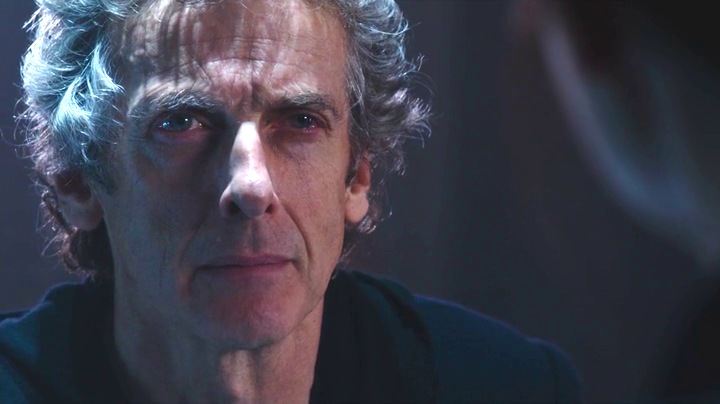
As long as there are people, there will be conflict. Notice how the Doctor doesn't advocate for a total dissolution of argument and angst. No, he's not naive. He knows--all too well--that whenever people exist together, be it on a small blue marble in the backwaters of the Milky Way galaxy or in the universe at large--conflict will arise. It's the nature of the beast because we have yet to come across any one species that is without want or desire or lust or anger. The Doctor, instead, advocates for the radical idea that we might talk out our problems; to not use violence and escalated button pushing to solve the problems of the world...or universe. What happens when the splinter cell becomes the majority and some new faction feels underprivileged and left out? What will they do? They will take their cues from the previous Revolution, of course. Nobody wins for long. Troublemakers arise, even if you've managed to defeat the bad guys. The Zygons are completely ignorant of that until the Doctor begins to poke holes in their plans. This splinter cell, as it turns out, will be the first ones against the wall when the next Revolution occurs. Speaking of enemies and how they arise, we're back to that idea that good guys exist alongside their nemeses. It's been a theme all season long: friend, enemy. Who can tell anymore? There are no friends and enemies, just people in complex situations with complex history and feelings. It all comes down to whether or not we can meet at a table with those complexities and smooth them over with some honest talk. Now, speaking of honest talk, let's take a second and applaud (like mad) Peter Capaldi's performance this week, especially for that wonderful monologue he delivered to Kate and Bonnie while their fingers hovered over the buttons in the Osgood box. It was one of those rare times when I stopped taking notes and simply watched, spellbound, as an actor really committed to the scene he was doing. His portrayal was full of grief and heartache and loss. Well done, sir!

In the end, it's all a game. The boxes are empty, though telling Kate and Bonnie this upfront would not have brought about a peaceful solution, only the desire to find another violent means to an end. But I have to wonder if the Doctor did the right thing in wiping Kate's memory. He cheekily remarks that this is the 15th time the three of them--Kate, Bonnie, and the Doctor--have done this to-push-or-not-to-push situation. This sly remark and suddenly being in on the joke made the moment far too light when it had been so weighted before. I'm not sure it was the best direction to go in, though letting Bonnie keep her memories, thus breaking the cycle, was a smart move. This episode was perhaps a bit better than last weeks, though I largely think that was due to the heartfelt portrayal by Capaldi and Coleman's chilling Bonnie depiction, especially when having a one-on-one conversation with Clara inside the pod. Political theater will always have a place in Doctor Who (and science fiction at large, if we're being honest).  It would be nice if our real world situations had such an easy solution, wouldn't it? But, I think, that is the great lesson to these two episodes of Doctor Who: there is an easy solution. Talk. Converse. Share. Emote. Do not cower behind bombs and bullets and nukes. Come. Sit and the table. And talk.

Miscellaneous Notes on The Zygon Inversion 

--The adventures of Doctor Puntastic and Bonnie sounds like a new spinoff at the BBC.

--"I'm over 2000 years old. I'm old enough to be your Messiah!" Oh, Doctor Who. You stay self-aware, you wonderful little show.

--The Zygons would rather "die in the fire than live in chains." That could be the motto of any splinter cell the world over.

--I'm glad Osgood turned down the Doctor. She might be the perfect companion (as all the mega fans would be) but she has her own task ahead of her. She can't go poncing off to see all of time and space in the Totally and Radically Driving in Space.

--How will Moffat write Clara out? We keep having fake-outs of her death so I'd find it hard to believe they'd kill her for good. 

--The only way to live in peace is to forgive.

Friday, November 6, 2015

In Which I Review Sleepy Hollow (3x6)

Women are dangerous; or, at least, that is the main thrust of this week's episode "The Red Lady From Caribee." Whether it's a bug spirit from Trinidad who infects you with literal fear and paranoia or it's a mystery lady who seems intent on taking down God's chosen Witnesses or even if it's just the gal you're taking out on a first date, women can be totally scary. I have to be somewhat honest here; Sleepy Hollow was feeling a little more than directionless before this episode. Filler or bridge episodes are perfectly fine when the rest of the episodes are trying to set the story down its straight and narrow path, but while each episode of Sleepy Hollow has the same beats and pattern, we are getting nowhere fast. I find myself asking more and more often what Pandora's endgame is with little result at the end of each episode. Even when the show did the big crossover last week, it was essentially the same pattern: Pandora sends a monster; we learn a bit of mythology; Witnesses defeat monster, and Pandora is inexplicably unbothered by the plans that never succeed. So, hey, isn't it nice that the show decided to push their narrative to the next level! The first 45 minutes were set up like past episodes (see the above pattern) but the last 10 minutes opened up the story (or tree) and pushed us into the next phase: Pandora's part one of her plan is completed, it's time to "Bear Witness" to the fruits of her labor. Watch out for wasp stings and let's go!

I have to hand it to Sleepy Hollow; it takes both guts and writing chops to have your thesis of an episode be that women are dangerous, scary, and just as villainous as men all while you build sympathetic characters out of them. Zoe, for example, is only scary to Ichabod. She's not a villain; she's not out to ruin his life or disrupt his mission to fight evil (she, of course, knows nothing about that). Zoe just wants to go for some Hibachi and wine and get to know Ichabod, a guy who is quirky, sexy, funny, sweet and, yes, a little socially awkward. But through the eyes of Ichabod, Zoe is part of uncharted territory. She's new. Too new. Too modern and the times are not a'changing but rather changed long ago while Ichabod slumbered. And, really, I think the true fear here is that Ichabod has never felt more out of time than when he's trying to transverse the dating world. Starbucks on every corner? Manageable. Having a nice meal with a pretty lady? Terrifying. Zoe isn't the only one who makes Ichabod quake, though. As our villain of the week, we have the titular Red Lady who is really a giant wasp that stings you and turns you into a paranoid and terrified mess. Good times. But really, the main scary ladies are Pandora and the Sisters Mills. First, Pandora continues to be a worthwhile villain with her cold demeanor and deeply laid plans. It's not romantic with Ichabod in any sense but there is a sort of flirty quality to Pandora and Ichabod interaction this week. They could probably go several rounds bickering and it would be both intensely scary and intensely hot. Pandora does not appear to have any fear of Ichabod; she's self assured and self confident in her plan--whatever it may be. After all, Pandora expertly played Ichabod and Abbie by simply letting them do their job. All she needed them to do was be Witnesses and well...Witnesses Represent. That's the real fear with Pandora; even when Team Witnesses were trying to stop her, they actually brought her plan to fruition. Finally, we have the Sisters Mills, both of whom scare their romantic interests (much like Zoe with Ichabod) and one sister who should be scaring everyone with her change of fate.

What's going on with Abbie and Daniel? If I didn't know better (and to be honest, I don't know, I'm just reading the scenes between the two as romantic) I would say that the constant beating around the bush and never stating outright that Abbie and Daniel were a couple was deliberate. Think about it. Every scene between the two about how they pushed each other and were there for each other is incredibly vague, as if there is some secret; the writers want us to think A but really they are going for B. I do believe that Daniel and Abbie were romantic (if only because that's how TV narrative works when the single leading lady suddenly has an old male friend with whom she was recently parted come to town) but for Daniel, Abbie's decision to move on and just push past what happened at Quanitco is scary because he can't move past it. Abbie, the woman who moves with time, and Daniel, the man who feels out of time and doesn't enjoy it. Sounds somewhat familiar, no? I don't know where Abbie and Daniel are headed, narratively speaking, and to be honest it's not something I'm interested in, at least not overly. What makes Abbie shine is that her story arc has nothing to do with romance. Yes, she and Ichabod have undeniable chemistry and there is some desire to see them be more than best friends, but she is not defined by wanting a romantic relationship. Her concerns are Sleepy Hollow, Jenny, and her co-Witness. Abbie Mills ain't got time for a man; she's busy saving the world! And then there's Jenny who, like Abbie, does not have time for a man (in the form of Joe Corbin, with whom some sparks were finally flying this week) but now I don't think she's going to even have a choice of exploring it. I have zero idea what happened with Jenny at the end of this week's episode, but her fate just changed and if I had to guess, I'd say that it's for the worse. You don't start seeing skulls and have glowing green eyes for the betterment of mankind. As the prophet said, Jenny will be claimed and we can go ahead and lay down some money that the claimer will not be holding a bouquet of flowers. With Pandora vanishing into a tree (what is with my shows and their mythic trees?) I have to wonder if Jenny and Pandora are about to team up as an unstoppable force for evil against Ichabod and Abbie. Phase one: complete. Phase two: coming soon!

Miscellaneous Notes on The Red Lady From Caribee

--Ichabod with a fruity drink and pink umbrella. How cute is he!

--I'm glad Ichabod and Zoe got a proper date that fits his and her aesthetics and did not try to be more than either of them are.

--I will refrain from spewing more negativity against Betsy Ross except to say that, once again, her insertion into this story was utterly pointless. Why couldn't Grace Dixon heal George Washington without Betsy being there to say a few lines while flashing her corseted boobs?

--I want a tree that grows earrings!

--Some truly lovely stills of Ichabod's face this week. Tom Mison continues to be one of the best things about this show. 

--Pandora went into the tree. If she comes out as Merlin, I'm done.

Monday, November 2, 2015

In Which I Review Once Upon a Time (5x6)

Here's a question for all my readers: do you, in all honesty, care about Once Upon a Time's Merida? I don't mean the Disney/Pixar Princess; in fact, just forget that pixelated red haired girl. I mean the live action character on your screens this Sunday: do you care about her? Or are you projecting your care for the aforementioned pixelated character on to this woman? Because this week's episode "The Bear and the Bow" was all about Merida--her problems, her character, her family, and her claim to the throne--and I honestly couldn't be bothered. Merida is one character that needed to be left alone, or at least not make her way over to OUAT. Merida, the young headstrong girl who refused romantic entanglement because she wanted to be who she was, would only be mangled from that positive role model to this aged up, hit-first-ask-questions-later kidnapper on OUAT. And, shockingly enough, that's what happened! Who needs character motivation or well thought out character progression when you can rely on people's fond memories of a Disney/Pixar movie? Because Merida only shows up sporadically, and with only hefty information dumps and overly loud bagpipes a'playing (because she's Scottish, y'all), we never get the chance to get to know her, not properly. So why care? OUAT managed to rob Merida, and the movie 'Brave,' of all its heart and spirit and message. This week's episode was much like other Belle centric episodes: dull, lackluster, frustrating, and causing the narrative (if that's what we want to call this season so far) to grind to a standstill. Get ready to face a giant bear and let's go!

Always Bring A Book To A Fight  

The opening scene to this week's episode feels like the set up to a really bizarre and decidedly unfunny joke. Prince Charming, Captain Hook, Merlin and Google--sorry, Belle-- walk into a jail cell. Why is Belle there to begin with? Why is she carrying a book? Why does anything think that bringing Belle--and her Google-powered iPad--along to rescue Lancelot is a good idea? This is one of the biggest (I know I say that a lot, but it really is) problems on Once Upon a Time: this total disregard for logic and explaining situations. We, as an audience, are not inside the writers heads. I do not know what their thought process was (and even if I did know at one point, it has since been utterly transformed, probably by a magical mcguffin) when they rationalized that Belle going into that jail cell was a good idea. I am just expected to buy into the idea that Charming, Merlin, and the pirate would take Belle along to a scuffle, fight, violent encounter, or any other synonym that involves fisticuffs. This wasn't the only instance of hand waving away questions of logic and problems with writing in this episode. Merida kidnaps Belle because she needs magic to rescue her triplet brothers. Okay, in some regards that makes perfect sense and I can see why Merida--who has had encounters with magic in the past--would think that magic is going to solve her problems. To be fair, it's how her Disney/Pixar character operated. But the issue here is that at no point did Merida see or hear that Belle has magic. Literally, all Belle did was point to something in her Google Operated iPad and Merlin did the magic on Lancelot's cell bars. Belle was....a book stand. Yes, that's what she was. She held a book and played a poor man's version of Siri while Merlin, the most accomplished wizard in the history of the Onceiverse, waved his hands. Logically, Merida should try to kidnap Merlin. Or even Emma if the Scottish red head was feeling particularly feisty and fresh, but no--she goes with the non-obvious, illogical solution of Belle. Finally, one more instance (that I'll talk about) in which logic is brushed aside and the writers simply tell us, "worry not about this!" Emma finally figures out that Merlin was the creepy usher in the movie theater when she was but a wee lass. Like the audience has been doing all season, she questions how Merlin was there since he was stuck inside a tree photosynthesizing for several millennia. Merlin, I kid you not, looks at Emma and tells her it doesn't matter how, what matters, instead, is what he told her (do not do the thing, young Skywalker!) On a show that can make up magical handwaving excuses faster than you can save Magical Plot Device, Merlin dismisses a major seasonal question with a condescending and patronizing answer and we are expected to swallow it, lock, stock and barrel. Nope, sorry. That's not how I roll. This is one case when the writers could have simply said "magic" and it would have been keeping in line with how powerful we're told Merlin is. Instead...we got the equivalent of a pat on the head and sent outside to play with our toys like good children.

So how was the BraveBeauty adventure? Dull, exposition dump heavy and full of rather insulting stereotypes. In other words, the same as her adventure with Mulan in Season 2 and her adventure with Anna in Season 4. First, the Scottish highlands are in the Enchanted Forest and just a quick boat ride from Camelot! How fortunate! This is a larger issue with OUAT that, to be fair, I've had for a few years and not just since the bloom went off the rose. Inserting legends that do not take place in some sort of fairy tale kingdom, or imagined alternative fantastical landscape, is hard. It's why Mulan's insertion back in season two felt awkward because how do you properly insert China into another realm? How can anything like China--the historical China that birthed the legend of Mulan--exist in another world. Mulan, and legends like Merida and even Arthur and his band of knights, belong to historical times that are born from events, circumstances, and other eras of days gone by. If the writers were to somehow explain that there is a common link between the stories in our world and the fictionalized Enchanted Forest and that, somehow, stories from the Enchanted Forest found their way to our world, then maybe I could suspend my disbelief and accept that the Scottish highlands and China are in the Enchanted Forest. The same goes for answering how on earth our world knows about Snow and Charming (and all your other favorite Disney movies) but got the stories wildly wrong. Sadly, this is another instance of the writers writing what comes to them in the moment or arc instead of using any sort of logic or well thought out worldbuilding. In that same vein, the Scottish highlands of the Enchanted Forest appropriated a lot of traditional Scottish motifs but rendered them as cliche instead of nuanced. I'm a big fan of Outlander and that's a show/book that respects culture and tries to portray it as accurately and respectfully as possible. OUAT's Scottish culture was just trying to recreate the Disney movie down to the guy with the poofy white hair. It doesn't work here because it doesn't feel genuine; it feels like a parody. I almost expected Merida to yell "you may take my lands, but you'll never take my FREEEEDOOOOM" a la Mel Gibson in 'Braveheart." Poor Belle. Whenever the writers remember that she exists and decide to send her on a girl power adventure, it never develops into anything positive.

UnBEARable 

Meanwhile, back in Storybrooke, the character formerly known as Rumple limps around, saying and doing stupid things that make me want to break his other leg. But first, before I go down that particular rabbit hole, let's stop by the so called heroes of Storybrooke and hear what they have to say about Rumple's fate. Oh, they don't care about Mr. Gold/Rumple/The Crocodile. If Rumple dies, then that's his own fault because he had many opportunities to turn into a hero. But these so called heroes absolutely have to save Emma Swan because she's innocent and the darkness simply has a hold on her but through their hard work, perseverance and determination (and love!) they can save the Swan! Hip hip huzzah. You flipping hypocrites! The darkness has been canonically established to be a sentient entity that can corrupt even a SAVIOR. What does that mean? It means that Rumple was just as much under the influence of that darkness as Blessed Emma Swan. So it means you should try to save BOTH. Because they BOTH matter and are family! COME ON. Remember when Rumple sacrificed himself for his one true love and his son? For the town? He is worth fighting for, just like Emma. This conversation was downright insulting to Rumple and to the characters themselves. Not even Regina would stick up for him; Regina who has a very complex relationship with her former master, father figure, enemy? Tell me, Snow and Charming, how many times has Rumple helped you and your family out in Storybrooke? How many times has he stopped whatever he was doing to help you with your various dramas because the two of you couldn't collectively figure your way out of a paper bag? Rumple's heart was literally being turned black by the same Darkness that is now infesting your daughter, but he's not worth saving because he couldn't fight it anymore than she could. I simply cannot with this level of hypocrisy from an Evil Queen, a Pirate and two Baby Snatchers! It was because of this that when Rumple and Belle were about to drive over the town line, I found myself yelling, "go! go! be free!" The other characters in the show will never afford Rumple an ounce of sympathy or compassion and only see him as the Dark One, never mind that his actions (while dark) were rooted in something totally human and understandable (finding his son). We still have no idea why Emma's doing what she's doing (brooding long and hard over a sword, removing everyone's memories, and ripping out little girl's hearts) but at least Rumple's motivation behind his sinister nature was compelling. Okay, I had to get that off my chest. Now, on to the Imp himself and some egregious character assassination.

Back in season two, when we finally saw how Rumple came by his famous limp, it was a story full of heroism and cowardice. A father returning home and a soldier fleeing the perils of war. It was this delicate balance of heroism and cowardice that really defined Rumple. He wanted to be brave but didn't know how so he found courage in trying to be a good father, even if it meant he was labeled a coward by everyone he knew. For Rumple, it was better to be a coward than to abandon his child. It worked on a really well thought out level when you remember that Rumple would later abandon Bae, but that, in turn, Rumple had been abandoned by Malcolm. It was a lovely circular story about the cycle of abuse and abandonment. However, in this week's episode, the writers decided to screw the pooch (bear?) and remove any and all complexity behind Rumple's character by simplifying it to the most base terms ever: Rumple is a coward, plain and simple. As Rumple tells Belle during their fight at the town line, he only injured himself because he was scared. That's it. Just scared. Nothing about manipulation from a seer, nothing about the fact that he was going to die and leave his child alone, nothing about how he "did it all for the boy!" Rumple is just a coward, guys. Malarkey. Absolute malarkey. And to make matters worse, it doesn't even fit with what was said last episode! Remember last week when Rumple talked about how he did everything for his boy? This show can’t even stay consistent from week to week, let alone arc to arc! Why should I continue to be invested in this show and its characters when they can't even be written consistently? Everything changes depending on what the plot calls for and who is writing the script of the week, which means that the characters comes across as disingenuous and poorly developed. Next week, Rumple will be back to explaining how everything was for Nealfire! But, hey. Rumple fought a bear by making it swallow a small bag (no, seriously, what was that??) and then magically pulled a sword from the stone, so there's that!

Miscellaneous Notes on The Bear and the Bow

--Very few one-liners this week, but I did enjoy Zelena's "was that a kick my little Munchkin?" I may loathe her, but Zelena does know how to be wickedly entertaining.

--Rumple shattered Chip. Back when Chip broke in season 2, it was heartbreaking because it was done in the heat of the moment after Amnesia! Belle and Rumple had been through an emotional roller coaster. This week it just felt silly and stupid and eye-roll worthy. Yes, I get it. Belle is going to save him!

--The CGI for the bear was okay. Much better than Mal's dragon back in season 4, at the very least.

--So, wait. Is Nimue not the First Dark One? Is she still alive? Why can she help? Merlin's voicemail was interesting.

--Merlin is seriously cute.

--Hook is back to calling Rumple the Crocodile and not caring if said amphibian dies. Two episodes ago, Hook was giving Emma some sort of sob story about how he (Hook) was the villain in the Rumple/Hook story of Season Two. Consistency. What are you?

--The return of the magical mushroom, which apparently can't be burned. There's a drug joke in here somewhere. 

--"You turned me into a hero." No, Rumple, Belle did. Did you not watch your own episode? But now that Rumple has pulled the sword from the stone, what can he possibly do against the Dark One?

Sunday, November 1, 2015

In Which I Review Doctor Who (9x7)

If we were to boil down science fiction, as a genre, to its nuts and bolts themes, we could argue that it largely deals with human beings trying to understand or analyze their present--the religions, the politics, the morals, the ethics, the cultures of the entire world--and cast it into the future, either showing it in a positive or negative light. Much of science fiction can be allegory and the lessons gleaned depend on which side of the line you are standing. After all, as Human Osgood and Zygon Osgood tell us in this week's episode, "The Zygon Invasion," any race is capable of the best and the worst. Are you the terrorist or the martyr? Are you the hero or are you the villain? Are you good? Or are you evil? And do terms like these even mean anything when we remember that they are absolutely subjective and based on our own experiences and understanding of the world. The Zygons are evil terrorists; the humans are the victims. Or did the humans force a dying, fleeing race to adapt (or perish) to their mores without considering Zygon independence and sentience? In other words, Doctor Who got deep this week in their quest to become political allegory. It works, if that's your thing. If it's not, then you likely didn't enjoy this episode that much. Where do I come down on the question? Grab some question mark underpants and let's go! 

This episode does not sparkle and shine like the past two weeks of episodes did. That might have something to do with the fact that the more fantastical elements of Doctor Who are put on a back burner as it becomes a more proper science fiction tale complete with a morality lesson about terrorism and being able to see people complexly (and, really, about the human race's inability to do the latter). Many a-moon ago, the 50th anniversary of Doctor Who aired and the Zygons landed on the planet Earth. In an attempt to come up with a peace treaty that would unify the humans and the Zygons the 10th, the 11th, and the War Doctor forced the humans (from UNIT) and the Zygons into a room and through some clever sonic screwdrivering, a peace accord called Operation Double was established. Don't worry if you don't remember all of this; I barely remembered it, but thankfully the episode begins with a nice flashback (helpful, no?) The crux of this peace accord was that 20 million Zygons would be settled around the world as humans, living and coexisting peacefully with the native earthlings. No one would ever be the wiser and the two races could cohabitant. Yeah, look around planet Earth for me. How's that going? This isn't a new concept and, if you look at history, it's how conquering peoples have treated their subjects because the conquering nation usually has little understanding (or, really, doesn't care) that the "inferior" race has their own culture, history, social groups, gender norms, and interactions. Instead, the conquerors simply lump everyone together and expect them to play nice because surely all these people must be the same. West Africa, the Middle East, these are prime example of what happens when nations try to squeeze factions of people together and expect them to simply abide. Since the peace treaty, a faction of Zygons who demand the right to be themselves and normalize have cropped up and, as young, frustrated, occupied peoples are wont to do, they decided to launch an invasion because there is no other way to get the attention of those in charge. Protests, marches, bombs, violence. It's on every news channel every night and it has been for years. We've just become desensitized to it. And so have the characters in universe; Kate's grand plan is to bomb them all (to which the Doctor yells "no bombs for you, Kate Stewart!") The commander out in fictional Turmezistan wants her soldiers to keep a brave face and shoot the Zygons who look like loved ones. Everyone in UNIT treats these rebels factions, these splinter cells, as if they represent the whole of the Zygon nation. The Doctor knows otherwise. Not all Zygons belong to the splinter cells; the other 99.9% of the aliens just want to live in peace and harmony. Sound familiar? It should: "not all Muslims are terrorists" might be the best way to put it in our modern parlance. This episode is, in other words, a mostly heavy handed political allegory about the life and times we are living in (complete with some metaphors about immigrants since that's the hot button issue in Britain these days). But does it work as an episode?

I don't know. That's the honest truth. I don't know. It works in the sense that it's a well written, well thought out episode. This episode wasn't bad but I don't think it deserves a lot of the overwhelming praise it's getting either. Yes, it's a great political allegory that is trying to say something about human relationships with those we consider alien (both of the space and here at home variety) but it's not as if Doctor Who hasn't done that before. Doctor Who has always--as proper science fiction--played with politics of the day. It's never shied away from issues like Margaret Thatcher, the Iraq War, terrorism, ect. So, like the third and fourth episode of this ninth season, it feels a bit rote and expected. It's also lacking in narrative tension, at least from my perspective. The Doctor's plane is not going to be hit by a missile; the Earth will not be overrun by terrorist Zygons; peace will be reached, Clara will be saved. I know how this story ends and while I've gotten a nice morality lessons out of it, it's not as if the world I live in is suddenly a better place or that our real world problems have been solved. As hard as it is to accept, there is no Doctor, President of the World, who can perform miracles and make us all live in peace. This week is a nice story that emphasizes the need for all human beings to see and understand each other complexly, but at the end of the day, it's a fictional story with a fictional ending. And is a morality tale still worth telling if nothing changes?

Miscellaneous Notes on The Zygon Invasion

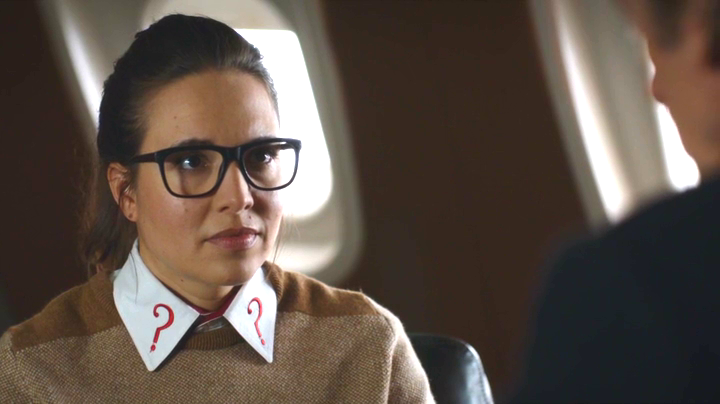
--Am I the only person in this fandom who doesn't find Osgood that compelling? The writers seem fixated on her but I find her to be a bit dull. Yes, she's basically a stand in for the mega fans (with her 12 ft long scarf and question mark sweater) but she works better as a one time stand in.

--Speaking of one time occurrences, enough with the guitar playing! Yes, Peter Capaldi is talented but, like Osgood, the guitar playing is going to become silly if it keeps cropping up.

--"You're very blobby!"

--The Doctor may not like being President of the World, but he does enjoy the perks of a giant plane.

--Am I going daft or was there a Harry Sullivan reference? Also, does UNIT have a portrait of the First Doctor hanging in its Safe House?

--The Doctor wears question mark underpants.   

Friday, October 30, 2015

In Which I Review Sleepy Hollow (3x5)

And thus, Ichabod Crane and Abbie Mills packed their bags and headed off to the Jeffersonian to meet Dr. Temperance "Bones" Brennen and Seeley Booth. Yeah, that's right. It's crossover time. When this crossover was announced, I was skeptical, to put it mildly. I had been a semi-regular viewer of Bones for the first six years it was on the air before giving up that ghost. Procedural cop shows have never been my cup of tea but the characters on Bones were delightfully quirky and fun and they kept me hanging on until I decided to call it quits. My point is that I have, at the very least, a passing acquaintance with the show and characters; enough to know that for Bones--scientific, pragmatic to a fault Bones--to come into contact with Ichabod--a time traveling, monster hunting, man from the 18th century--and not have it fundamentally alter the way she views the world (through her myopic and science-only lens) would be disingenuous and that something was rotten in the state of Denmark. And this was my problem with the crossover when it was promoted. How could those characters possibly exist in the same world? Abbie and Booth? Sure, no problem. Even Booth and Ichabod could find common ground since Booth has a lot more faith and belief than his other half. But Bones and Ichabod could not possibly exist in the same universe, to say nothing of interacting. But, with all that said, this two part episode "The Resurrection in the Remains" (the Bones half) and "Dead Men Tell No Tales" (the Sleepy Hollow half) was fun. A lot of fun, to be precise. The overarching mystery isn't exactly important and nothing was really added to the mythology of either show, but it was a good romp. Sometimes, that's all you need. 

This one is going to be rather brief. As I said above, this isn't a mythology building episode (or episodes). It's about what happens when we take our characters and put them outside of their comfort zones (Sleepy Hollow, each other) and watch them interact with people who do not understand--and even know about--the world in which Ichabod and Abbie find themselves every week. The biggest surprise here, honestly, was the chemistry and interaction between Ichabod and Bones. Abbie and Booth seem to get each other and thus, while they might rub each other the wrong way initially, have similar cop mentalities that mesh. Ichabod and Bones are on opposite ends of the spectrum, so while having these two interact was my original complaint about this crossover, the actors and writing sold me on why it was important and necessary to have the man out of time with the soul of a poet and the woman with the heart, soul, and mind of a scientist engage in various tet-a-tet's. Whether it be love vs science or the higher mysteries vs skepticism, Bones and Ichabod will simply never see eye to eye. It doesn't matter that Ichabod can point out that love is more than just a series of numbers (and use Bones's own relationship with Booth as the linchpin in that argument); to Bones it all stems from a need to procreate, one of the most basic urges in the universe. Conversely, it doesn't matter how many scientific proofs Bones can point to for why faith, art, and feelings of love exist, Ichabod will see beauty in the universe, in art, in poetry, in religion, in love, in humankind. Of course, much of this comes from their own experiences and the experiences we witness every week with both casts. Bones deals with murderers on a daily basis; these murderers kill for the most mundane of reasons: jealousy, lust, money, greed, ect. Ichabod deals with the supernatural forces that are only stopped by belief in Abbie, in the mission, and that good can overcome evil. For Bones, the only thing that overcomes evil is science and evidence. Her belief is in the numbers (though, Bones would never deign to call it belief). It is as Ichabod himself says, in my favorite line of the night, about Bones: "she'd dismiss Moloch as a tall man with a skin condition." While I was very (very) skeptical at first about Bones and Ichabod meeting, it turned out much better than I envisioned because the driving home point is really that both mentalities--the scientific and the poetic--are valid and one does not cancel out the other. They can exist together. Bones need not be radically altered after meeting Ichabod Crane because her own preservation of self would never allow for such an alteration; Bones's essence will forever find a scientific rationalization for the bizarre and otherworldly. But that's okay; Ichabod has enough belief in the otherworldly for everyone. After all, he's (one half) of a hero team destined to save the world.

Miscellaneous Notes on Dead Men Tell No Tales 

--Ichabod did not beam from the planet Vulcan, everyone. Just to be clear.

--"I was referring to the four of us getting along." Ichabod got the best lines of the night.

--General Zombie Howe and his zombie army were very scary. Once again, props to the CGI team behind Sleepy Hollow this season.

--The one scene with Betsy Ross was pointless, solidifying my belief that her insertion into this show is completely unnecessary.

--Jenny and Joe have a little adventure that is probably highly relevant to the overall season but thus far continues to be a "watch and see" plot line. I'm fine with that.

--Ichabod does his own sewing and embroidery. He's a crafter. Like me. We belong together. 

Monday, October 26, 2015

In Which I Review Once Upon a Time (5x5)

Well this episode happened. Here’s the thing; this week's episode "Dreamcatcher" is very hard for me to watch, analyze, and discuss because right now I hurt. That’s the thing with OUAT. It knows how to bait and reel you in. Obviously, the Neal references tonight were just…yeah. All over and they hurt. The problem (THE PROBLEM) is that I know that the references and hints were all bait and they were all there to try and appease a group of fans and that, in the long scheme of things, they don’t mean anything. The show will continue to promote another ship (and bait, still, another one) and Neal will be forgotten once more. Notice how they don’t even say his name–Hook gets to say Baelfrie, but Rumple can’t even say “Bae.” Sure, because that makes logical sense. I guess, if anything, this episode continued to prove to me that SwanFire was always endgame but somewhere along the lines it got…killed. In other news: this week's episode was 100% better than last week in terms of morals (well, mostly) and a lot better in terms of plot, though still with the abundance of Magical McGuffins. Seriously, stop that! Right now it’s tying with 501 for best episode of the season and it also feels like we are actually beginning to advance the plot a bit more, which is always welcome. How about we shed our tears and dive in? Let's go!


You Don't Know You Have A Heart Until It Breaks

The biggest theme of this episode was heartbreak over your first love. Henry and Violet; Regina and Daniel; Emma and Neal. Those three relationships--all of which ended badly or were somehow tainted by the machinations of others--took center stage this week as we learned that losing your first love is often the catalyst for knowing you have a heart to begin with. It is with this theme that I want to spend most of my time instead of going from past to present. Author's prerogative, I guess. I hope I don't get sucked into a book by an old Apprentice. When we first met young Violet, I was against Henry having a love story, even if it was puppy love. The fact is, our young Swan-Mills-Cassidy boy wonder is too damn young to have a girlfriend when he doesn't even have a single friend and spends most of his time either kidnapped, trying to make his various mothers stop killing people, or hanging out with his fuddy duddy grandparents. The boy is lacking in the social graces, is what I'm saying. How about we develop Henry with his peers without making it romantic? But, of course, here on OUAT, you're not really a character until you're romantically liked with someone of the opposite sex. However, I will put all of those quibbles (which still stand, by the way) aside in order to say that I found this week's version of VioletBeliever (cute ship name or really silly? I can't decide) to be heartfelt and sweet. It wasn't presented as a new epic love story; it was actually just a boy and a girl having similar interests and common backgrounds and fumbling their way around each other because they honestly don't know how to interact at this stage. But, hey, none of us knew how to interact with the objects of our affection when we were thirteen (side note: Henry is thirteen? Is that...real? Does that match anyone's timeline or am I just supposed to nod and go along with it? Right, nod and go along). What struck a chord most between Henry and Violet was that they've both lost a parent. When Violent announced that she had lost her mother some time ago, I actually rolled my eyes because of course she had. That's how OUAT tells stories: everyone loses a parent--though, that's just rather common to fairy tales. But what really mattered is that Henry can relate; Henry knows the pain Violet is in because he's in it too. There are things, he tells the young lass, that he wishes he could tell Neal, things they could talk about. I have maintained, through it all, that if ABC absolutely mandated CaptainSwan, then fine, I'd deal but Henry deserves his father and Neal deserved a chance to be a father. Taking that away, robbing OUAT of a chance to explore that father/son dynamic (while Neal was helping to heal the breach with Rumple) is powerful storytelling and should have been at the heart (correction: it was the heart of the show) of OUAT. The fact that Henry is sharing in this pain with Violet speaks to a level of self-awareness about their characters and human nature that I didn't think Adam and Eddy still possessed. Right on, boys.

This love story, of course, is not without its issues (because, again, that's how OUAT rolls). Oh, Emma. Emma Emma Emma. You became Cora. That was a twist I did not anticipate and whenever OUAT can surprise me, in a good way, I will genuinely applaud it. I knew that Emma's descent had to be a dark one (how could it not? Savior turning into the Dark One should be dark) but I didn't expect the victim in Ms Swan's descent to be her son, Henry, and his new girlfriend (who is just a girl and just a friend for now). Henry, of course, has been manipulated by a mother before, but that was always on Regina's shoulders. Regina had no problems magicking her son or trying to poison Emma or convincing Henry that he was crazy for believing that the town was full of fairy tale characters who lost their memories (spoiler alert: they were and they did!) While Emma may not have believed Henry way back in season one, she did not try to emotionally manipulate him so that Henry would do as she wanted. She never went behind his back. Remember what Henry said? "You don't have to be mean, I can tell you like me." Henry saw through Emma's walls because he knew she was the hero he needed. For Emma to pull Violet's heart out and command the young girl to break Henry's heart in order to gain her weekly Magical McGuffin (tears of the broken hearted mixed together with other random potion ingredients in no set measurement to free a wizard from a tree. This show y'all) is a level of low that is...well, it's low. Let's just say that. It's a Malcolm and it's a Cora level of low. However, while it's low there are two other things I'd like to point out about HeartSnatch! Gate. Here’s the thing that bothers me: the idea that Regina’s heartbreak wouldn’t be strong enough. Just because you move on with another person doesn’t mean that the pain still isn’t there. It doesn’t mean that those memories don’t still have a hold on you. Regina can love Robin all she wants but losing Daniel was a major turning point in her life. Probably THE turning point. The idea that this lost isn’t strong enough comes across as a weak sauce of an excuse just so we could see Emma do something hurtful. The writers wanted to kibosh the whole Regina-Daniel thing so that they could simultaneously kibosh using Emma-Neal’s death and simultaneously (lots of simultaneously’s) split up Emma and Henry as a team and make Emma look like a true villain because true villains take hearts (Rumple, Regina, Cora, Zelena). As soon as Regina's heartbreak tears over Daniel did not work, I thought we'd be watching Emma holding Neal as he died. Of course, that would be thematically important and would show that Emma was still human inside (something utterly important in Dark One portrayal--we saw it with Zoso wanting to be free, and we saw it in spades with Rumple) so, naturally, it couldn't happen that way because SwanFire must be baited but never explicit. Instead, Henry's heart is broken for various plot filled reasons. All of that I have a problem with, but the next bit, not so much. The other aspect to all this is a reoccurring motif: desperate souls do desperate things. This fits so seamlessly into the show that I can't hate the plot line of it, not entirely. The more dark magic Emma uses, the more she becomes addicted and the more addicted she becomes, the scarier it gets and the more desperate Emma becomes to rid herself of that dark magic but this only drives her to use more dark magic. It's a horrible cycle and it's a narrative through line that OUAT actually sticks to. I give them credit when credit is due, and it's due here. Now give poor Violet back her heart, Swan!

Speaking of the Lady Swan, she is not over Neal. Not even by a long shot. As I said above in the opening, I know all of these Neal references were bait, but they were so carefully crafted as to make Neal look like an absolutely stellar man. Someone you would fall in love with and someone you would stay in love with for a long time. Like Emma, back in season three, confessed to her parents, "I never stopped loving him." There is something heart wrenching about watching Dark One Emma Swan cry over a dreamcatcher after hearing Rumple talk about his lost little boy and how you always lose the ones you love. My friend has a great metaphor for OUAT that I think I'd like to share. The story of OUAT was a bridge and it was really Emma's fairy tale. When we meet the Swan, she is broken hearted and closed off and has her famous walls but over the course of the show, in the end, with villains and magic and plot along the way, she opens up and becomes a fully realized Savior. Emma was always supposed to go dark (heroes journey 101) but on the other side of that darkness were her home and her family. Part of this narrative bridge was Neal and SwanFire. It was part of the structure that held up that bridge. The story of Emma becoming the fully realized Savior and a fully realized Emma Swan was finding a new kind of Tallahassee with Neal and Henry in the town of Storybrooke with the Evil Queen, Snow White, Prince Charming, Rumple, and Belle and everyone else. It was the idea that Tallahassee need not be the actual Floridian city but a feeling--it was the feeling of home. Never forget that this entire series began with Emma being cast out of her home. The ending is clear: Emma Swan comes home at long last and is embraced by and embraces all those she loves with open arms. What happened, along the way, was the the show removed those structural beams and replaced them Styrofoam. The narrative is still there: Emma will still go on her heroes journey and still rise as a fully realized Savior and fully realized Emma Swan but the poetry, the magical poetry of OUAT, is long gone. Instead of Neal, we have another character who doesn't have the same resonance and poetic appeal that Neal did in terms of Emma's journey to find her home and now with our current plot of Emma's battle with the darkness. Who better to know what it means to be lost to the power of the Dark One if not Nealfire Cassidy? This entire show centered around a young boy who watched his father be over taken by the Darkness, flee from that father, and then that father seek out a way to find him again and create a Savior in the process. Hook's character is periphery to all of that and that's why the narrative bridge is now so lackluster and full of holes. It can't hold up under the scrutiny it once did because it has removed its support beams. There were some other really beautiful SwanFire moments in this episode but I'll leave them until the notes. I'll just say, in closing of this section, that SwanFire was supposed to be end game. It was always supposed to be Neal and Emma finding their way back to each other, to their respective families, and finding Tallahassee in a quiet town in Storybrooke.

Behind The Mask And Under The Tree

We've got one more love story to tackle and it's a shorter one. Raise your hand if you're surprised that Merlin lost the only woman he's ever loved to the Darkness. If you have your hand raised, then I'm going to assume it's being done sarcastically. It is, of course, exactly how OUAT rolls (I keep saying that this week, don't I?) Let's just be open and honest here: the first Dark One was also Merlin's lost love and it's probably Nimue. There’s a reason the writers put that person in a mask. There is a big reveal to be had later on. Nimue is the First Dark One and Merlin’s lost love and he couldn’t kill her because he loved her so much, but she couldn’t kill him either, so she turned him into a tree. It would be keeping with Arthurian mythology that Merlin loved Nimue and she eventually put him in a tree for reasons that are complicated but here will likely be reduced to "darkness inside her." It's not very fresh nor innovative and while it sticks with mythology, it's rather rote and expected. However, I'm going to be very glad to get that story because, at long last, we'll have some answers about the Dark One and how he/she/it came about and more importantly why. I have no idea why Nimue is the First Dark One or how that happened. Was it a magic spell gone wrong? Was it fate? Did Merlin mean to tether the Darkness to Nimue? Was it an accident? Was he trying to tether it to himself or to the sword/dagger? Also, where is Merlin now? We haven't seen him in Storybrooke. Oh god. Did Emma kill him!? Please tell me she did not kill a person of color Merlin. Plus, he's kinda cute, amiright? I'm willing to leave it all to speculation right now and just wait and see. The themes of the episode were enough this week; the plot can wait. And now, I think I'll go look at the dreamcatcher I made in honor of SwanFire and Neal and mourn over the love I lost for this show. (Yes, that was dramatic of me, I know).

Miscellaneous Notes on Dreamcatcher 

--"I liked your dad because he was always himself."

--"Changing so someone likes you never works." Wise words, Emma Swan. Now if only you would follow them.

--"Only You" the song Henry played for young Violet is the same song Neal used to play for Emma because "it always works." So basically, it's a SwanFire song: "Only you can make this change in me. For it's true, you are my destiny. When you hold my hand, I understand the magic that you do. You're my dream come true. My one and only you." Yup, that's pretty SwanFire to me.

--Regina shooting down Hook trying to teach Henry how to woo a woman. Attagirl, Tiger Mom!

--Could the writers please stop using "many years ago" for Camelot. How many is many? 50? 100? 10000? 2? See, no one knows! 

--The front porch conversation between Emma and Regina felt very season one, especially with Regina switching to calling Emma "Ms. Swan."

-- What is this Rumple and Merida NONSENSE. Seriously. What is this story?? It’s stupid is what it is. Since when is learning how to fight a sign of bravery? And wasn't Rumple already brave when he faced his father and sacrificed his own life for the sake of his family? Also, how does Merida know about the book?

--I want Regina's red dress. Now, please.

--Impressive CGI for freeing Merlin, with both light and dark magic. Pretty thematically heavy. Well done, OUAT.

Sunday, October 25, 2015

In Which I Review Doctor Who (9x6)

Companion-lite episodes are a long standing tradition on Doctor Who. The Doctor, without his trusty sidekick, embarks on an adventure where he gets to interact with other people whom the audience will never see again, most likely; but overall it's a chance for the Doctor to stretch his legs and get out of the sometimes very rote storytelling of Doctor + Companion + Danger = episode. However, in this week's episode, "The Woman Who Lived," a follow up to last week's phenomenal episode, the Doctor himself became the companion as we followed a broken and dark Ashildr around the 1651 English countryside and got an answer to what would happen if the Doctor was alone for too long. This episode was not as funny as last week's, but it absolutely fit in the overall theme of the season as a whole which is examining the Doctor's influence on his friends, companions, and even his enemies. From the Mistress, to Davros, to Clara, to Ashildr, we are tasked with answering if the Doctor's magical and mythical influence on us is as beneficial as we sometimes believe it to be. It's a hard question because as mundane people living our ordinary lives, we want to believe in the extraordinary. We want that taste of the divine; but Ashildr is proof: sometimes tasting the divine is like falling into Hell. Grab a mask and let's go! 

I'll start off with something that was probably fairly obvious if you were paying even half attention: Ashildr is a stand-in for the Doctor. There are some big clues like the immortality and the need for adventure, but there was also her desire to forget her own name, to take on an identity that sounds strange to everyone except herself. For the Doctor it's...."Doctor." For Ashildr it's "Me" which she uses to remind herself that she cannot become attached; she is her own companion and alone in this very lonely world. Other companions die and become like smoke that blows out when a strong wind comes. See. Another Doctor parallel. How many companions has the Doctor had now? A lot. Let's face it; we can't count them all (well, I could look at Wikipedia, but I'm trying to make a point here). The Doctor takes on companions and he loses them. He mourns them, telling himself that they are leading better lives and that he gave them something spectacular in the short time they were with him--and, of course, conversely, his companions gave the Doctor something as well. Their mayfly existence reminds him that life is beautiful because it is so fleeting. In the end, though, they break his heart(s). Ashildr has lost that perspective, that wonder she had when she first began her own adventure. She sees the endless years stretching out before her, never ending. One day after the next, looking for her next adventure, her next score, her next battle with the dreary world she inhabits. Unlike the Doctor, Ashildr doesn't have a TARDIS. She can't pop off to another planet or another time and still make it home for tea. She has to witness the end of life and cultures and eras as they happen in real time. The Doctor, in many ways, is lucky. He knows history backwards and forwards and sideways and can avoid the more painful aspects, like the Black Plague. Ashildr had to live through the horror, losing three children in the process. You can argue that the Doctor had that experience--the nightmare of day to day living without being able to escape--in the Time War (where he also lost children. See, parallels) which is why he still runs, but Ashildr does not have this option. The Doctor's influence on those he comes into contact with is almost always painted as "good." After all, the mad man in his box normally saves the day so what's not to love. But the fact is that he has astounding influence on those he meets and for all the good he does, there are bodies and lives that fall in his wake. For all the grief I give him, Moffat has done a fine job of slowly dismantling the idea that meeting the Doctor is all sunshine and roses. It's not. He changes you; he changes everything. And that doesn't necessarily bode well. Look at Clara Oswald; her character thesis is a study in addiction and abuse. Look at Ashildr. What has immortality done to Ashildr, and maybe more importantly, what would immortality do to the Doctor if he didn't have his companions? In short: nothing good.

When we met Ashildr in the Viking village, some 800 years ago, she was an energetic, enthusiastic, lovable and passionate young girl. The "Me" we meet now is a withdrawn, introverted, dark, and cold woman. Over the course of so many years, Ashildr likes to believe that her heart has turned to stone, or perhaps vanished altogether. After all, why have a heart when everyone you love dies? Sound familiar? It should except the parallel character happens to have two hearts, which I'm sure only adds to the pain. Ashildr wants to escape, to see the stars and other worlds  and have other adventures that aren't the same ones she's having everyday. Ashildr wants to travel with someone who understands her, and the only person who does is the Doctor, a being who is reluctant to let her step foot in the TARDIS. Along the way, the girl we knew lost bits and pieces of herself in the various villages she inhabited. When Ashildr tries to save peasants from Scarlet Fever, she is drowned as a witch; we can only imagine that this same scene plays out many times over the course of centuries. As she loses bits and pieces of herself and her heart hardens, Ashildr starts to believe that she simply doesn't care for any of these mortal mayflies. They can die or live, it makes no matter to her. Life will go on with or without them and so shall she, forgetting their existence the longer Ashildr is alive. This is, in other words, exactly how the Doctor would begin to act if he were left alone too long. We've seen episodes in which the Doctor has clearly been apart from a companion too long and is more maniacal and clearly has a more alien approach to the current plot. He's frantic, moving to and fro, talking to himself. Several companions, like River or Clara have warned him against being alone too long, knowing the toll it would take on him. On his own, the Doctor would become more like Ashildr and I have to wonder if he'd being to forget humanity (and his own humanity to be perfectly honest, if you'll forgive the reference given that he is a Time Lord). Would the Doctor forget his companions or the rich history and experiences he has shared with them like Ashildr has (or at least claims she has)? Possibly. His mind is obviously bigger than her's but I think he'd start to force himself to forget what he has lost. Eternity, Ashildr reminds the Doctor, frightens him. And that's the real reason the Doctor has a companion; he cannot be alone; it's too scary. To be alone is a fate worse than living forever with a hand to hold or someone to hug. Being alone turns you into someone who forgets what it is to care. Ashildr, in the end, remembers that she cares because, as expected, the people around her are in danger. One threat from above and she (and the Doctor) remember that their hearts are bigger than their loneliness and that, in spite it all, they really do care. The loneliness will come, of course. You can see it written on the Doctor's face in the final frame when he watches Clara, still wide eyed as she beholds the spinning gears of the TARDIS before it takes off in flight. He'll lose her sooner rather than later. He'll lose them all. But, the Doctor will pick up the pieces, find another friend, another soul who can behold the universe with its infinite wonders and he'll remember: he cares.

Miscellaneous Notes on The Woman Who Lived

--This season is really hitting it out of the park. Out of the six so far, 5 have been truly spectacular with one mostly very good (but not astounding) episode.

--Could we possibly have Maisie Williams come on as a full time companion. I'm sure she can do Game of Thrones when Doctor Who isn't filming, right? Please?

--"What took you so long, Old Man?"

--"What happened to you?" "You did." This little exchange between Ashildr and the Doctor is a nice callback to last week's conversation between the Doctor and Clara in which the Doctor wonders what he's "done" to Clara.

--Very little Clara this week, obviously, but the bit she was in was quite nice but also sad as we near the end of her run.

--Love the Jack Harkness shout out. If we ever manage to get him back, I demand that he shoot some arrows, though. (Malcolm Merlyn reference for the win!)  

--"I live in the world you leave behind."

--The final conversation between the Doctor and Ashildr highlights another theme of this season in which the lines between friends and enemies are blurred beyond recognition. The Doctor can save the world, but Ashildr is going to save the world from him. Friends? Enemies? Who can tell.